Coworking & Creative Spaces in Bad Kissingen
Coworking & Creative Spaces in Bad Kissingen – What Will Be Possible Next in 2026/2027
A future-oriented guide for flexible workspaces, space concepts, and community formats – specifically for Bad Kissingen and the region.
Status: Planning perspective 2026–2027 (without details on concrete, already established providers on site).
Why Coworking in Bad Kissingen Can Now Enter the Next Phase
In the coming months and years, work will continue to decouple for many people: from the fixed office, from classic commuting routes, and from rigid time slots. Exactly from this, a new, local future market can emerge in Bad Kissingen: flexible workspaces, creative project areas, and hybrid places that can be combined with spa and health stays, culture, and city center life.
For 2026/2027, three developments in particular are relevant, which are expected to intensify further:
- More hybrid work: Teams will come together more often for single days and will need rooms that can be booked at short notice.
- More solo self-employment: Individuals will want to work professionally without entering into long-term office rental contracts.
- More demand for "third places": Places between home and the classic office will become more important – with focus, exchange, and good infrastructure.
Bad Kissingen can function particularly well in this future logic because the city stands for tranquility, quality of stay, and encounters – and coworking will translate exactly this mix of concentration and network into a plannable offer.
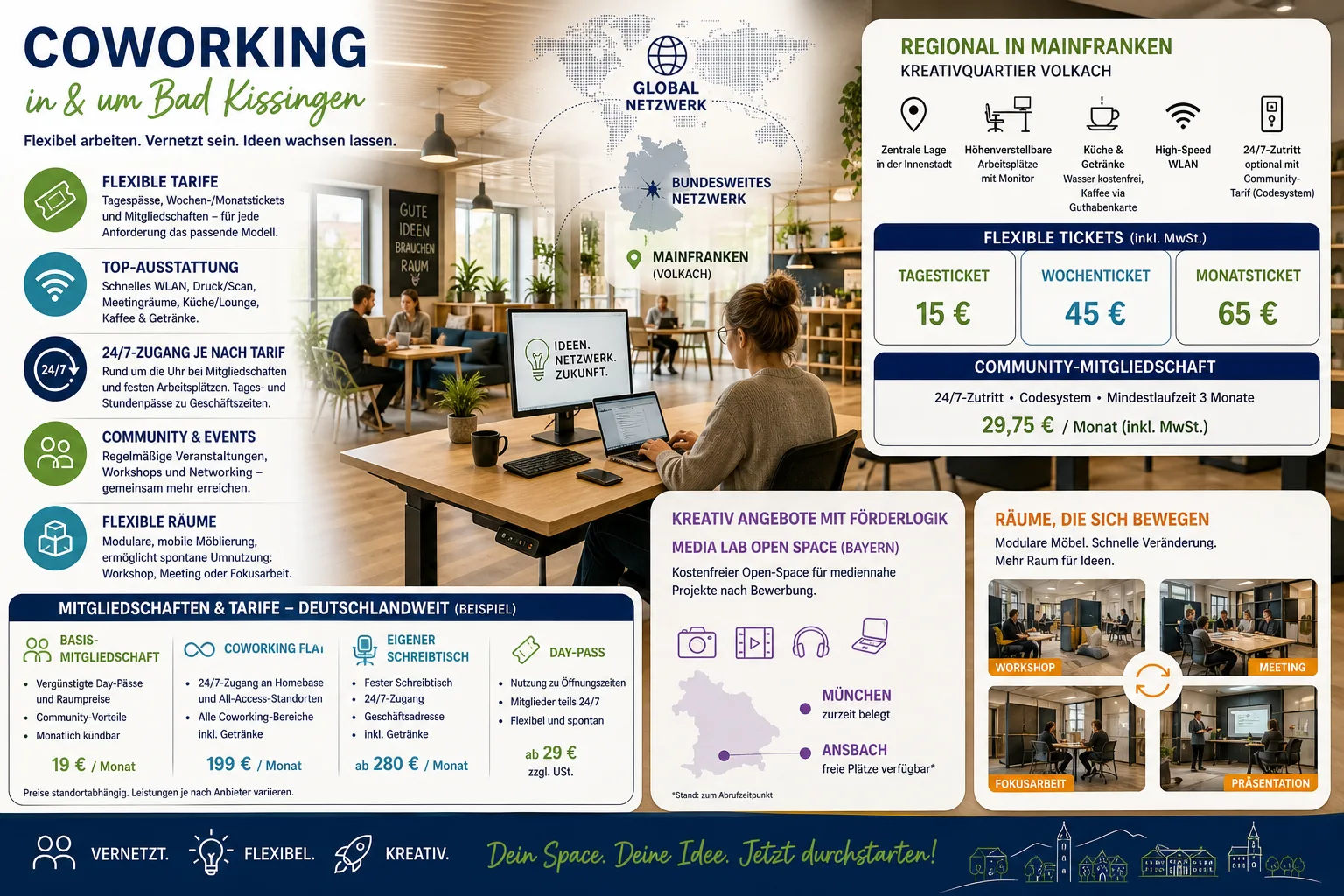
Future Offer Models: What Rates and Access Could Look Like
For coworking to be sustainable in Bad Kissingen in 2026/2027, offers will likely be planned modularly: low-threshold entry, clear upgrades, transparent rules. Instead of "one package for everyone," tiered models will prevail that cover different life and work rhythms.
1) Flexible Passes (for visitors, spa guests, and occasional users)
- Day pass: Focus workspace, stable Wi-Fi, phone-friendly zones, basic use of kitchen/community area.
- Multi-use card: e.g., 5 or 10 usage days that can be redeemed within a time window.
2) Time Packages (for project phases)
- Weekly ticket: Useful for team sprints, retreat phases, editorial weeks, or product iteration cycles.
- Monthly package: Suitable for founding phases, longer rehab/spa stays with work component, or transition periods between jobs.
3) Memberships (for regularity & community)
- Community membership: Priority access to events, discounted bookings, internal channels, and matching offers.
- Flatrate option: Often with extended hours (e.g., early/late) and better conditions for meeting rooms.
- Fixed desk: Fixed desk for permanent setup (monitor/peripherals), optionally with lockable storage.
So that users can compare fairly, a standard transparency set will likely prevail in 2026/2027: clear information on minimum contract periods, cancellation deadlines, access times, included services, additional costs (e.g., meeting rooms), and house rules (e.g., phone calls, quiet times, guests).
Space Design 2026/2027: How Idea Spaces Will Be Planned
Modern coworking and creative spaces in 2026/2027 will be defined less by "nice furniture" and more by measurable function: acoustics, ergonomics, lighting, zoning, and good transitions between focus and collaboration. Bad Kissingen will particularly benefit if spaces are deliberately planned to enable both quiet individual work and lively formats.
The Three Zones a Space Will Almost Always Need in the Future
- Focus zone: Quiet workspaces, acoustically dampened, with ergonomic standards and clear rules for phone calls.
- Collaboration zone: Whiteboards, mobile tables, presentation area, quickly convertible for workshops.
- Regeneration zone: Kitchen/community corner, short breaks, informal conversations (important for network effects).
Ergonomics & Health as a Future Advantage
Since Bad Kissingen is perceived as a health location, a coworking offer in 2026/2027 will likely be particularly coherent if ergonomics and healthy working are planned as a core service, not as an add-on: appropriate desk heights, good chairs, glare-free lighting, sensible break architecture, clear wayfinding, and air quality.
For planning, established ergonomic guidelines and standards will serve as a reference so that space quality becomes comprehensible (see sources).
Community & Events: Formats That Suit Bad Kissingen
A future space will not just "rent out places," but structure encounters. For this to work in Bad Kissingen, events in 2026/2027 will likely be more closely adapted to the daily rhythms of spa guests, locals, and commuters: shorter, more regular, more plannable.
Event Formats That Will Scale Realistically Well in 2026/2027
- Morning Focus (60–90 minutes): Silent co-working session with a short goal-setting at the beginning (ideal for writing and concept work).
- Lunch & Learn (45–60 minutes): Short inputs on tools, taxes/organization for self-employed, AI workflows, marketing, project management.
- Afterwork Community (90 minutes): Moderated networking, topic islands (e.g., design, consulting, software, health, culture).
- Demo evenings (monthly): Small product or project presentations with constructive feedback (clear schedule, fixed speaking times).
- Workshop Saturdays (quarterly): In-depth formats, e.g., prototyping, storytelling, funding logic, portfolio building.
For Bad Kissingen, a "spa-compatible" offer will also be suitable: events that harmonize with therapy and leisure windows without disturbing the character of a place of relaxation. This will broaden the target group without overwhelming the local community.
The goal in 2026/2027 will not be "as many events as possible," but a few reliable formats that trigger cooperation: joint projects, contracts, learning groups, and local visibility.
Implementation Roadmap: From Idea to Functioning Space
Anyone planning a coworking or creative space in Bad Kissingen in 2026/2027 will reach a robust offer more quickly with a clear roadmap. The key is to reduce risks: test first, then expand.
Step 1: Define Target Groups & Use Cases
- Locals (regular use)
- Spa guests/visitors (limited time, plannable windows)
- Project teams (meeting rooms, workshop areas)
- Creatives/cultural actors (presentation, small events)
Step 2: Set the Space Program
- Open desk + focus zone
- 1–2 small meeting rooms
- Phone booth(s) or clearly defined call zones
- Workshop/event area with modular furniture
- Kitchen/community area as a social anchor
Step 3: Make Operating Model & Rules Transparent
- Access times, house rules, noise and phone rules
- Data protection and security principles (e.g., handling guest Wi-Fi, locking systems)
- Cancellation and booking rules for rooms
Step 4: Pilot Operation with Feedback Loops
In pilot operation, the space in 2026/2027 will likely learn fastest which zones are really used, which event times fit, and which pricing models keep occupancy stable. Typical success metrics will be occupancy by time of day, repeat rate, meeting room conversion, and event-to-membership transitions.