Cultural Education and Participation in Bad Kissingen
Cultural Education & Societal Discourse in Bad Kissingen: Which Formats Will Become Possible and Meaningful in the Coming Years
9 min readLaura Müller
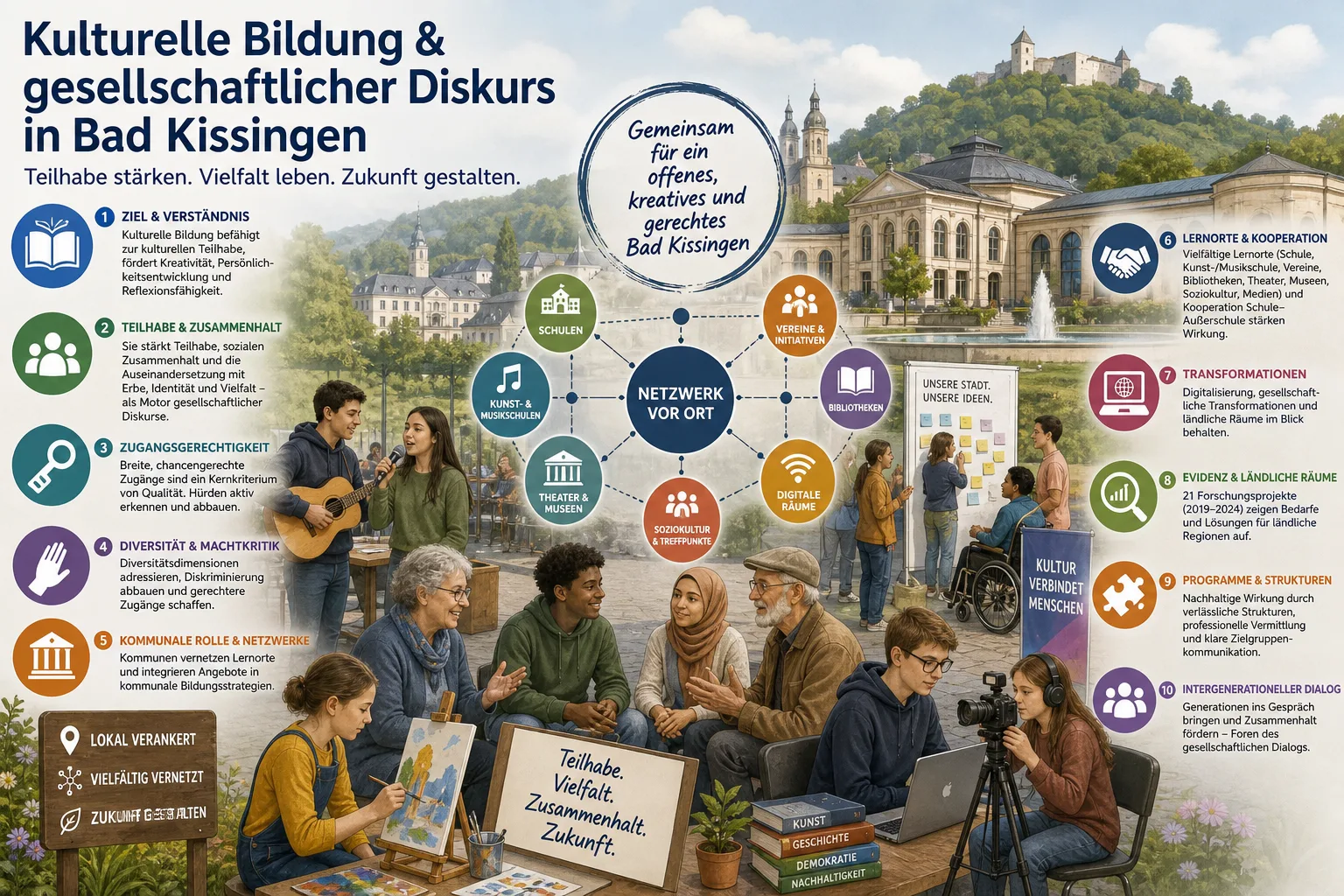
In Bad Kissingen, cultural education offerings will gain particular impact in the coming years when they do not remain merely events "for an audience," but are planned as joint projects: with visible participation, space for discussion, and reliable structures that extend beyond individual dates.
This article bundles concrete, future-oriented formats that can realistically be implemented in a spa and health city with a rural surrounding area, without relying on short-term trends: intergenerational, low-barrier, digitally compatible, and democracy-strengthening.
What Will Be Effective as "Cultural Education" in Bad Kissingen in the Future
In the coming years, cultural education in Bad Kissingen will have an impact especially where culture is understood as practice: people will not only watch, but create, reflect, and become publicly visible. A broad concept of culture will remain decisive: in addition to music, theater, or exhibitions, everyday culture, biographical narratives, regional traditions, and digital forms of expression will also be used as opportunities for learning and discourse.
Future projects will pursue two goals simultaneously:
- Aesthetic Practice: Participants will try out artistic means (voice, image, body, text, media) and develop new forms of expression.
- Democratic Discourse Ability: Groups will practice changing perspectives, negotiate conflicts according to rules of fairness, and conduct public conversations in a moderated manner.
Especially in a city where locals, spa guests, patients, and commuters meet, such projects will function as "social bridges" in the future: they will enable encounters that otherwise rarely occur in everyday life.
Participation & Diversity: Who Will Have a Voice in the Future
In the coming years, the question of quality will be decided less by how "high-quality" a program is on paper, but by who actually participates, who stays long-term, and who becomes publicly visible. Participation will mean more than just presence: people will take on roles (co-leadership, co-curation, stage presence, editorial work, jury, moderation) and thus actively shape cultural life.
Which Accesses Should Be Planned for the Future
- Financial: Socially tiered fees and clear, easily accessible discount rules will stabilize participation.
- Spatial: Decentralized formats in districts as well as mobile offerings (e.g., workshop days in changing locations) will shorten distances.
- Linguistic: Simple language and multilingual short information will reliably reach new target groups.
- Social: Open "trial dates" without prior knowledge will lower entry barriers.
- Accessibility: Low-barrier communication, accessible locations, and suitable assistance solutions will make participation practical.
Diversity will no longer be treated as an "add-on," but as a design principle: topic selection, team composition, and public relations will be set up so that different life realities are not only "considered," but actually present.
Learning Spaces in the Future: Where Bad Kissingen Will Learn Culture
In the coming years, three forms of learning will work in parallel if they are purposefully connected: formal, non-formal, and informal cultural education. The greatest impact will arise when transitions are organized so that participants can move from one offering to the next.
Formal Offerings (in the future more cooperative)
Schools will be particularly effective in the future when they cooperate with local cultural actors. Project weeks, temporary artist residencies, or joint presentations will connect teaching and urban society without reducing culture to a single subject.
Non-formal Offerings (in the future as long-term learning paths)
Music schools, libraries, clubs, youth offerings, and project workshops will work well in the coming years if they do not just offer individual courses, but learning paths: entry, deepening, presentation, and co-creation (e.g., as mentors).
Informal Offerings (in the future made more visible)
Informal education will become more visible in Bad Kissingen in the future if spontaneous or everyday cultural spaces are consciously included: open rehearsals, storytelling cafés, neighborhood walks with audio contributions, digital "story maps," or temporary actions in public spaces.
Networking & Municipal Responsibility: How Structures Will Enable Discourse in the Future
The most sustainable impact in the coming years will arise where projects are embedded in stable structures. For cultural education to open up spaces for discourse, planning, responsibilities, and resources will need to be reliable.
Which Municipal Tasks Will Be Decisive in the Future
- Transparency: An up-to-date overview of offerings (target group, accessibility, participation paths) will provide orientation.
- Coordination: Regular exchange rounds between schools, culture, social work, volunteers, and administration will avoid duplicate structures and simplify cooperation.
- Reach Management: Underrepresented groups will be specifically invited in the future, not just "considered."
- Resource Security: Spaces, technology, fees, and training will be planned so that projects do not fail due to short-term uncertainty.
- Public Conversation Culture: Moderated formats (e.g., audience discussions, workshop forums, citizen dialogues with artistic introduction) will be planned as standard.
If these points are implemented, future projects will be more than presentations: they will become reliable places where Bad Kissingen will publicly negotiate identity, change, diversity, and future topics.
Digital Transformation & Rural Area: Which Formats Will Be Sustainable in the Coming Years
Digital and hybrid formats will not function as a replacement in the coming years, but as a supplement. They will be particularly meaningful when they expand access: for people with mobility impairments, caregiving responsibilities, shift work, or from more distant districts.
Formats That Will Reliably Work in the Future
- Hybrid Workshops: In-person dates will be combined with short online phases (e.g., feedback rounds, material collection, rehearsal planning).
- Digital Archives: Participants will document results (audio, text, photo, video) and thus make the discourse accessible over a longer period.
- Media Literacy Through Culture: Projects will practically practice source criticism, image rights, AI-supported design, and responsible publishing.
- "District Streaming": Public discussions will be broadcast so that people outside the center can also participate and ask questions.
Proposal for an Annual Program (as a Model) for Upcoming Seasons
The following model will function as a repeatable framework in the coming years because it systematically connects participation, artistic practice, and discourse. It is deliberately described as a model so that it can be flexibly adapted to real partners, spaces, and target groups without losing its core.
1) Kick-off: Open Theme Workshop "Bad Kissingen Tells Its Story"
At the beginning of the year, open workshop evenings will take place in which participants collect topics they want to discuss publicly (e.g., coexistence, health, generations, images of home, tourism, natural environment). From the suggestions, a work plan will be created, which will be supported by the participants.
2) Project Phase: Three Parallel Workshops
- Text & Voice: Writing workshop, reading training, podcast or audio piece production.
- Image & Space: Photography, illustration, exhibition design, interventions in public space.
- Stage & Movement: Theater, staged reading, dance/performance, moderated forum theater elements.
Each workshop will in the future be planned with a clear role for participants: co-creation of content, dramaturgy, moderation, and presentation. In this way, discourse will not be conducted "about" people, but "with" them.
3) Discourse Phase: Public Discussion Evenings with Artistic Introduction
In the discourse phase, short artistic contributions will serve as a starting point for conversation. Afterwards, a moderated audience discussion will take place in which different perspectives are negotiated respectfully. To ensure this, discussion rules will be made transparent in advance and consistently moderated.
4) Conclusion: Presentation, Documentation, Follow-up Opportunities
At the end of the year, there will be a public presentation (exhibition, performance, or multimedia event). In addition, documentation will be created so that results have a lasting effect. Afterwards, follow-up opportunities will be offered: advanced courses, mentoring roles, or new project groups for the following year.
Quality Criteria: How Bad Kissingen Will Measure Future Offerings
In order for cultural education to actually strengthen participation and discourse in the coming years, offerings will be planned and reviewed according to clear criteria. Not only visitor numbers will be decisive, but also process quality.
- Participation Quality: Participants will visibly co-decide (topics, roles, presentation form).
- Accessibility: Information will be easy to find and understand; locations will be accessible and as barrier-free as possible.
- Diversity as Practice: Teams, content, and visual language will actively reflect diversity without stereotyping.
- Discourse Safety: Moderation, rules, and protection from devaluation will be firmly anchored.
- Learning Continuity: There will be follow-up opportunities so that learning paths do not end after one project.
- Documentation: Results will be documented so that they can be used and reflected upon later.
Note on responsibility: Cultural education projects will be planned particularly carefully in the coming years with regard to child and youth protection, data protection, as well as image and usage rights, especially when published digitally.
Sources & Standards
- German UNESCO Commission: Cultural Education — Overview of goals and significance of cultural education (accessed 2026-10-28)
- Federal Association for Cultural Child and Youth Education (BKJ) — Professional positions, practical approaches, and quality issues of cultural educational work (accessed 2026-10-28)
- Federal Ministry of Education and Research (BMBF) — Framework conditions and programs in the education sector (as context for municipal planning) (accessed 2026-10-28)
- Federal Agency for Civic Education (bpb) — Basics on democratic discourse culture, participation, and social cohesion (accessed 2026-10-28)