Political Discussions & Talks in Bad Kissingen
Political Discussions & Talks in Bad Kissingen: Which Formats Will Be Important in the Coming Months
Bad Kissingen stands for spa, culture, and relaxation – and at the same time for a municipal political everyday life that thrives on citizen dialogues, public meetings, and discussion formats. Anyone who wants to get informed or get involved in the coming months will find several ways in the city: from town hall appointments to public committee meetings and open discussion rounds.
Note on timeliness: Dates and formats may change at short notice. The announcements of the city and the respective organizers are always binding.
Contents
Panel Discussions & Talks: When Local Politics Becomes Public
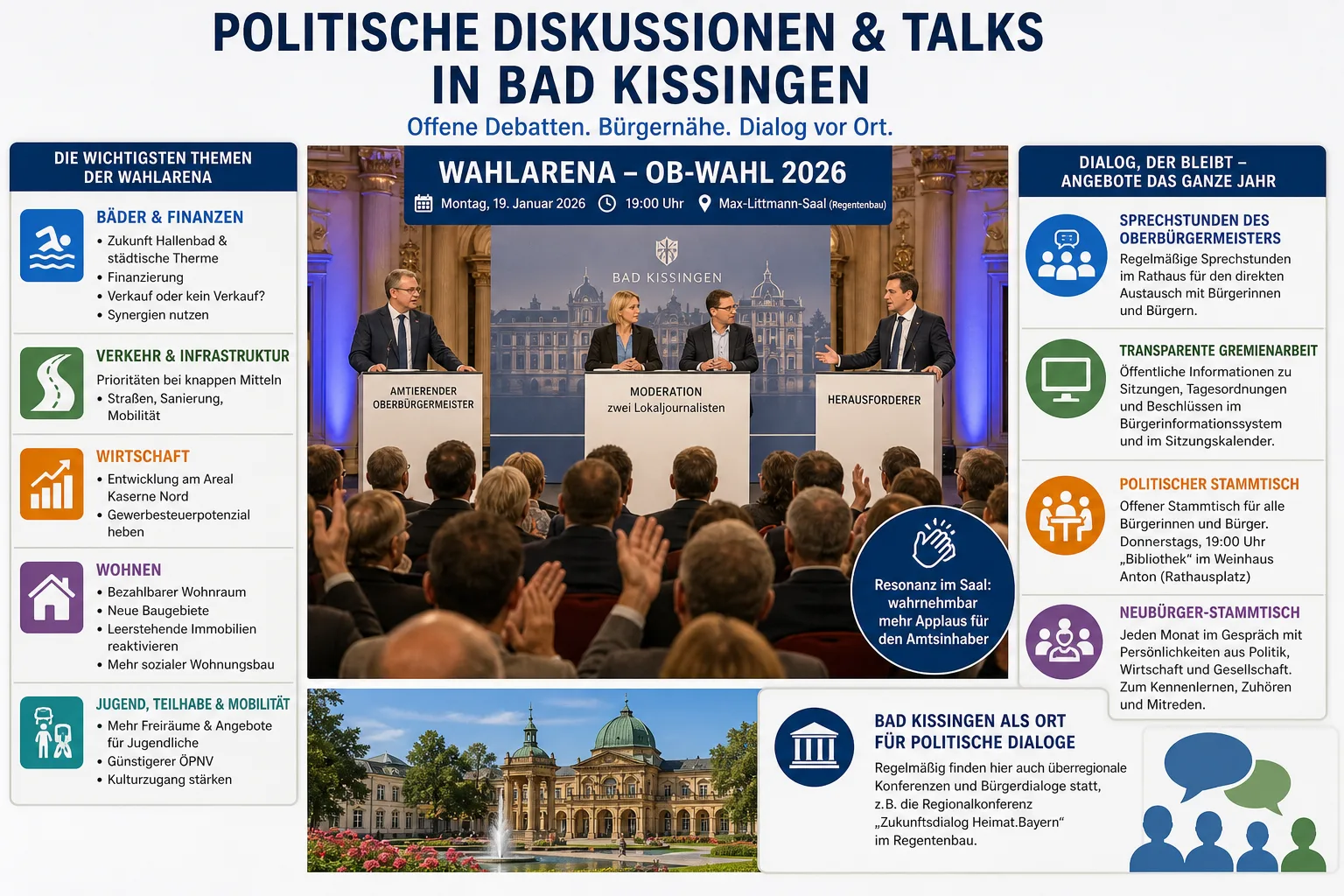
In the coming months, public discussions are to be expected again and again in Bad Kissingen as soon as larger municipal projects, budget decisions, or urban development issues are put on the agenda. Such formats typically take place in larger halls or venues and are often moderated so that the audience and panel can engage in a structured conversation.
Which topics are typically the focus of future talks
- Urban Development & Infrastructure: Priorities for roads, public buildings, traffic safety, and investments.
- Housing: Strategies against vacancies, development of new residential areas, socially acceptable rents, and densification.
- Economy & Location: Settlement of businesses, use of land, jobs, and municipal revenues.
- Social Affairs, Culture & Participation: Offers for young people, accessibility, volunteering, cultural promotion.
- Mobility: Public transport connections, cycling and walking, parking management.
If you are specifically looking for “the next big discussion,” it is worth checking the official event calendars (see Practical Guide) – especially around budget consultations, major construction projects, or citizen participation.
Town Hall & Citizen Dialogue: Direct Paths in the Coming Months
The lowest-threshold access to local politics remains direct contact with the city administration. For the coming months, it is particularly relevant that citizen dialogue does not only take place at major events, but also in direct exchange – for example, via contact points in the town hall, citizen services, and announced discussion offers.
Consultation Hours & Direct Concerns
Many cities offer regular or occasion-related consultation hours in which concerns are recorded in a structured manner. In Bad Kissingen, you can find current information on contact options and responsibilities on the official city pages. This allows you to prepare for an appointment in advance (topic, location, affected area, desired outcome) and conduct the conversation efficiently.
When direct dialogue is particularly useful
- When you want to report a specific problem on site (e.g. traffic situation, noise, safety).
- When you want to contribute an idea for your neighborhood (e.g. quality of stay, green spaces, play facilities).
- When you want to clarify procedural questions (e.g. how participation works or who is responsible).
Public Meetings & Citizen Information System: How to Keep Track of Upcoming Decisions
If you want to understand political discussions not only as an “event” but as a process, you should keep an eye on the upcoming meetings of the city council and committees. Topics are prepared, discussed, and decided there – often with documents, agendas, and draft resolutions.
How to use the Citizen Information System effectively in the coming weeks
- Filter dates: Search for city council, committees, and relevant specialist bodies.
- Read the agenda in advance: Mark items that affect your neighborhood or topic.
- Check documents: Pay attention to templates, attachments, draft resolutions, and justifications.
- Note questions: Formulate specific questions that arise from the documents.
- Follow-up: Afterwards, check results, minutes, or resolutions, if published.
This creates a reliable information base for any further discussion – whether at the regulars’ table, in initiatives, or in direct contact with elected representatives.
Regulars’ Tables & Discussion Rounds: Politics on a Smaller Scale
In addition to formal meetings, political conversations in Bad Kissingen also develop in smaller, regular rounds. For the coming months, the following applies: Informal formats are particularly suitable if you want to listen, ask questions, or get to know different perspectives – without the atmosphere of a big stage.
What informal talks can achieve in practice
- Orientation: Classification of local topics that seem difficult to grasp in official documents.
- Network: Contacts with committed people, associations, initiatives, or knowledgeable citizens.
- Feedback loops: Bundling topics before they are brought to politics or administration.
If you want to participate in discussion rounds, pay attention to clear framework rules: respectful interaction, transparent moderation, and the separation of facts, opinions, and rumors. This increases the quality of the discussion – and the chance that concerns will be taken seriously later on.
Bad Kissingen as an Event Venue: Regional Dialogues with Impact
As a spa and event city, Bad Kissingen will continue to be an obvious place for regional conferences, meetings, or dialogue formats. Such events can bundle political topics, bring together actors from different levels, and – depending on the concept – also be accessible to interested citizens.
If you are looking for upcoming regional dates, it is worth combining:
- Event notices from the city,
- Calendars of major venues,
- Announcements from regional institutions and media.
Practical Guide: How to Participate in Upcoming Discussions
1) Get informed: Where to reliably find future dates
- Official city website: Current information on citizen services, citizen participation, and municipal announcements.
- Citizen Information System: Meeting dates, agendas, documents, and – if published – results.
- Regional event calendar: Information on lectures, discussion evenings, or conferences.
2) Prepare: How to make a good statement in 10 minutes
- Formulate one goal: What should be clearer after the discussion?
- State one specific reference: location, street, target group, or situation.
- Ask a precise question that can be answered with facts.
- Separate observation (what is) from suggestion (what should be).
3) Participate: Ways beyond just listening
- Written submissions: If a topic is complex, written notes are often more effective than spontaneous contributions.
- Initiatives & associations: More can be researched, bundled, and represented together.
- Stay on it long-term: Those who want to accompany decisions follow several meetings and development steps.
Good local debates arise where information is accessible, questions remain concrete, and different life realities are respected.