Zero Waste Green Event in Bad Kissingen
Zero Waste & Green Events: How Bad Kissingen Can Celebrate Sustainably in the Future
How can a festival in a spa town be lively, comfortable, and climate- and resource-friendly at the same time – without mountains of waste, unnecessary traffic, or greenwashing? This guide compiles practical measures that can be applied to upcoming events in Bad Kissingen: from travel and energy to reusable systems and waste separation, as well as sustainable procurement, accessibility, and transparent communication.
Important: For most events, the biggest climate lever is not the cup, but arrival and departure as well as energy use. Those who plan these areas consistently often reduce emissions significantly – and also improve noise and air quality.
1) Mobility as a Climate Key: Rethinking Arrival for Future Events
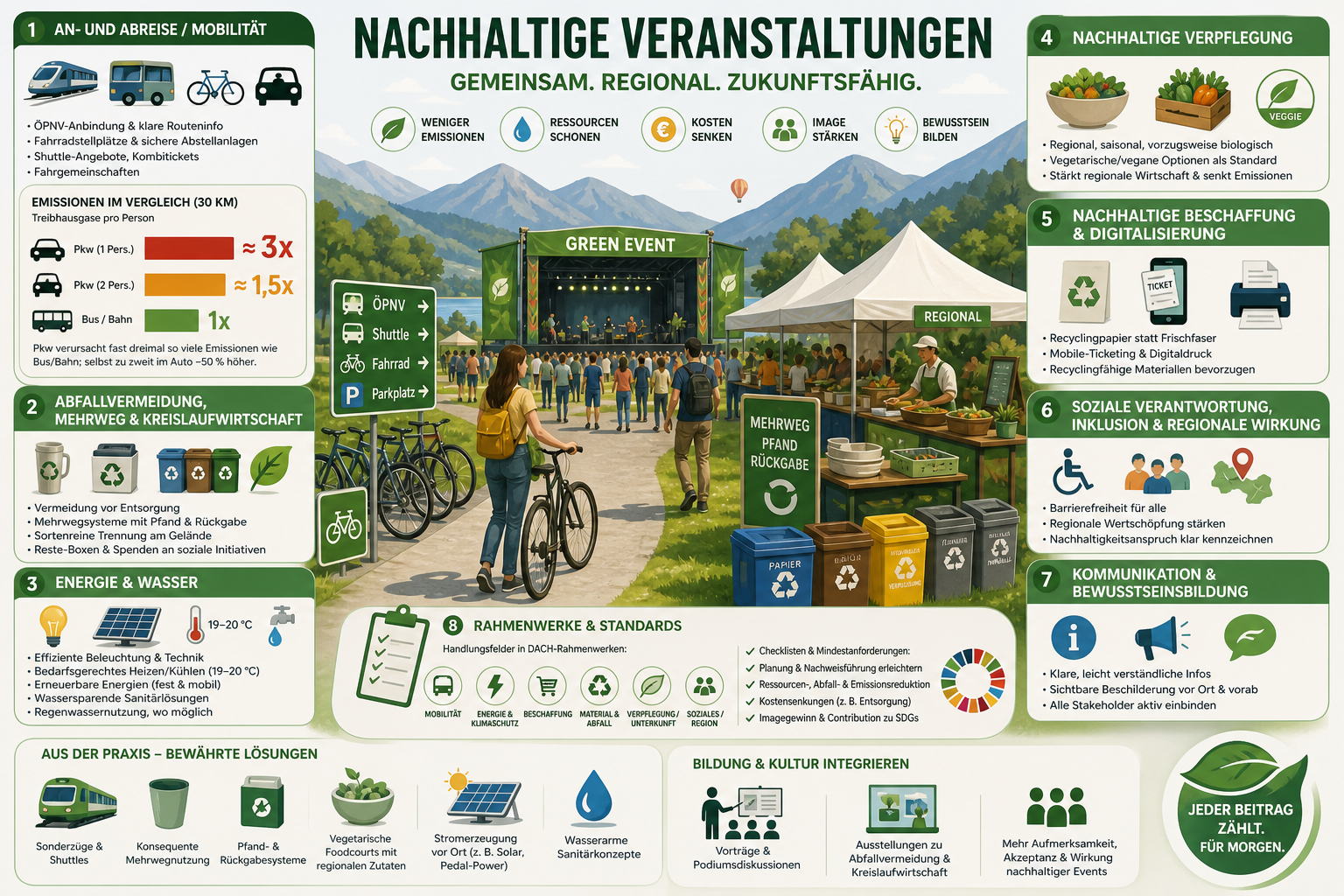
For many events, a large share of greenhouse gas emissions is caused by the arrival and departure of the audience. Therefore, it is worthwhile not only to "consider" mobility, but to treat it as a central program point in planning: information, infrastructure, and incentives.
Concrete Measures for Organizers
- Prominently communicate public transport: On the website, tickets, posters, and social media, train and bus connections, last departures, and walking routes to the venue should be clearly explained.
- Bicycle-friendly infrastructure: Sufficiently lit, well-signposted bicycle parking as close as possible to the entrance; for larger formats, additionally temporary bicycle parking areas.
- Parking management: Deliberately limit car parking spaces, consider park-and-ride, and design routes from the parking lot so that public transport and cycling appear more attractive (without disadvantaging people with mobility impairments).
- Shuttle options for peak times: When high attendance is expected, shuttles (e.g., station–venue) can reduce the number of individual arrivals.
- Facilitate carpooling: Actively invite carpooling in event communication (e.g., via a clear "Ride & Share" section in the FAQ or a community post).
Concrete Measures for Guests
- Prefer public transport or bicycle – especially for short and medium distances.
- Bundle trips: If a car is necessary, travel together as much as possible and combine several errands with the trip.
- Plan your route in advance: Check departure times, safe cycling routes, and the way home (especially in the evening) before the event starts.
In a spa town like Bad Kissingen, a low-mobility event logic pays off twice: less congestion, less noise, fewer local air pollutants – and an atmosphere that fits the place.
2) Zero Waste On Site: Avoiding Waste Instead of Just Disposing of It
Zero Waste starts before the first full trash can. The most effective approach follows a clear order: avoid, reuse, recycle – and only as a last option dispose. For future events in Bad Kissingen, this means consistently planning material flows: What comes onto the site, what leaves again?
Consistently Implement Reusable Systems
- Reusable cups and dishes with deposit: Deposits ensure return rates. Return points should be highly visible, available in multiple locations, and easily accessible.
- Systematically replace single-use items: Especially for drinks and to-go food, a lot of waste is otherwise generated in a short time.
- Don't forget backstage: Crew catering and production areas should meet the same reusable standard as the audience area.
Waste Separation That Really Works
- Collection islands instead of single bins: Fewer, well-designed collection stations often work better than many scattered trash cans.
- Clear signage: Pictograms, examples (e.g., "Cups here"), and color coding; ideally multilingual if an international audience is expected.
- Staff/"Waste Guides": For larger formats, trained helpers can briefly and kindly assist with correct separation – this significantly increases the quality of recyclable fractions.
Minimize Food Waste
- Portion planning & flexible servings: Offer small portions as an option, allow seconds, instead of selling standard oversized plates.
- Reduce leftovers: Align menus with easily plannable products and define processes for storage/reprocessing.
When avoidance, reusables, and separation come together, sustainability becomes visible to guests: cleaner paths, fewer overflowing bins, and an overall more relaxed venue.
3) Energy, Water, and Catering: Celebrating Resource-Efficiently
Energy: Less Consumption, Cleaner Sources
- Use efficient technology: LED lighting, needs-based illumination, energy-saving devices, and sensible scheduling (e.g., switching off outside opening hours).
- Realistically size power needs: Oversized generators and continuous loads are common emission drivers. A load profile (which consumers when?) helps reduce peaks.
- Prefer renewable electricity: Where grid power is used, a green electricity tariff or appropriate procurement is an obvious step; for temporary solutions, energy planning should transparently consider emission impacts.
Water: Ensure Comfort, Reduce Consumption
- Water-saving equipment: Where temporary sanitary solutions are used, efficient systems and clear operator standards are an important lever.
- Drinking water stations: Where conditions allow, clearly visible drinking water points reduce the need for single-use bottles and also improve comfort.
Catering: Regional, Seasonal, Plant-Based
Food is a central part of the event experience – and an area where environmental impact and enjoyment can be well combined.
- Regional & seasonal: Shorter transport routes and stronger regional value creation.
- Expand plant-based options: Vegetarian and vegan dishes should not be a "side option" but attractively and visibly placed.
- Transparency in offerings: Short notes such as "seasonal," "regional," or "organic" (only if verifiable) provide orientation.
4) Procurement, Digitalization, and Social Responsibility
Sustainable Procurement
- Recycled paper for programs, notices, and internal documents; consistently reduce print quantities.
- Modular, reusable equipment: Durable signage, reusable banner solutions, reusable decorations, and rental systems instead of buying single-use materials.
- Choose circular materials: Where possible, prefer pure and easily recyclable materials to simplify disposal.
Digitalization with Measure
- Digital tickets and information: Mobile ticketing, digital programs and site maps, and push information for arrival reduce paper and improve orientation.
- Plan offline alternatives: Digital solutions should be low-barrier; central information points on site remain important.
Social Responsibility: Accessibility, Safety, Public Welfare
- Accessible paths & offerings: Accessibility, low-barrier sanitary solutions, and clear information design (e.g., clear pictograms) should be included early in planning.
- Good working conditions: Fair processes for crew and service providers (shift planning, breaks, water, safe workflows) are part of credibility.
- Regional integration: Cooperation with local clubs, cultural workers, and businesses strengthens acceptance and value creation.
5) Communication, Standards, and Impact: Making Green Events Work
The best measure only works if it is used. That is why communication is a real sustainability lever: it makes sustainable options visible, easy, and socially "normal."
Before the Event
- "How to get there climate-friendly" as a fixed section on the event page (public transport, bike, on foot, park-and-ride, accessibility).
- Explain reusables & deposit: What does the deposit cost, where is it returned, what happens to cups/dishes?
- Announce catering transparently: Make regional, seasonal, and plant-based options visible.
During the Event
- Clear wayfinding: Clearly mark collection stations, return points, bicycle parking, and drinking water stations.
- Short, positive notes: Few, understandable messages instead of a "sign forest."
After the Event (for Future Editions)
For the further development of future events, a short, fact-based review is worthwhile: Which measures were implemented, what worked well, what will be improved next time? This builds trust and prevents accusations of greenwashing.
Standards as Guidance
For systematic planning, frameworks such as a sustainability management system for events (e.g., according to ISO 20121) and national guidelines are helpful. They structure typical fields of action (mobility, energy, materials/waste, catering, social aspects, communication) and facilitate documentation.
6) A Practical Roadmap for the Next Events in Bad Kissingen
- Prioritize mobility: Public transport information, bicycle parking, and incentives for shared arrivals are fixed early and prominently communicated.
- Define reusable & return logic: Deposit, return stations, washing/logistics, and backstage standard in a unified concept.
- Plan waste separation like a visitor experience: Collection islands, signage, staff, and cleaning routines.
- Measure and reduce energy needs: Size technology, optimize operating times, make electricity sourcing transparent.
- Make catering sustainable: Regional, seasonal, plant-based, with good planning to prevent food waste.
- Integrate accessibility and safety: Paths, information, sanitary facilities, quiet/retreat options, and clearly visible contact persons on site.
- Document results: Short, honest evaluation as a basis for the next event.
This way, Bad Kissingen can further develop future festivals, concerts, congresses, and cultural formats step by step as green events – fitting the spa town identity: high quality of stay, health, tranquility, and responsible hospitality.