
Bad Kissingen
Kapellenstraße 17, 97688 Bad Kissingen, Deutschland
Chapel Cemetery Bad Kissingen | History & Photos
The Chapel Cemetery in Bad Kissingen is much more than a historical burial site. Those searching for Chapel Cemetery Bad Kissingen, Chapel Cemetery photos, or Chapel Street Cemetery will find a place where city history, spa history, monument preservation, and a tranquil park atmosphere intertwine. The site is located right next to the Marienkapelle and has been the resting place of physicians, hoteliers, spa guests, and other personalities who shaped the profile of the spa town for centuries. Today, the place is experienced as a public park and is one of the special attractions in the UNESCO World Heritage of the Great Spa Towns of Europe. It is precisely this blend of historical depth and calm, almost enchanted effect that makes the Chapel Cemetery a destination for walks, photo opportunities, and cultural-historical discoveries. It is also a key location for visitors interested in history, architecture, or the development of Bad Kissingen as a world spa: The graves tell of social networks, the Marienkapelle of religious and artistic continuity, and the war scars of the 19th century make it clear that this place not only preserves memory but also documents conflict history. ([welterbe.badkissingen.de](https://welterbe.badkissingen.de/welterbe-bad-kissingen/sehenswuerdigkeiten/41618.Kapellenfriedhof.html))
History of the Chapel Cemetery in Bad Kissingen
The first documented mention of the Chapel Cemetery and the associated Marienkapelle dates back to 1348. At a time when the plague threatened large parts of the population, the site was established outside the city walls as a necessary burial space. A plague stone from 1568/69 at the cemetery wall still reminds us today of another epidemic of the 16th century, during which, according to urban tradition, a third of the population was wiped out. Over the centuries, the cemetery grew several times: In 1838, plans were first made for a morgue and for an expansion of the area; the morgue was built in 1841, an extension to the east took place in 1855, and in 1895 the site was once again expanded after long planning. As early as 1890, the old morgue made way for a new building that still stands today; in 1909, an archway was added at the main entrance. These dates show how closely the Chapel Cemetery is linked to the growth of Bad Kissingen and how urban needs, burial culture, and architectural development have interacted here over centuries. As demands continued to rise in the 20th century, a new cemetery area was planned in the 1920s, and in 1936, another large facility was opened with the park cemetery at Sinnberg. For the Chapel Cemetery itself, the turning point came in 1980: Since then, no more burials have taken place there. Instead, the site has developed into a cemetery park that can now be experienced as a public, more natural green space and does not hide the past but visibly organizes it. Thus, it is an example of how historical cemeteries in Bad Kissingen have been transformed into new cultural and landscape contexts without losing their memorial value. ([badkissingen.de](https://www.badkissingen.de/media/www.badkissingen.de/org/med_18400/172591_kapellenfriedhof_sgi_2025_final.pdf))
Marienkapelle and Significant Personalities
The Marienkapelle is inseparably linked to the Chapel Cemetery and shapes its appearance to this day. It was also first securely documented in 1348. In the 15th century, it received a distinctive structure with the tower from 1446, and later underwent a profound renewal: The nave was demolished in 1725 and rebuilt according to plans by Balthasar Neumann by 1744. The baroque interior, including the high altar, side altars, and pulpit, was created between 1734 and 1738 by Benedikt Lutz from Neustadt. Together with later changes, such as the tower extension of 1906, the church shows several layers of time that are immediately recognizable in today's cityscape. The names Marienkapelle, Liebfrauenkirche, and St. Burkardus Church also belong to the local tradition and make it clear how much religious use, artistic expression, and regional memory overlap here. Particularly noteworthy is its function as a burial church for the local nobility: Two epitaphs inside commemorate the Schletten and Heußlein families from Eußenheim, who are closely linked to the history of Bad Kissingen. On the outer wall of the Marienkapelle, according to city historical information, there are 23 epitaphs. This diversity makes the chapel a stone archive of city history, where architectural art and memory culture merge. Many personalities associated with the spa industry rest in the cemetery itself: for example, the honorary citizen Anton Kliegl, the government president Friedrich von Luxburg, the spring doctors Franz Anton von Balling, Oscar Diruf, and Alfred Sotier, the court photographer Jacques Pilartz, the Kissingen architects Carl and Franz Krampf, and the sculptor Valentin Weidner. In local communication, relatives of Napoleon Bonaparte, Count von Luxburg and his wife, the opera singer Johann Baptist Hoffmann, and other famous spa doctors are also mentioned. Thus, those who visit the site do not experience an anonymous cemetery but a dense network of family, professional, and city history. It is precisely these names that make the Chapel Cemetery so interesting for historical walks and photos. ([badkissingen.de](https://www.badkissingen.de/media/www.badkissingen.de/org/med_18400/172591_kapellenfriedhof_sgi_2025_final.pdf))
The War of 1866 and the Culture of Remembrance
Among the most poignant chapters in the history of the Chapel Cemetery is the German War of 1866. On July 10, 1866, Prussian and Bavarian troops met here. At that time, the city was already in Prussian hands, but a company of 400 men from the 9th Bavarian Infantry Regiment had entrenched itself in the cemetery. A skirmish followed in which artillery fire hit the cemetery and the Prussians ultimately captured the cemetery at great cost. For Bad Kissingen, this was a pivotal moment, and the traces of this event are still visible today. Numerous fallen soldiers were buried in the Chapel Cemetery; a memorial column commemorates the dead of the war of 1866. Across the street on Chapel Street, the Mourning Germania was erected in 1869, a work by Michael Arnold, which commemorates the 62 soldiers who fell in Kissingen in a mass grave and symbolically stands for reconciliation. Thus, the site is readable not only as a cemetery but also as a historical space of remembrance. The combination of tombstones, memorial stones, and military historical traces gives the area a depth that goes far beyond its function as a park. That the city actively communicates this aspect to this day is also evident in events such as the World Heritage Day, where the Chapel Cemetery is highlighted in tours, lectures, and an open workshop for the restoration of stone buildings. Thus, the memory of 1866 is not museum-frozen but is embedded in a lively communication of monument preservation, reconciliation, and city history. ([badkissingen.de](https://www.badkissingen.de/media/www.badkissingen.de/org/med_18400/172591_kapellenfriedhof_sgi_2025_final.pdf))
Parking, Access, and Visiting On-Site
Those wishing to visit the Chapel Cemetery can reach it via Chapel Street in the city area of Bad Kissingen, right next to the Marienkapelle. For orientation, it is important to note: The city explicitly includes the area around Chapel Street in its parking concept; parking is available there at the same rate as in other central streets. Additionally, the city of Bad Kissingen offers a large number of parking spaces, including around 700 free parking spaces located about 10 to 15 minutes on foot from the city center, as well as around 500 inexpensive parking spaces in close proximity to the city center. For longer stays, there are daily, weekly, and monthly tickets available. This makes visiting the Chapel Cemetery relaxed even when combining the tour with a stroll through the city center, the spa garden, or other attractions. Those not arriving by car benefit from the compact location in the spa district: The site is close to the city and can be easily incorporated into a walk through the World Heritage area. Since the Chapel Cemetery is now used as a public park, it is no longer a classic cemetery with restricted hours but a freely accessible historical green space. This is particularly attractive for many visitors, as it combines a quiet place of remembrance with short distances, urban infrastructure, and a clear monument reference. For targeted parking information, the city also refers to its general parking overview and the access map with parking options for cars, coaches, and electric vehicles. The location is thus uncomplicated not only for locals but also for day visitors and cultural travelers who want to explore the Chapel Cemetery along with the Marienkapelle, the city center, or other World Heritage sites. ([badkissingen.de](https://www.badkissingen.de/information/parken/39667.Parken-im-Stadtgebiet-Bad-Kissingen.html?utm_source=openai))
Photos, Atmosphere, and the Chapel Cemetery as a Cemetery Park
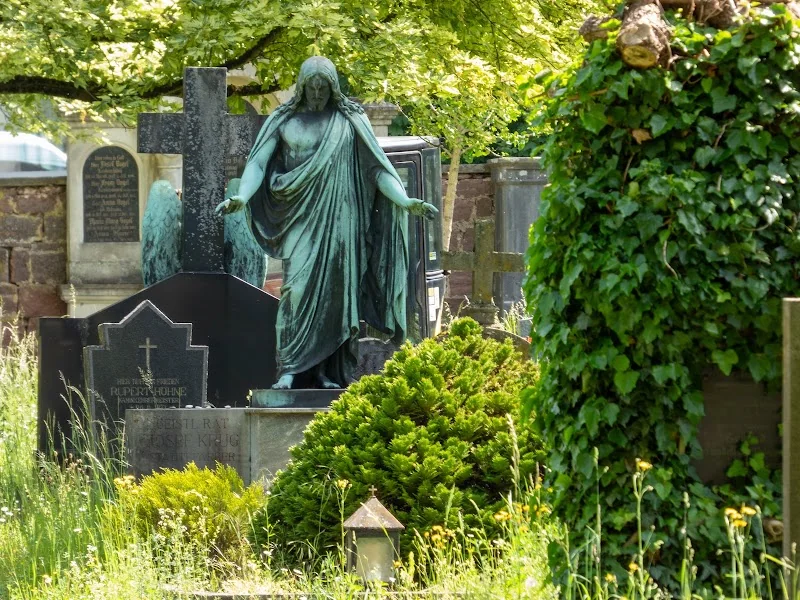
Those searching for Chapel Cemetery photos quickly find the special charm of this place: a mix of historical tombstones, the immediate proximity of the Marienkapelle, old walls, green paths, and a calm, park-like effect. On the official World Heritage site, the Chapel Cemetery is presented with a photo by Alexandra Nadler; it is described as a public park where many physicians, hoteliers, guests, and other personalities were buried. The city complements this image with guided tours that highlight the quiet charm of the cemetery park, the magnificent furnishings of the Marienkapelle, and the still visible grave inscriptions. For photo shoots, the contrast is particularly interesting: opulent family tombs meet green spaces, historical memory meets an atmosphere that invites slow walking rather than quick consumption. Since 1980, no more burials have taken place there, and the park area has been designed to be more natural; according to the city newsletter, there are now more green areas visible, walkable grass paths are regularly mowed, and flowering areas are maintained. Thus, the place has found a form that is neither museum sterile nor neglected. It remains a visible cemetery while also being a landscape space, monument, and walking destination. This transformation is an advantage for visitors who want to photograph quietly or let the historical atmosphere take effect. The best motifs often arise not from spectacular perspectives but from details: the relationship between stone and green, the traces of family graves, the memorial signs for 1866, and the silhouette of the chapel. Thus, a search term like Chapel Cemetery photos becomes an invitation to explore a sensitive historical space with an open view. Those who look closely will recognize not only individual tombstones but an entire narrative urban space where architecture, nature, and memory are inextricably linked. ([welterbe.badkissingen.de](https://welterbe.badkissingen.de/welterbe-bad-kissingen/sehenswuerdigkeiten/41618.Kapellenfriedhof.html))
UNESCO World Heritage, Monument Protection, and Current Maintenance
The Chapel Cemetery is today not only a local monument but also part of the World Heritage site Great Spa Towns of Europe. The official World Heritage site describes Bad Kissingen as a model spa with ongoing function and emphasizes that the city's contribution to the UNESCO World Heritage is based on material and immaterial values. The Chapel Cemetery is listed as an attraction and exemplifies how much the spa town thrives on historical building substance, social memory, and designed landscape. The recent communication also makes it clear that this is not about a decommissioned relic: For World Heritage Day 2026, guided tours, lectures, and an open workshop for the restoration of stone buildings have been announced, providing insights into damage mapping, cleaning techniques, and surface treatment. As early as 2024, the city highlighted in a contribution that the Chapel Cemetery is popular as a historical park facility, is considered a time witness of the brother war of 1866, and remains open as a park facility for visitors. At the same time, the preservation of the site is accompanied by craftsmanship and organization, such as maintenance of the areas, restoration measures on the supporting wall of the Marienkapelle, and continuous communication through the city archive and World Heritage coordination. This is important for visitors because it explains why the place appears so lively despite its age: It is not simply preserved but is maintained, read, and integrated into the urban space. Therefore, those who visit the site with open eyes will recognize several layers at once: medieval origins, baroque redesign, war and memory history, current park use, and the status as a World Heritage attraction. This multi-layeredness makes the Chapel Cemetery in Bad Kissingen an extraordinary destination for culture-interested walks, quiet photo moments, and in-depth city history. For many visitors, this is precisely the appeal: a place that is historically difficult to grasp and precisely for that reason remains long in memory. ([welterbe.badkissingen.de](https://welterbe.badkissingen.de/welterbe-bad-kissingen?utm_source=openai))
Sources:
- City of Bad Kissingen – The Chapel Cemetery Bad Kissingen (City Historical Information 2025)
- Great Spa Towns of Europe – Chapel Cemetery
- City of Bad Kissingen – Chapel Cemetery and Marienkapelle
- City of Bad Kissingen – Parking in the City Area of Bad Kissingen
- City of Bad Kissingen – Churches in Bad Kissingen
- UNESCO World Heritage Bad Kissingen – World Heritage Day on June 7, 2026
Mehr anzeigenWeniger anzeigen
Chapel Cemetery Bad Kissingen | History & Photos
The Chapel Cemetery in Bad Kissingen is much more than a historical burial site. Those searching for Chapel Cemetery Bad Kissingen, Chapel Cemetery photos, or Chapel Street Cemetery will find a place where city history, spa history, monument preservation, and a tranquil park atmosphere intertwine. The site is located right next to the Marienkapelle and has been the resting place of physicians, hoteliers, spa guests, and other personalities who shaped the profile of the spa town for centuries. Today, the place is experienced as a public park and is one of the special attractions in the UNESCO World Heritage of the Great Spa Towns of Europe. It is precisely this blend of historical depth and calm, almost enchanted effect that makes the Chapel Cemetery a destination for walks, photo opportunities, and cultural-historical discoveries. It is also a key location for visitors interested in history, architecture, or the development of Bad Kissingen as a world spa: The graves tell of social networks, the Marienkapelle of religious and artistic continuity, and the war scars of the 19th century make it clear that this place not only preserves memory but also documents conflict history. ([welterbe.badkissingen.de](https://welterbe.badkissingen.de/welterbe-bad-kissingen/sehenswuerdigkeiten/41618.Kapellenfriedhof.html))
History of the Chapel Cemetery in Bad Kissingen
The first documented mention of the Chapel Cemetery and the associated Marienkapelle dates back to 1348. At a time when the plague threatened large parts of the population, the site was established outside the city walls as a necessary burial space. A plague stone from 1568/69 at the cemetery wall still reminds us today of another epidemic of the 16th century, during which, according to urban tradition, a third of the population was wiped out. Over the centuries, the cemetery grew several times: In 1838, plans were first made for a morgue and for an expansion of the area; the morgue was built in 1841, an extension to the east took place in 1855, and in 1895 the site was once again expanded after long planning. As early as 1890, the old morgue made way for a new building that still stands today; in 1909, an archway was added at the main entrance. These dates show how closely the Chapel Cemetery is linked to the growth of Bad Kissingen and how urban needs, burial culture, and architectural development have interacted here over centuries. As demands continued to rise in the 20th century, a new cemetery area was planned in the 1920s, and in 1936, another large facility was opened with the park cemetery at Sinnberg. For the Chapel Cemetery itself, the turning point came in 1980: Since then, no more burials have taken place there. Instead, the site has developed into a cemetery park that can now be experienced as a public, more natural green space and does not hide the past but visibly organizes it. Thus, it is an example of how historical cemeteries in Bad Kissingen have been transformed into new cultural and landscape contexts without losing their memorial value. ([badkissingen.de](https://www.badkissingen.de/media/www.badkissingen.de/org/med_18400/172591_kapellenfriedhof_sgi_2025_final.pdf))
Marienkapelle and Significant Personalities
The Marienkapelle is inseparably linked to the Chapel Cemetery and shapes its appearance to this day. It was also first securely documented in 1348. In the 15th century, it received a distinctive structure with the tower from 1446, and later underwent a profound renewal: The nave was demolished in 1725 and rebuilt according to plans by Balthasar Neumann by 1744. The baroque interior, including the high altar, side altars, and pulpit, was created between 1734 and 1738 by Benedikt Lutz from Neustadt. Together with later changes, such as the tower extension of 1906, the church shows several layers of time that are immediately recognizable in today's cityscape. The names Marienkapelle, Liebfrauenkirche, and St. Burkardus Church also belong to the local tradition and make it clear how much religious use, artistic expression, and regional memory overlap here. Particularly noteworthy is its function as a burial church for the local nobility: Two epitaphs inside commemorate the Schletten and Heußlein families from Eußenheim, who are closely linked to the history of Bad Kissingen. On the outer wall of the Marienkapelle, according to city historical information, there are 23 epitaphs. This diversity makes the chapel a stone archive of city history, where architectural art and memory culture merge. Many personalities associated with the spa industry rest in the cemetery itself: for example, the honorary citizen Anton Kliegl, the government president Friedrich von Luxburg, the spring doctors Franz Anton von Balling, Oscar Diruf, and Alfred Sotier, the court photographer Jacques Pilartz, the Kissingen architects Carl and Franz Krampf, and the sculptor Valentin Weidner. In local communication, relatives of Napoleon Bonaparte, Count von Luxburg and his wife, the opera singer Johann Baptist Hoffmann, and other famous spa doctors are also mentioned. Thus, those who visit the site do not experience an anonymous cemetery but a dense network of family, professional, and city history. It is precisely these names that make the Chapel Cemetery so interesting for historical walks and photos. ([badkissingen.de](https://www.badkissingen.de/media/www.badkissingen.de/org/med_18400/172591_kapellenfriedhof_sgi_2025_final.pdf))
The War of 1866 and the Culture of Remembrance
Among the most poignant chapters in the history of the Chapel Cemetery is the German War of 1866. On July 10, 1866, Prussian and Bavarian troops met here. At that time, the city was already in Prussian hands, but a company of 400 men from the 9th Bavarian Infantry Regiment had entrenched itself in the cemetery. A skirmish followed in which artillery fire hit the cemetery and the Prussians ultimately captured the cemetery at great cost. For Bad Kissingen, this was a pivotal moment, and the traces of this event are still visible today. Numerous fallen soldiers were buried in the Chapel Cemetery; a memorial column commemorates the dead of the war of 1866. Across the street on Chapel Street, the Mourning Germania was erected in 1869, a work by Michael Arnold, which commemorates the 62 soldiers who fell in Kissingen in a mass grave and symbolically stands for reconciliation. Thus, the site is readable not only as a cemetery but also as a historical space of remembrance. The combination of tombstones, memorial stones, and military historical traces gives the area a depth that goes far beyond its function as a park. That the city actively communicates this aspect to this day is also evident in events such as the World Heritage Day, where the Chapel Cemetery is highlighted in tours, lectures, and an open workshop for the restoration of stone buildings. Thus, the memory of 1866 is not museum-frozen but is embedded in a lively communication of monument preservation, reconciliation, and city history. ([badkissingen.de](https://www.badkissingen.de/media/www.badkissingen.de/org/med_18400/172591_kapellenfriedhof_sgi_2025_final.pdf))
Parking, Access, and Visiting On-Site
Those wishing to visit the Chapel Cemetery can reach it via Chapel Street in the city area of Bad Kissingen, right next to the Marienkapelle. For orientation, it is important to note: The city explicitly includes the area around Chapel Street in its parking concept; parking is available there at the same rate as in other central streets. Additionally, the city of Bad Kissingen offers a large number of parking spaces, including around 700 free parking spaces located about 10 to 15 minutes on foot from the city center, as well as around 500 inexpensive parking spaces in close proximity to the city center. For longer stays, there are daily, weekly, and monthly tickets available. This makes visiting the Chapel Cemetery relaxed even when combining the tour with a stroll through the city center, the spa garden, or other attractions. Those not arriving by car benefit from the compact location in the spa district: The site is close to the city and can be easily incorporated into a walk through the World Heritage area. Since the Chapel Cemetery is now used as a public park, it is no longer a classic cemetery with restricted hours but a freely accessible historical green space. This is particularly attractive for many visitors, as it combines a quiet place of remembrance with short distances, urban infrastructure, and a clear monument reference. For targeted parking information, the city also refers to its general parking overview and the access map with parking options for cars, coaches, and electric vehicles. The location is thus uncomplicated not only for locals but also for day visitors and cultural travelers who want to explore the Chapel Cemetery along with the Marienkapelle, the city center, or other World Heritage sites. ([badkissingen.de](https://www.badkissingen.de/information/parken/39667.Parken-im-Stadtgebiet-Bad-Kissingen.html?utm_source=openai))
Photos, Atmosphere, and the Chapel Cemetery as a Cemetery Park
Those searching for Chapel Cemetery photos quickly find the special charm of this place: a mix of historical tombstones, the immediate proximity of the Marienkapelle, old walls, green paths, and a calm, park-like effect. On the official World Heritage site, the Chapel Cemetery is presented with a photo by Alexandra Nadler; it is described as a public park where many physicians, hoteliers, guests, and other personalities were buried. The city complements this image with guided tours that highlight the quiet charm of the cemetery park, the magnificent furnishings of the Marienkapelle, and the still visible grave inscriptions. For photo shoots, the contrast is particularly interesting: opulent family tombs meet green spaces, historical memory meets an atmosphere that invites slow walking rather than quick consumption. Since 1980, no more burials have taken place there, and the park area has been designed to be more natural; according to the city newsletter, there are now more green areas visible, walkable grass paths are regularly mowed, and flowering areas are maintained. Thus, the place has found a form that is neither museum sterile nor neglected. It remains a visible cemetery while also being a landscape space, monument, and walking destination. This transformation is an advantage for visitors who want to photograph quietly or let the historical atmosphere take effect. The best motifs often arise not from spectacular perspectives but from details: the relationship between stone and green, the traces of family graves, the memorial signs for 1866, and the silhouette of the chapel. Thus, a search term like Chapel Cemetery photos becomes an invitation to explore a sensitive historical space with an open view. Those who look closely will recognize not only individual tombstones but an entire narrative urban space where architecture, nature, and memory are inextricably linked. ([welterbe.badkissingen.de](https://welterbe.badkissingen.de/welterbe-bad-kissingen/sehenswuerdigkeiten/41618.Kapellenfriedhof.html))
UNESCO World Heritage, Monument Protection, and Current Maintenance
The Chapel Cemetery is today not only a local monument but also part of the World Heritage site Great Spa Towns of Europe. The official World Heritage site describes Bad Kissingen as a model spa with ongoing function and emphasizes that the city's contribution to the UNESCO World Heritage is based on material and immaterial values. The Chapel Cemetery is listed as an attraction and exemplifies how much the spa town thrives on historical building substance, social memory, and designed landscape. The recent communication also makes it clear that this is not about a decommissioned relic: For World Heritage Day 2026, guided tours, lectures, and an open workshop for the restoration of stone buildings have been announced, providing insights into damage mapping, cleaning techniques, and surface treatment. As early as 2024, the city highlighted in a contribution that the Chapel Cemetery is popular as a historical park facility, is considered a time witness of the brother war of 1866, and remains open as a park facility for visitors. At the same time, the preservation of the site is accompanied by craftsmanship and organization, such as maintenance of the areas, restoration measures on the supporting wall of the Marienkapelle, and continuous communication through the city archive and World Heritage coordination. This is important for visitors because it explains why the place appears so lively despite its age: It is not simply preserved but is maintained, read, and integrated into the urban space. Therefore, those who visit the site with open eyes will recognize several layers at once: medieval origins, baroque redesign, war and memory history, current park use, and the status as a World Heritage attraction. This multi-layeredness makes the Chapel Cemetery in Bad Kissingen an extraordinary destination for culture-interested walks, quiet photo moments, and in-depth city history. For many visitors, this is precisely the appeal: a place that is historically difficult to grasp and precisely for that reason remains long in memory. ([welterbe.badkissingen.de](https://welterbe.badkissingen.de/welterbe-bad-kissingen?utm_source=openai))
Sources:
- City of Bad Kissingen – The Chapel Cemetery Bad Kissingen (City Historical Information 2025)
- Great Spa Towns of Europe – Chapel Cemetery
- City of Bad Kissingen – Chapel Cemetery and Marienkapelle
- City of Bad Kissingen – Parking in the City Area of Bad Kissingen
- City of Bad Kissingen – Churches in Bad Kissingen
- UNESCO World Heritage Bad Kissingen – World Heritage Day on June 7, 2026
Chapel Cemetery Bad Kissingen | History & Photos
The Chapel Cemetery in Bad Kissingen is much more than a historical burial site. Those searching for Chapel Cemetery Bad Kissingen, Chapel Cemetery photos, or Chapel Street Cemetery will find a place where city history, spa history, monument preservation, and a tranquil park atmosphere intertwine. The site is located right next to the Marienkapelle and has been the resting place of physicians, hoteliers, spa guests, and other personalities who shaped the profile of the spa town for centuries. Today, the place is experienced as a public park and is one of the special attractions in the UNESCO World Heritage of the Great Spa Towns of Europe. It is precisely this blend of historical depth and calm, almost enchanted effect that makes the Chapel Cemetery a destination for walks, photo opportunities, and cultural-historical discoveries. It is also a key location for visitors interested in history, architecture, or the development of Bad Kissingen as a world spa: The graves tell of social networks, the Marienkapelle of religious and artistic continuity, and the war scars of the 19th century make it clear that this place not only preserves memory but also documents conflict history. ([welterbe.badkissingen.de](https://welterbe.badkissingen.de/welterbe-bad-kissingen/sehenswuerdigkeiten/41618.Kapellenfriedhof.html))
History of the Chapel Cemetery in Bad Kissingen
The first documented mention of the Chapel Cemetery and the associated Marienkapelle dates back to 1348. At a time when the plague threatened large parts of the population, the site was established outside the city walls as a necessary burial space. A plague stone from 1568/69 at the cemetery wall still reminds us today of another epidemic of the 16th century, during which, according to urban tradition, a third of the population was wiped out. Over the centuries, the cemetery grew several times: In 1838, plans were first made for a morgue and for an expansion of the area; the morgue was built in 1841, an extension to the east took place in 1855, and in 1895 the site was once again expanded after long planning. As early as 1890, the old morgue made way for a new building that still stands today; in 1909, an archway was added at the main entrance. These dates show how closely the Chapel Cemetery is linked to the growth of Bad Kissingen and how urban needs, burial culture, and architectural development have interacted here over centuries. As demands continued to rise in the 20th century, a new cemetery area was planned in the 1920s, and in 1936, another large facility was opened with the park cemetery at Sinnberg. For the Chapel Cemetery itself, the turning point came in 1980: Since then, no more burials have taken place there. Instead, the site has developed into a cemetery park that can now be experienced as a public, more natural green space and does not hide the past but visibly organizes it. Thus, it is an example of how historical cemeteries in Bad Kissingen have been transformed into new cultural and landscape contexts without losing their memorial value. ([badkissingen.de](https://www.badkissingen.de/media/www.badkissingen.de/org/med_18400/172591_kapellenfriedhof_sgi_2025_final.pdf))
Marienkapelle and Significant Personalities
The Marienkapelle is inseparably linked to the Chapel Cemetery and shapes its appearance to this day. It was also first securely documented in 1348. In the 15th century, it received a distinctive structure with the tower from 1446, and later underwent a profound renewal: The nave was demolished in 1725 and rebuilt according to plans by Balthasar Neumann by 1744. The baroque interior, including the high altar, side altars, and pulpit, was created between 1734 and 1738 by Benedikt Lutz from Neustadt. Together with later changes, such as the tower extension of 1906, the church shows several layers of time that are immediately recognizable in today's cityscape. The names Marienkapelle, Liebfrauenkirche, and St. Burkardus Church also belong to the local tradition and make it clear how much religious use, artistic expression, and regional memory overlap here. Particularly noteworthy is its function as a burial church for the local nobility: Two epitaphs inside commemorate the Schletten and Heußlein families from Eußenheim, who are closely linked to the history of Bad Kissingen. On the outer wall of the Marienkapelle, according to city historical information, there are 23 epitaphs. This diversity makes the chapel a stone archive of city history, where architectural art and memory culture merge. Many personalities associated with the spa industry rest in the cemetery itself: for example, the honorary citizen Anton Kliegl, the government president Friedrich von Luxburg, the spring doctors Franz Anton von Balling, Oscar Diruf, and Alfred Sotier, the court photographer Jacques Pilartz, the Kissingen architects Carl and Franz Krampf, and the sculptor Valentin Weidner. In local communication, relatives of Napoleon Bonaparte, Count von Luxburg and his wife, the opera singer Johann Baptist Hoffmann, and other famous spa doctors are also mentioned. Thus, those who visit the site do not experience an anonymous cemetery but a dense network of family, professional, and city history. It is precisely these names that make the Chapel Cemetery so interesting for historical walks and photos. ([badkissingen.de](https://www.badkissingen.de/media/www.badkissingen.de/org/med_18400/172591_kapellenfriedhof_sgi_2025_final.pdf))
The War of 1866 and the Culture of Remembrance
Among the most poignant chapters in the history of the Chapel Cemetery is the German War of 1866. On July 10, 1866, Prussian and Bavarian troops met here. At that time, the city was already in Prussian hands, but a company of 400 men from the 9th Bavarian Infantry Regiment had entrenched itself in the cemetery. A skirmish followed in which artillery fire hit the cemetery and the Prussians ultimately captured the cemetery at great cost. For Bad Kissingen, this was a pivotal moment, and the traces of this event are still visible today. Numerous fallen soldiers were buried in the Chapel Cemetery; a memorial column commemorates the dead of the war of 1866. Across the street on Chapel Street, the Mourning Germania was erected in 1869, a work by Michael Arnold, which commemorates the 62 soldiers who fell in Kissingen in a mass grave and symbolically stands for reconciliation. Thus, the site is readable not only as a cemetery but also as a historical space of remembrance. The combination of tombstones, memorial stones, and military historical traces gives the area a depth that goes far beyond its function as a park. That the city actively communicates this aspect to this day is also evident in events such as the World Heritage Day, where the Chapel Cemetery is highlighted in tours, lectures, and an open workshop for the restoration of stone buildings. Thus, the memory of 1866 is not museum-frozen but is embedded in a lively communication of monument preservation, reconciliation, and city history. ([badkissingen.de](https://www.badkissingen.de/media/www.badkissingen.de/org/med_18400/172591_kapellenfriedhof_sgi_2025_final.pdf))
Parking, Access, and Visiting On-Site
Those wishing to visit the Chapel Cemetery can reach it via Chapel Street in the city area of Bad Kissingen, right next to the Marienkapelle. For orientation, it is important to note: The city explicitly includes the area around Chapel Street in its parking concept; parking is available there at the same rate as in other central streets. Additionally, the city of Bad Kissingen offers a large number of parking spaces, including around 700 free parking spaces located about 10 to 15 minutes on foot from the city center, as well as around 500 inexpensive parking spaces in close proximity to the city center. For longer stays, there are daily, weekly, and monthly tickets available. This makes visiting the Chapel Cemetery relaxed even when combining the tour with a stroll through the city center, the spa garden, or other attractions. Those not arriving by car benefit from the compact location in the spa district: The site is close to the city and can be easily incorporated into a walk through the World Heritage area. Since the Chapel Cemetery is now used as a public park, it is no longer a classic cemetery with restricted hours but a freely accessible historical green space. This is particularly attractive for many visitors, as it combines a quiet place of remembrance with short distances, urban infrastructure, and a clear monument reference. For targeted parking information, the city also refers to its general parking overview and the access map with parking options for cars, coaches, and electric vehicles. The location is thus uncomplicated not only for locals but also for day visitors and cultural travelers who want to explore the Chapel Cemetery along with the Marienkapelle, the city center, or other World Heritage sites. ([badkissingen.de](https://www.badkissingen.de/information/parken/39667.Parken-im-Stadtgebiet-Bad-Kissingen.html?utm_source=openai))
Photos, Atmosphere, and the Chapel Cemetery as a Cemetery Park
Those searching for Chapel Cemetery photos quickly find the special charm of this place: a mix of historical tombstones, the immediate proximity of the Marienkapelle, old walls, green paths, and a calm, park-like effect. On the official World Heritage site, the Chapel Cemetery is presented with a photo by Alexandra Nadler; it is described as a public park where many physicians, hoteliers, guests, and other personalities were buried. The city complements this image with guided tours that highlight the quiet charm of the cemetery park, the magnificent furnishings of the Marienkapelle, and the still visible grave inscriptions. For photo shoots, the contrast is particularly interesting: opulent family tombs meet green spaces, historical memory meets an atmosphere that invites slow walking rather than quick consumption. Since 1980, no more burials have taken place there, and the park area has been designed to be more natural; according to the city newsletter, there are now more green areas visible, walkable grass paths are regularly mowed, and flowering areas are maintained. Thus, the place has found a form that is neither museum sterile nor neglected. It remains a visible cemetery while also being a landscape space, monument, and walking destination. This transformation is an advantage for visitors who want to photograph quietly or let the historical atmosphere take effect. The best motifs often arise not from spectacular perspectives but from details: the relationship between stone and green, the traces of family graves, the memorial signs for 1866, and the silhouette of the chapel. Thus, a search term like Chapel Cemetery photos becomes an invitation to explore a sensitive historical space with an open view. Those who look closely will recognize not only individual tombstones but an entire narrative urban space where architecture, nature, and memory are inextricably linked. ([welterbe.badkissingen.de](https://welterbe.badkissingen.de/welterbe-bad-kissingen/sehenswuerdigkeiten/41618.Kapellenfriedhof.html))
UNESCO World Heritage, Monument Protection, and Current Maintenance
The Chapel Cemetery is today not only a local monument but also part of the World Heritage site Great Spa Towns of Europe. The official World Heritage site describes Bad Kissingen as a model spa with ongoing function and emphasizes that the city's contribution to the UNESCO World Heritage is based on material and immaterial values. The Chapel Cemetery is listed as an attraction and exemplifies how much the spa town thrives on historical building substance, social memory, and designed landscape. The recent communication also makes it clear that this is not about a decommissioned relic: For World Heritage Day 2026, guided tours, lectures, and an open workshop for the restoration of stone buildings have been announced, providing insights into damage mapping, cleaning techniques, and surface treatment. As early as 2024, the city highlighted in a contribution that the Chapel Cemetery is popular as a historical park facility, is considered a time witness of the brother war of 1866, and remains open as a park facility for visitors. At the same time, the preservation of the site is accompanied by craftsmanship and organization, such as maintenance of the areas, restoration measures on the supporting wall of the Marienkapelle, and continuous communication through the city archive and World Heritage coordination. This is important for visitors because it explains why the place appears so lively despite its age: It is not simply preserved but is maintained, read, and integrated into the urban space. Therefore, those who visit the site with open eyes will recognize several layers at once: medieval origins, baroque redesign, war and memory history, current park use, and the status as a World Heritage attraction. This multi-layeredness makes the Chapel Cemetery in Bad Kissingen an extraordinary destination for culture-interested walks, quiet photo moments, and in-depth city history. For many visitors, this is precisely the appeal: a place that is historically difficult to grasp and precisely for that reason remains long in memory. ([welterbe.badkissingen.de](https://welterbe.badkissingen.de/welterbe-bad-kissingen?utm_source=openai))
Sources:
- City of Bad Kissingen – The Chapel Cemetery Bad Kissingen (City Historical Information 2025)
- Great Spa Towns of Europe – Chapel Cemetery
- City of Bad Kissingen – Chapel Cemetery and Marienkapelle
- City of Bad Kissingen – Parking in the City Area of Bad Kissingen
- City of Bad Kissingen – Churches in Bad Kissingen
- UNESCO World Heritage Bad Kissingen – World Heritage Day on June 7, 2026
Frequently Asked Questions
Reviews
No reviews found