
A. L. Kennedy
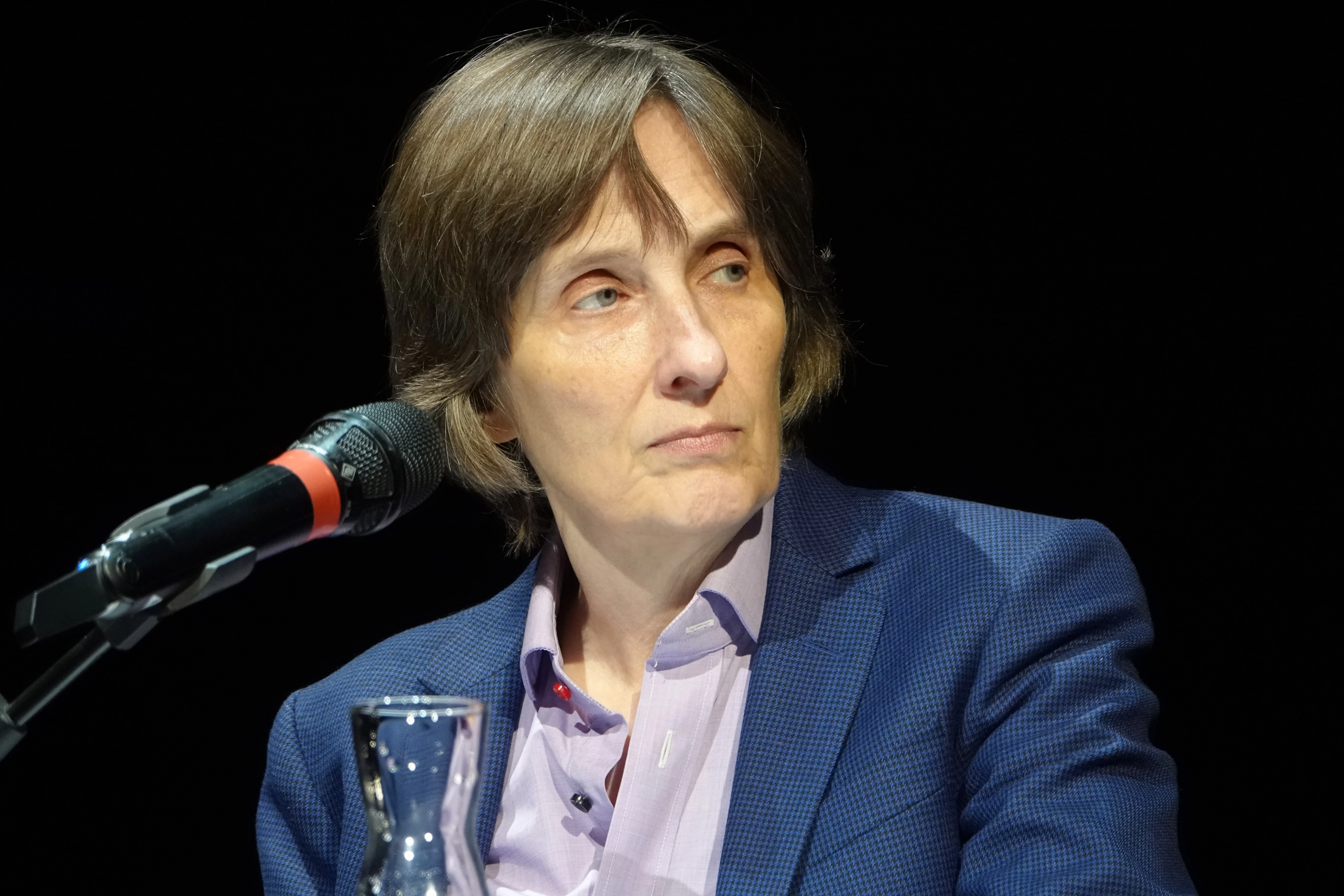
Image from Wikipedia
Image from Wikipedia
A. L. Kennedy – Precision, Empathy, and Uncompromising Narrative Power
One of the pivotal voices in contemporary British literature – straddling novels, short stories, essays, and the stage
Alison Louise “A. L.” Kennedy, born on October 22, 1965, in Dundee, Scotland, has been one of the most influential storytellers in the English-speaking literary world since the early 1990s. One might search in vain for her music career here – but her stage presence is real: Kennedy not only writes novels and stories but also performs as a stand-up comedian, works in radio, and conceptualizes literature performatively. This artistic evolution – from literary debut to international awards – makes her a writer who combines aesthetic rigor with human warmth. The diversity of her work, her masterful composition, and the precise arrangement of her prose evoke a discography in a figurative sense: a bibliography of novels, story collections, and nonfiction that has resonated for decades.
Early Years and Artistic Development
Growing up in Dundee and educated at the University of Warwick, Kennedy entered the literary arena with a clear voice and a sensibility for existential conflicts. Early on, she worked in community and cultural projects, wrote for theater and radio, and refined her artistic development within the tension between everyday observation and formal experimentation. Her public debut came through short prose – a genre where composition and timing resemble musical rhythm: pointed, rhythmic, with orchestrated pauses. Motifs such as loneliness, vulnerability, dignity, and humor have since structured her metaphorical music career: a path of authorship that embodies both fine-tuning and energy.
Breakthrough and International Recognition
With her first novels and short story collections, Kennedy established herself as a precise observer of emotional borderlands. The international breakthrough crystallized in awards and curated rankings: she was included twice in Granta’s “Best of Young British Novelists” (1993, 2003). Novel highlights like “Paradise” (2004) and “Day” (2007) showcased her mastery in arranging inner monologues, psychological voices, and ethical depth. “Day” was awarded Costa Book of the Year in 2007 – a milestone that solidified her authority in the English-speaking canon. Further honors – including the Lannan Literary Award, the Heinrich Heine Prize, and the Austrian State Prize for European Literature – underscore the lasting impact of this voice.
Overview of Works – Novels, Short Prose, Nonfiction
Kennedy’s discography as an author – her bibliography – encompasses novels, story collections, and essays that are stylistically consistent in structure and production. Notable novels include “Looking for the Possible Dance” (1993), “So I Am Glad” (1995), “Everything You Need” (1999), “Paradise” (2004), “Day” (2007), “The Blue Book” (2011), “Serious Sweet” (2016), and “The Little Snake” (2018). The short prose – ranging from “Night Geometry and the Garscadden Trains” (1990) to “We Are Attempting to Survive Our Time” (2020) – serves as a laboratory for formal questions: shifts in perspective, economy of sentences, precise dynamics in sentence structure. In the nonfiction realm, “On Bullfighting” (1999) and “On Writing” (2013) exemplify her reflective relationship to tradition, ethics, and craft – a glimpse behind the scenes of composition and production of literary texts.
Style, Themes, and Technique – A Style Analysis
Kennedy’s prose blends formal rigor with warmth. Her language employs condensed metaphors, fine-grained psychology, and a tone that oscillates between sarcasm and sensitivity. Central are characters who live on the edges of rupture: people in exceptional states where their inner world collides with external violence, shame, or political injury. The author modulates the rhythm and phrasing of her sentences like musical phrases – crescendos, fermatas, surprising cadences. Kennedy’s narrative economy avoids pathos, seeks precision, and generates intensity through undertones. This creates a soundscape of modern literary composition that both records itself in literary history and critically illuminates the present.
Stage, Radio, Stand-up – Literary Performance
As a performer, Kennedy brings text and body together. Her radio works – monologues, radio plays, essays – utilize acoustic spaces to layer perspectives and intertwine voices. On the stand-up stage, she sharpens timing, gaze, and proximity to the audience – experiences that feed back into her book production. This stage presence creates an immediacy that is palpable in readings as well as essays: an art of addressed language that balances responsibility, engagement, and laconicism.
Reception and Awards – Authority Through Achievement
Critical reception has long highlighted the accuracy of her character depictions, the moral seriousness, and the humorous resistance. “Day” was named “Book of the Year” at the Costa Book Awards 2007, while “Serious Sweet” made the longlist for the Man Booker Prize in 2016. Additionally, she has received prestigious awards such as the Lannan Literary Award, the Heinrich Heine Prize, and the Austrian State Prize for European Literature. Institutionally, Kennedy is associated with the Royal Society of Literature. These recognitions demonstrate authority not as a pose, but as a result of work, discipline, and public discourse.
Current Projects and Recent Publications (2024–2026)
With “Alive in the Merciful Country,” Kennedy returns to the grand form of the novel. The English edition will be published by Saraband; the release has already been widely discussed in the British press and is announced for the 2024/25 season. Critics emphasize the tension between political injury and private healing, between activism, betrayal, and the struggle for integrity. The German-speaking readership is familiar with the thematic field from “Als lebten wir in einem barmherzigen Land” (Hanser, 2023), where Kennedy fictionalizes the crisis landscape of Brexit, the pandemic, and political cynicism. Collectively, these projects mark a late phase where she connects aesthetically mature storytelling with social diagnosis.
Kennedy’s Place in Literary History – Context and Influence
As a Scottish author from the generation after the great modernists, Kennedy bridges the British narrative tradition with a postmodern awareness of perspective, power, and language. Her texts explore the relationship between intimacy and public life, body and state, love and self-protection. In contemporary British literature, she occupies a key position: visible in awards, the canon of higher education, and international translation efforts. Her work resonates in writing schools, at festivals, and in media – not as an empty term of “influence,” but as a lived experience of an author who views artistic development as a continuous exercise in precision.
Teaching and Mentoring – Expertise in Transmission
Alongside her own writing, Kennedy is committed to teaching Creative Writing, including at the University of Warwick. There, she conveys structural work, text criticism, revision, and dramaturgy – the craft side of composition and arrangement. This pedagogical practice is more than a professional biography: it reflects a relationship of trust toward literature as a public good, one that requires care, criticism, and solidarity.
Publications in the German-Speaking World – Publishers, Translations, Stage
In the German-speaking world, Kennedy's books have been published for years by renowned publishers. dtv and the Klaus Wagenbach Verlag have shaped her visibility; media outlets like the Frankfurter Allgemeine Zeitung, WDR, and ORF have intensely discussed her new releases. Theater adapts her works for the stage, and festivals regularly invite her. This infrastructure – publishers, cultural sections, stages – contributes to a critical public that seriously examines Kennedy’s texts while also appreciating her narrative boldness.
Craft and Ethos – Why Kennedy’s Books Endure
What remains is a literary timbre: sentences that breathe; characters that contradict; worlds that wound and comfort. Kennedy demonstrates that composition and precision are not cold virtuosity but empathy in form. Her books do not provide simple answers – they orchestrate experiences, challenge readers, and create spaces for doubt, courage, and tenderness. In this way, Kennedy stands in a tradition that understands literature as a moral and aesthetic practice.
Conclusion: Why Read A. L. Kennedy Now – and Experience Her Live
A. L. Kennedy is an author for our time: sharp in observation, alert in tone, brave in feeling. Her novels and stories combine technical mastery with humanity; her essays widen the lens on art, politics, and dignity. Those who experience her texts live in readings feel the concentration, the readiness for humor and pain of an artist who sees language as a responsibility. In a present that often seems loud and fleeting, Kennedy’s books deliver the quiet, sustainable tones – texts that endure and grow.
Official Channels of A. L. Kennedy:
- Instagram: No official profile found
- Facebook: No official profile found
- YouTube: No official profile found
- Spotify: No official profile found
- TikTok: No official profile found
Sources:
- A. L. Kennedy – Official Website
- Antony Harwood Literary Agency – Author Profile
- The Guardian – Review: Alive in the Merciful Country (December 26, 2024)
- The Guardian – Review: Alive in the Merciful Country (January 12, 2025)
- Consortium/Saraband – Alive in the Merciful Country (Release 2025)
- Barnes & Noble – Product Page Alive in the Merciful Country (June 5, 2025)
- dtv – Author Page A. L. Kennedy
- Klaus Wagenbach Verlag – Title Info (Works by A. L. Kennedy)
- Royal Society of Literature – Fellows: A. L. Kennedy
- Wikipedia: A. L. Kennedy – Image and Text Source