
Armida Quartett
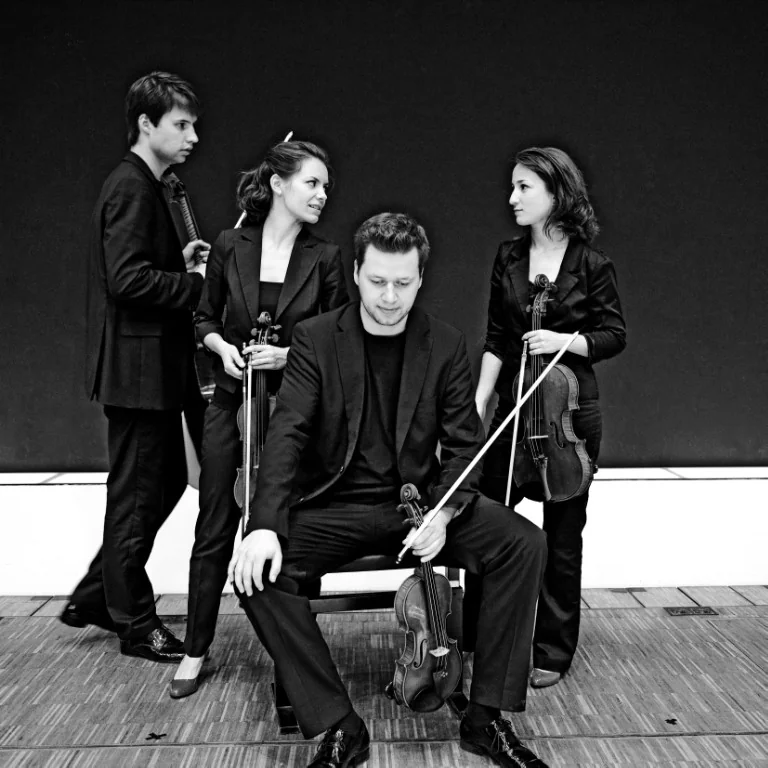
Image from Wikipedia
Image from Wikipedia
Armida Quartet – Precision, Poetry, and Pioneering Spirit in the String Quartet
A String Quartet That Sparks Excitement: The Armida Quartet Enthralls with Sound Imagination, Stylistic Sharpness, and Artistic Development
The Armida Quartet is one of the defining voices of the younger German chamber music scene. Since its founding in 2006 in Berlin, Martin Funda (violin), Johanna Staemmler (violin), Teresa Schwamm-Biskamp (viola), and Peter-Philipp Staemmler (cello) have performed in an unchanging line-up – a consistency that is reflected in their perfectly balanced ensemble sound, uncompromising musicianship, and impressive stage presence. The name refers to Joseph Haydn's opera Armida – a commitment to the tradition of the string quartet and the curious renewal that the ensemble embodies in every concert and production. The quartet's music career combines top competition successes with international presence, a critically acclaimed discography, and a stylistically aware, modern program dramaturgy that captivates both audiences and critics alike.
Early studies with members of the Artemis Quartet, along with influences from Rainer Schmidt (Hagen Quartet), Alfred Brendel, Reinhard Goebel, and Tabea Zimmermann shaped their artistic development. Their international breakthrough came in 2012 with a spectacular victory at the International ARD Music Competition (First Prize, Audience Prize, and six Special Prizes), complemented by successes such as the win in Geneva in 2011 and appointments as BBC New Generation Artists (2014–2016) and ECHO Rising Stars (2016/17). Regular invitations to prestigious venues – from the Berlin Philharmonie to the Concertgebouw in Amsterdam and London's Wigmore Hall – testify to the ensemble's authority in the current chamber music discourse. These milestones not only mark career highlights but also demonstrate the sustainable artistic maturity and continuous refinement of their sound culture, phrasal intelligence, and interpretative energy.
Biography: From Berlin to the International Centers of Chamber Music
The Armida Quartet was formed from Berlin musicians who shared a clear vision: an ensemble sound that merges transparency, precision, and emotional pull. Masterclasses with the Alban Berg, Guarneri, and Arditti Quartets, as well as intensive work with the Artemis Quartet, laid the technical and aesthetic groundwork. The award phase in 2011/2012 placed the quartet on the international map; since then, it has maintained an active concert schedule at renowned festivals such as the Rheingau Music Festival, Schwetzingen SWR Festival, Beethovenfest Bonn, Heidelberger Frühling, Davos Festival, and Festspiele Mecklenburg-Vorpommern. Their ongoing artistic development is also reflected in educational activities – teaching positions, masterclasses, and mentorship work – as well as in their active engagement with editing and research topics surrounding the string quartet genre. Sources: official biography, management, and festival information. (armidaquartett.com)
Artistic Profile: Stylistic Clarity, Chamber Music Breath, Dramatic Insight
Characteristic of the Armida Quartet's interpretations are a lean yet colorful ensemble tone, meticulous timing, articulate precision, and an intelligent balance between textual fidelity and personal expression. In classical repertoire – especially with Haydn and Mozart – the ensemble cultivates a high degree of score transparency, while in the Late Romantic and Contemporary works, it develops dramatic arcs of tension and finely chiseled soundscapes. This artistic identity is evident in curations such as the series “Mozart Exploded” and in collaborations with edition partners, merging a reflective, source-critical performance practice with contemporary dramaturgy. Reviews from renowned media attest to the Armida's groundbreaking interpretations of Mozart and their exceptional expressiveness – assessments that align with the live experience when the quartet translates their stage presence into an organically breathing dialogue of sound speech, dynamics, and agogic sensitivity. (armidaquartett.com)
Career Highlights Since 2012: Awards, Residencies, and Collaborations
With the ARD victory in 2012, an international success curve began: BBC New Generation Artists, ECHO Rising Stars, debuts in top venues, and invitations to leading European festivals. For the 2025/26 season, the quartet announces a concert series with Sabine Meyer and a three-year Italy-Schubert cycle; furthermore, it will serve as the recipient in residence at the Festspiele Mecklenburg-Vorpommern in 2026 – a format that consolidates artistic versatility and repertoire depth across more than 20 events. These projects deepen the ensemble's profile as a program-defining, collaboratively minded chamber music formation with a clear curatorial signature. (armidaquartett.com)
Current Projects 2024–2026: Complete Recording of Mozart, Festival Residency, Schubert Cycle
After years of work, the Armida Quartet has released a complete recording of Mozart's string quartets – a thoughtfully edited major project in collaboration with G. Henle Verlag. The final CD box was released by CAvi Music and encapsulates an interpretive journey hailed by experts as groundbreaking for Mozart reception in the 21st century; Volume 4 received an Opus Klassik award. Simultaneously, the quartet is preparing for an extensive residency in 2026 at the Festspiele Mecklenburg-Vorpommern and will embark on a multi-year tour in Italy during the 2025/26 season, focusing on Schubert’s quartet oeuvre. These endeavors showcase the ensemble as a forward-thinking musical entity, integrating production, editing, concert dramaturgy, and educational outreach in a coherent manner. (armidaquartett.com)
Discography: From Modern Core Repertoire to Edited Mozart References
The discography documents the breadth of the quartet's playing: the debut (2013, CAvi) combines Bartók, Ligeti, and Kurtág – a statement on modernity and the structural clarity of the ensemble's sound. This is followed by Beethoven–Shostakovich (2016), the stylistically focused album Fuga Magna (2017) with Baroque and Classical fugue references, and the large-scale Mozart series (Volumes II–V and the final box), whose editorial ambition and interpretive coherence have drawn superlative reviews from critics. In 2023, the quartet expanded its late-Romantic facet with two recordings: Reger/Senfter – the world premiere recording of the Senfter Clarinet Quintet – with Kilian Herold, as well as piano quintets by César Franck and Frank Martin with Martin Klett. These productions underscore their expertise in composition, arrangement, and production – from structurally focused sound balance to chamber music breath in quintet line-ups. (armidaquartett.com)
Even in contemporary contexts, the ensemble remains curious and present – contributions to works by Samy Moussa, Birke J. Bertelsmeier, Milica Djordjević, and Ursula Mamlok demonstrate their engagement with today's composition. Thus, the Armida Quartet encompasses the entire spectrum of quartet literature: from historically informed approaches to advanced contemporary works – a defining arc that transforms the discography into a panorama of chamber music possibilities. (armidaquartett.com)
Style and Playing Culture: Sound Architecture, Articulation, Phrasal Intelligence
At the heart of the Armida sound lies an architecture of sound based on crystal-clear intonation, discernible voice leading, and finely tuned internal relationships. The violins outline lines with a slender vibrato and nuanced articulation, the viola anchors the middle sound, and the cello structures the foundation with tightly controlled bows and subtle color differentiation. This leads to interpretations that organically connect dynamic terraces, floating pianissimi, and dramatically emphasized climaxes. This blend of textual fidelity and narrative impulse explains why goals of historically informed practice – articulatory clarity, agogic flexibility, soundcolor transparency – manifest themselves in an audible way, without appearing dogmatic. Press reviews speak of “standards” and “great diversity,” confirming both the stylistic competence and the reliable quality of live performances as well as studio work. (armidaquartett.com)
Collaborations and Networks: From Soloist Partnerships to Editorship
Artistic partners include pianists such as Alexander Melnikov, Martin Helmchen, and Martin Klett, singers like Benjamin Appl, as well as instrumentalists such as Kit Armstrong, Maximilian Hornung, Nils Mönkemeyer, and Kilian Herold. These collaborations expand the quartet's sonic palette and dramatic possibilities – from classical quintet archetypes to cross-genre projects. Particularly noteworthy is the collaboration with G. Henle Verlag, as part of which the ensemble contributed to a new edition of the Mozart quartets: a contribution that combines editorial expertise, performance practice, and artistic responsibility. This interplay of partnerships, editorial work, and concert dramaturgy underscores the authority of the ensemble far beyond the pure concert stage. (armidaquartett.com)
Awards, Reception, and Cultural Influence
The ARD triumph in 2012 served as a catalyst for an international career; prior to this, the quartet had already received first and audience prizes in Geneva in 2011. Subsequently, the Armida Quartet established itself as ambassadors of a modern yet score-faithful quartet aesthetic. Critical accolades – from NDR Kultur, Klassik Heute, and Fono Forum – position the complete recording of Mozart as a contemporary reference. Additionally, the musicians act as ambassadors for sustainability: as the first chamber music ensemble, the Armida Quartet was appointed as an ambassador for the Association Orchestra of Change. Thus, the ensemble combines musical excellence with social responsibility – a vital element of its trustworthiness. (armidaquartett.com)
Education, Teaching, and Outreach
The Armida Quartet is committed to masterclasses and teaches at prestigious universities. This teaching activity reflects practical experience from rehearsal and concert life, studio work, and editorial practice. Students benefit from concrete insights into sound balance, voice leading, bow technique, phrasal logic, and ensemble communication – all factors that shape the artistic development of young quartets. The ensemble demonstrates how expertise in composition, arrangement, and interpretation can be conveyed didactically without losing the artistic spark. (armidaquartett.com)
Voices of the Fans
The reactions from fans clearly show: The Armida Quartet excites people worldwide. A YouTube comment puts it succinctly: “One of the most inspired cycles of Mozart of our time – so transparent yet so full of tension.” Another writes: “The fine articulation and the collective breathing are pure goosebumps.” Such feedback reflects what reviews attest: an ensemble that transforms technical excellence into emotional directness. (youtube.com)
Conclusion: Why the Armida Quartet Fascinates
The Armida Quartet combines stylistic discipline with vivid expression, editorial precision with dramatic courage, and social responsibility with pedagogical passion. Its discography documents interpretive depth, while live it electrifies with chamber music breath, sound precision, and striking energy. Anyone wanting to experience how contemporary sound and tradition merge in the string quartet today should witness the Armida Quartet in concert – ideally where the ensemble curates programs, unfolds cycles, and brings its artistic signature fully to life.
Official Channels of the Armida Quartet:
- Instagram: No official profile found
- Facebook: No official profile found
- YouTube: https://www.youtube.com/channel/UCG2p5Afb67nHwaFctc667ag
- Spotify: No official profile found
- TikTok: No official profile found
Sources:
- Armida Quartet – Official Website
- Armida Quartet – About the Quartet (Biography, Season 2025/26, Awards)
- Armida Quartet – Discography (CAvi, Reger/Senfter, Fuga Magna, Beethoven–Shostakovich, Mozart)
- Armida Quartet – Complete Mozart Recording (Collaboration with G. Henle Verlag, Press Reviews)
- Karsten Witt Music Management – Armida Quartet (Management, Projects, Resonance)
- Festspiele Mecklenburg-Vorpommern – Prizewinner in Residence 2026
- ARD International Music Competition – Armida Quartet
- Kronberg Academy – Armida Quartet (Profile)
- Apple Music Classical – Armida Quartet (Biographical Context)
- Wikipedia (DE) – Armida Quartet
- Wikipedia (EN) – Armida Quartet
- YouTube – Official Channel Armida Quartet
- CRESCENDO – “Quartet goes App” (Background on Editing and Rehearsal Practice)
Upcoming Events
Beach Concert: Tett (the Vagabond)
Opening Concert of the Festival Summer 2026 with the Armida Quartet
The Armida Quartet – Opening Concert of the Festival Summer 2026
Mecklenburg-Vorpommern Festival: Beethoven and Schumann
Beethoven and Schumann Finale – Armida Quartet & Friends