
Avalon (Mythologie)
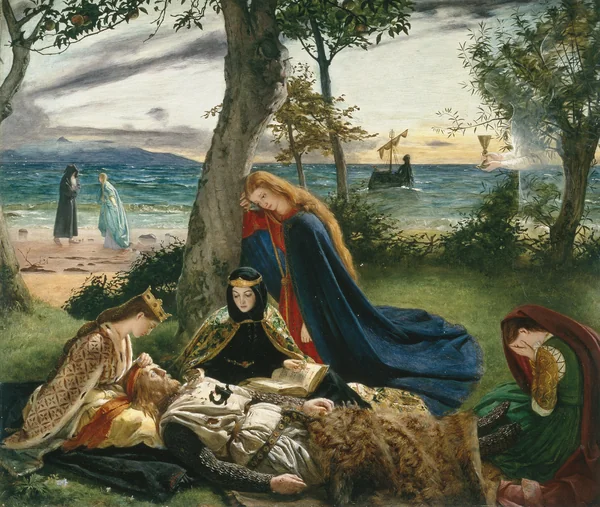
Image from Wikipedia
Image from Wikipedia
Avalon – The Mythical Apple Island of the Arthurian Legend
A Journey into the Heart of Celtic Legend
Avalon has fascinated for centuries as that shimmering island of mist and apple orchards, where the wounded King Arthur was taken for healing. The name etymologically refers to the apple and opens up a symbolic landscape filled with abundance, regeneration, and immortality. Between Celtic otherworld, medieval poetry, and modern pop culture, Avalon stands as a cultural symbol of hope, return, and the promise of a golden age. This introduction connects tradition, linguistic history, and reception to make the significance of this place in the European mythological tradition visible.
As the setting for great narratives, Avalon consolidates motifs such as the wounding of the king, the healing island, and the threshold to the otherworld. The place is less about geography than poetics: a stage for transitions, initiation, and renewal. In the Arthurian legend, Avalon unites power, magic, and healing; at the same time, in later centuries, the island is placed in dialogue with concrete landscapes – particularly around Glastonbury in Somerset. This creates a complex web of legend, topography, and culture of memory.
Origins and Etymology: The Apple Island as a Symbol of Abundance
The common derivation of the name Avalon from an Indo-European root for "apple" frames the island as a sanctuary of abundance: apple trees, fruits, everlasting harvest. In Celtic traditions, apples function as a cipher for healing and otherworldly grace. This interpretation gives Avalon a clear iconographic line: where apple orchards thrive, there lies a place of recovery, transcending time yet deeply rooted in the imagination of Europe. Linguistic parallels in Brittonic and Irish names underscore the semantic core "apple/fruit."
This symbolism continues to resonate in medieval literature: as the "Isle of Apple Trees," Avalon becomes a topos of paradisiacal abundance. The apple does not merely represent food but serves as a poetic condensation of life energy, regeneration, and magical medicine. Thus, Avalon serves as a mythological resonance space, where healing and sovereignty are sacredly intertwined.
Geoffrey of Monmouth and the Literary Canonization
The significant shaping of the Avalon myth occurs in the Latin texts of the 12th century. In scholarly poetry and historical narrative, the island acquires clear poetic contours: a place to which the mortally wounded king is taken to recover under the care of powerful women. This literary positioning functions like a compositional principle: Avalon becomes the dramatic link between kingship, wounding, and hope for return.
Especially influential is the depiction of the "Lady" of the island – a sorceress, skilled in healing and mutable – who becomes inextricably linked with Avalon. Through this figure, later identified with Morgan le Fay, the place receives a clear, femininely coded authority. In the intricate weaving of historical myth and poetic vision, an island landscape emerges that is navigable not so much cartographically but primarily mythically.
Magic, Healing, and the Threshold to the Otherworld
The narrative motifs surrounding Avalon – healing power, eternal youth, mist and transition – position the island between this world and the next. In the composition of the legends, it functions as a liminal space where worldly time is suspended, and sacred renewal occurs. This dramatic architecture provides the Arthurian story with its specific resonance: The king does not disappear; he lingers. The option of return cements Avalon's role as a reservoir of collective hope.
At the level of character development, the female sphere is crucial: knowing women, priestesses, or fairies master healing arts, transform, and guard knowledge. The artistic development of the Arthur material works with this contrast – warring outside world here, healing island there – thus creating narrative tension between loss of power and restoration.
Glastonbury as a Landscape of Memory: Topography Meets Myth
Starting in the High Middle Ages, a topographical localization begins: landscapes in Somerset, the hill of Glastonbury Tor, and the ruins of the abbey are related to Avalon. Whether this equation is historically tenable retreats behind its cultural-historical function: by connecting to real places, a pilgrimage and memory space arises where legend, archaeology, and local narratives overlap. The landmarks form stage settings that make the material experientially accessible.
Reports of findings, inscriptions, and grave displays served not only devotion in later centuries but also economy and reputation politics. The idea of the "second burial" of the king or crosses with interpretive inscriptions illustrates how literature charges the landscape – and how the landscape is meant to validate the literature. Thus, Glastonbury becomes a kind of "memory archive" that conserves the aura of Avalon.
The Holy Grail, Excalibur, and the Dramatic Unity of the Material
Whether it's the quest for the Grail, Excalibur, or the final battle: Avalon intertwines central motifs of the Arthurian legend in a dense web of meaning. As a place of liminality, the Grail gains its narrative depth – healing, trial, reinstatement. The sword stands as a symbol of rightful rule and spiritual authorization. This dramatic unity allows for variations of the narrative threads across generations without abandoning the core – the healing island.
In musical and literary adaptations, this unity is repeatedly orchestrated anew: choral lament for the fallen king, instrumental soundscapes for mist and water, vocalises as an acoustic counterpart to the suspension between worlds. Even if Avalon is not a "real" place, it remains a precisely composed stage, whose arrangements – healing, suspension, return – intricately interweave.
Reception in Literature, Music, and Pop Culture
From medieval chronicles to Elizabethan poetry to modern novels, the range of Avalon images is vast: mysterious, female-connoted, nature-magical. In the Romantic period and contemporary fantasy, the island is updated as a mythical power place. Popular receptions illustrate how strongly the imagery – mist, apple grove, water, distant song – shapes cultural imagination.
Music and theater projects also draw upon the semantic sound: harp and choral arrangements evoke flowing time, drone textures call forth the hum of the otherworld. Film scores and stage compositions utilize floating harmonies, pentatonic figures, and modal scales to enhance the mythical quality. Thus, an aesthetic continuum forms that inscribes the island into the collective sound memory.
Cultural Significance: Memory, Hope, Identity
Avalon is less a map than an architecture of memory. It consolidates collective desires for healing, just rule, and the return of a "true" king. As the "apple island," it represents abundance; as the "healing island," it symbolizes safety; as the "island of mist," it embodies the mystery of the threshold. In political readings, Avalon can be understood as a figure of longing for a just order – beyond violence, close to the ideal.
The cultural impact relies on the balance between vagueness and signature: enough contour to carry narratives; enough mist to allow for projections. Thus, Avalon remains accessible for generations of readers, listeners, and travelers, who carve their own paths between text, music, and landscape.
Toponyms, Variants, and the Diversity of Tradition
The tradition knows various names and nuances for the place, confirming the motif field "fruit/apple." Variants arise from translation, dialect, poetic practice, and scholarly tradition. They mark not a contradiction but the vibrancy of a narrative world that circulates across multiple linguistic regions. This polyphony strengthens Avalon's authority as a core motif of Arthurian literature.
The question of geographical identification – whether Glastonbury, Brittany, or a symbolic distant island – is also part of the legend's creative apparatus. What matters is not arriving at an exact coordinate but the poetic insight: Avalon is the staging of hope at a place that eludes measurement and precisely because of this becomes effective.
Methodological Classification: Text, Topos, Tourism
Research differentiates between literary poetry, later chronicles, archaeological findings, and modern memory economics. Legends surrounding findings, graves, or crosses must always be read in the context of their time of origin. This critically source-conscious perspective enhances the reliability of the interpretation: Avalon remains a literary artifact with enormous impact, not a verifiable historical place.
At the same time, the history of reception demonstrates how powerful myths reshape landscapes. Travel reports, festivals, museums, and local narratives make the material navigable – a "stage presence" of the legend in the public space. Thus, philology meets cultural practice: texts create places; places mirror texts.
Conclusion: Why Avalon Resonates to This Day
Avalon unites healing power, beauty, and mystery in a single, strong metaphor. The island shines as a dramatic focal point of the Arthurian legend and as a projection surface for the longing for renewal. Those who engage with Avalon experience an artistic development over centuries: from the medieval chronicle through Romantic poetry to the sound language of modern stages. The myth invites following traces in texts and landscapes – and using one's imagination as a compass. Those wishing to experience the legend “live” will find atmospheric backdrops in the memory landscapes around Glastonbury, where the apple island retains its voice.
Official Channels of Avalon (Mythology):
- Instagram: No official profile found
- Facebook: No official profile found
- YouTube: No official profile found
- Spotify: No official profile found
- TikTok: No official profile found
Sources:
- Wikipedia (de) – Avalon (Mythology)
- National Geographic Germany – In the Footsteps of King Arthur
- Encyclopaedia Britannica – Vita Merlini
- University of Reading – Glastonbury Abbey Archaeology: Arthurian Myth
- University of Cambridge (ASNC) – Geoffrey and the "Insula Pomorum"
- Wikipedia: Image and text source