
Die Enttäuschung
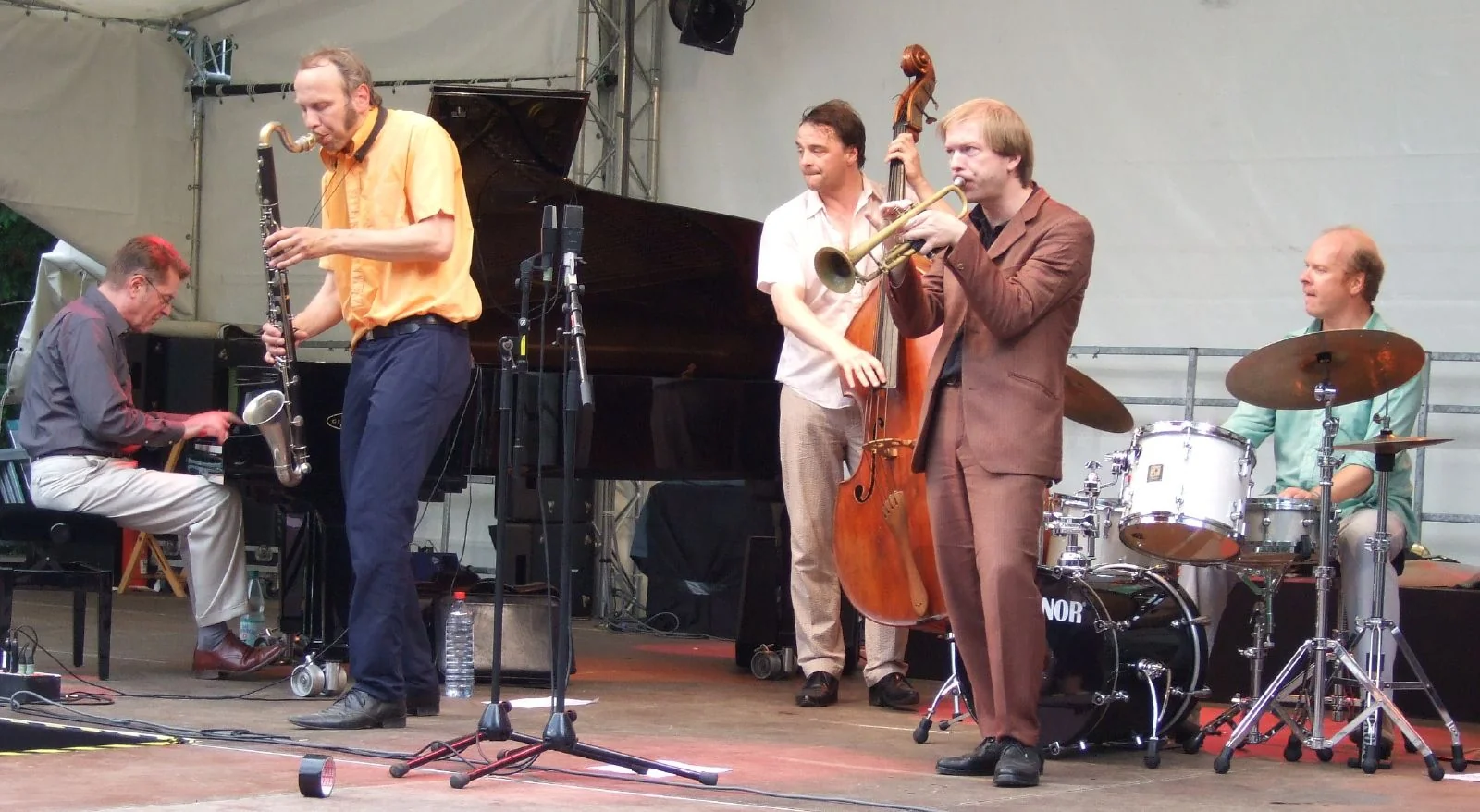
Image from Wikipedia
Image from Wikipedia
The Disappointment – Berlin's Jazz Intelligence Between Monk, Free Bop, and Musical Freedom
A Berlin Jazz Group with Cult Status, Wit, and Artistic Consistency
The Disappointment is a Berlin jazz group that has been working since the late 1990s based on a clear idea: to not treat jazz in a museum-like manner, but to unfold it as a lively, risky, and highly musical practice. The ensemble was initially founded as a quartet and briefly expanded to a quintet in 2017 before returning to its quartet form in 2021. The international reputation of the band is derived from a mix of compositional accuracy, improvisational freedom, and a distinctive stage presence that can even excite sober critics. (de.wikipedia.org)
The Origin: From a Monk Idea to a Distinct Berlin Voice
The roots of The Disappointment lie in the 1990s when Rudi Mahall, Joachim Dette, Uli Jenneßen, and Axel Dörner formed the quartet. The debut album from 1996 consisted entirely of compositions by Thelonious Monk and already marked the aesthetic tension that defines the band to this day: respect for the original material, but without a pedantic obsession with originality. Instead, the ensemble transformed Monk's material into a Berlin style that merges swing, breaks, open forms, and ironic distance. (de.wikipedia.org)
Particularly formative was the collaboration with Alexander von Schlippenbach, with whom The Disappointment performed Monk's complete works in the monumental edition Monk’s Casino and released it in 2005 as a 3-CD edition. This production is considered an artistic coup because it did not conservatively preserve the canon but treated it as playable, contemporary music. The band early on demonstrated that historical material and spontaneous improvisation do not exclude each other but can electrify one another. (de.wikipedia.org)
The Line-up: An Ensemble of Strong-Willed Improvisers
The core of the band comprises Rudi Mahall on bass clarinet and clarinet, Axel Dörner on trumpet, Jan Roder on bass, and since 2017, Michael Griener on drums; in between, Christof Thewes supplemented the formation on trombone, turning The Disappointment into a quintet. Since 2021, the group has been operating again as a quartet. Even the instrumentation is programmatic: without a harmonic instrument, but with maximum acoustic openness, a format emerges that relies on interaction, timbral friction, and linear tension. (de.wikipedia.org)
The official website describes the formation as unobtrusive yet highly concentrated, as a Berlin band that shapes its own aesthetics from Free Bop, open sound, melodic improvisation, and a clear sense of swing. This is precisely what makes The Disappointment special: the music never feels academic, even though it is complex, and never arbitrary, although it breathes freely. This tension between structure and instinct gives the band its extraordinary artistic credibility. (dieenttaeuschung.org)
Career Development and Artistic Evolution
Over nearly three decades, The Disappointment has remained remarkably creatively consistent. According to band and label information, the group has navigated through various combinations of bass clarinet, trumpet, double bass, drums, and occasionally trombone without losing its identity. That the band was able not just to survive during this time but also to musically grow is due to its ability to not only quote jazz history but to translate it into a living process. (dieenttaeuschung.org)
A significant turning point was the opening up toward original compositions. After the early Monk references, several albums were created with pieces by band members, including releases that further sharpened the interplay in the quartet. The Disappointment 5 and later works showcase a formation that increasingly refined its vocabulary: less mere homage to tradition, more assertive shaping of its own sound. (de.wikipedia.org)
The Comeback 2023/2024: New Releases, New Attention
With Music Minus One and Die Komplette Enttäuschung, both released in 2023, The Disappointment returned with renewed strength. The official website lists these releases as current works; Music Minus One was released in July 2023, and Die Komplette Enttäuschung in September 2023 as an art catalog plus CD featuring works by Katja Mahall and design by Karl Mahall. Magnet Magazine highlighted in 2024 that the band remains creatively active for nearly three decades, connecting complex bebop structures with freely improvised sound gestures. (dieenttaeuschung.org)
Also evident in the band's news is that The Disappointment does not function as an archival project in 2024 and beyond but as an active concert and recording entity. Reviews in Jazzword, Magnet Magazine, and FreeJazzBlog are referenced, as well as performances at the Berlin jazz club Badenscher Hof. The group therefore lives not only off its history but also from continuous presence. (dieenttaeuschung.org)
Discography: From the Monk Canon to Its Own Language
The discography of The Disappointment documents an unusually coherent development. Key releases include Die Enttäuschung (1995), Die Enttäuschung 1, Die Enttäuschung 2, Die Enttäuschung 3, the major project Monk’s Casino, Die Enttäuschung 4, Die Enttäuschung 5, Vier Halbe, Lavaman, Monk’s Casino Live at AuTopsi Pohl, Music Minus One, and Die Komplette Enttäuschung. The titles themselves reveal the mix of understatement, humor, and precision that characterizes this band. (de.wikipedia.org)
Especially Lavaman from 2017 marked a distinct moment in the discography, as Christof Thewes complemented the formation as a quintet. The album was released by Intakt Records and described by the label as an expression of a process in which the band absorbs jazz history and transforms it into "musical lava." This term remarkably captures the ensemble's working method: tradition is not reproduced but melted, condensed, and recast. (dieenttaeuschung.org)
Monk’s Casino remains the major reference point of the discography. Intakt Records describes the project as the first complete overview of Monk for live performance within an evening, arranged without museal petrification, but with subversive spark. That this endeavor has been perceived internationally as a milestone is due to the combination of historical depth, formal discipline, and the desire to rewrite the canon in real time. (dieenttaeuschung.org)
Style, Sound Image, and Musical Language
Stylistically, The Disappointment navigates between Free Bop, Free Jazz, and freely organized improvisation. The official website mentions open sound spaces, melodic improvisation, and a clear pleasure in swing – and simultaneously in its interruption. This dual movement is what makes the band so appealing: the groove is never an end in itself, but a starting point for breaks, echo effects, condensations, and surprising harmonic reactions. (dieenttaeuschung.org)
Magnet Magazine described the music in 2024 as a complex interplay of bebop twists, extended playing techniques, rhythmic shifts, and sometimes sharply contoured sonorities of freely improvised music. Intakt Records added that the ensemble possesses exceptional timing between bebop, early free jazz, and free improvisation. This results in a language that is historically rooted yet radically contemporary. (magnetmagazine.com)
The instrumental roles are also precisely balanced. Mahall's bass clarinet provides darkness, humor, and eruptive lines; Dörner's trumpet works with colors, breaks, and concentrated energy; Roder's bass keeps the center open; and the drums – whether with Jenneßen, Griener, or during the quintet phase with Thewes as an additional color in the arrangement – create an elastic structure instead of mere accompaniment. This aesthetic produces a jazz language that is intellectually challenging yet physically immediate. (dieenttaeuschung.org)
Critical Reception and Cultural Influence
The critical reception has been strikingly strong. DownBeat quoted John Corbett with the assessment that The Disappointment is "the best jazz combo of today," praising the combination of playfulness, musical ambition, and lack of rigidity. Magnet Magazine emphasized the long-term creativity of the ensemble, while Jazzword referred to the group as one of the most consistently stimulating formations in the international creative music scene. Such reactions underline the band's standing far beyond the Berlin context. (dieenttaeuschung.org)
The cultural impact is also remarkable. The Disappointment has shaped not only a repertoire but also a habitus: humor, self-irony, respect for tradition, and a willingness to productively disrupt musical rules. The band exemplifies a German jazz attitude that does not play intellectual sharpness, collective improvisation, and historical knowledge against each other. This combination makes them persistently relevant for fans of sophisticated modern jazz. (dieenttaeuschung.org)
Conclusion: Why The Disappointment Remains So Exciting
The Disappointment is a band for listeners who love jazz as an open art form: full of history, full of wit, full of risk. Its appeal lies in the rare balance of formal clarity and improvisational freedom, respect for Monk, and the courage to question every template anew. Those who experience the group live hear not a nostalgic reenactment, but a concentrated, present, and highly virtuosic musical discussion. (dieenttaeuschung.org)
For this reason, it is worthwhile to experience The Disappointment on stage: there, the full power of interaction, sound intelligence, and Berlin jazz energy unfolds. This music thrives on immediate presence, timing, glances, breath, and risky turns. Anyone seeking creative improvisation at the highest level should definitely see this band live. (dieenttaeuschung.org)
Official Channels of The Disappointment:
- Instagram: No official profile found
- Facebook: No official profile found
- YouTube: No official profile found
- Spotify: No official profile found
- TikTok: No official profile found