
Hagen Rether
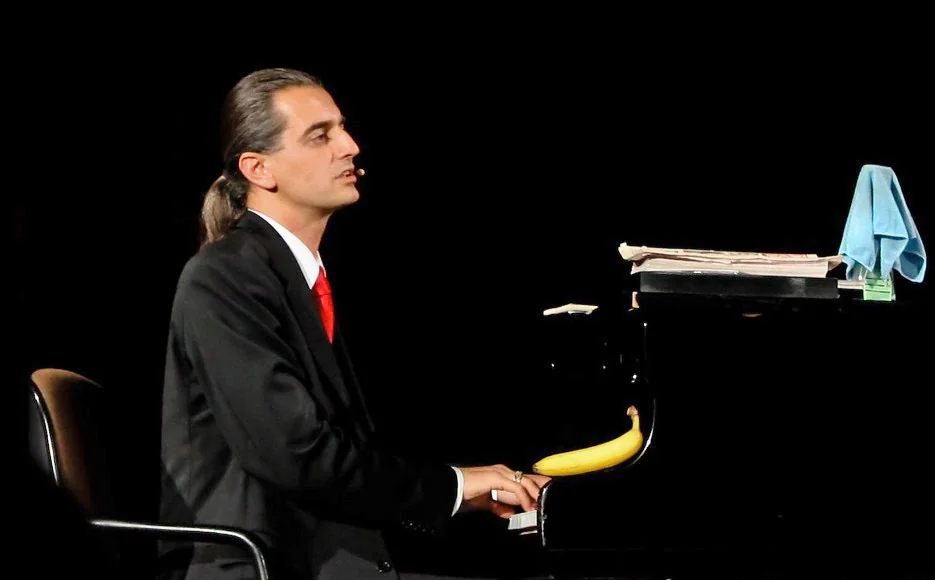
Image from Wikipedia
Image from Wikipedia
Hagen Rether – the uncompromising cabaret artist at the piano
An artist who transforms cabaret with attitude, language, and musicality
Hagen Rether is one of the most distinctive voices in German political cabaret. Born on October 8, 1969, in Bucharest and raised after his parents' resettlement in Freiburg im Breisgau, he developed a close connection to the piano and the stage early on. His artistic journey took him from classical musical training at the Folkwang University of the Arts in Essen to a style that uniquely combines music, analysis, and societal sharpness. ([munzinger.de](https://www.munzinger.de/register/portrait/biographien/rether%20hagen/00/27875))
Rether represents a cabaret that does not rely on quick punchlines, but rather on intellectual depth, rhythmic dramaturgy, and the power of endurance. His program “Liebe” has been the artistic centerpiece for years and at the same time a versatile body of work that continually adapts to current developments. Through this, he has earned a solid position in the German-speaking cabaret and cultural scene. ([munzinger.de](https://www.munzinger.de/register/portrait/biographien/rether%20hagen/00/27875))
Biographical roots: Bucharest, Freiburg, Essen
Hagen Rether was born in Bucharest to German, Transylvanian Saxon parents and spent his early childhood years in Romania before the family relocated to Germany. This biographical shift between origin and arrival shapes his artistic self-understanding to this day: observation, distance, and the ability to make cultural fractures productive are at the beginning of his career. The combination of migration experience and musical socialization early on provided him with a perspective that becomes evident time and again in his later programs. ([munzinger.de](https://www.munzinger.de/register/portrait/biographien/rether%20hagen/00/27875))
At the age of eight, he began playing the piano, later studying music at the Folkwang University of the Arts in Essen, while also completing training as a naturopath. This educational path reveals that Rether does not come from a classical comedy background, but rather works from a serious musical and intellectual practice. This connection of expertise, discipline, and stage instinct is what makes his performances so distinctive. ([munzinger.de](https://www.munzinger.de/register/portrait/biographien/rether%20hagen/00/27875))
The path to the stage: From musical accompaniment to solo cabaret
His stage career did not begin in the traditional sense as a soloist but initially as a pianist alongside the Essen cabaret artist Ludger Stratmann. From 1996 onwards, Rether toured with Stratmann from stage to stage for many years, gaining experience in timing, musical emphasis, and direct audience engagement. This phase had a lasting impact on his later solo work as it taught him how closely music and language can intertwine on a cabaret stage. ([munzinger.de](https://www.munzinger.de/register/portrait/biographien/rether%20hagen/00/27875))
What initially started as a piano evening with improvisations gradually evolved into an evening of commentary with piano accompaniment. This shift defines the essence of Rether's art: music is not just an accessory but part of an argumentative dramaturgy. The piano becomes a resonance space for thoughts, friction, and societal sharpening. ([munzinger.de](https://www.munzinger.de/register/portrait/biographien/rether%20hagen/00/27875))
His breakthrough in the cabaret scene occurred gradually through being recognized as a hidden gem before reaching a larger audience. To this day, the presence of the concert grand piano acts as the visual and dramaturgical centerpiece of his performances. His performance blends focused storytelling, musical interjections, and a stage presence that aims for insight rather than mere entertainment. ([munzinger.de](https://www.munzinger.de/register/portrait/biographien/rether%20hagen/00/27875))
“Liebe” as a life’s work: The enduring program with change at its core
The program “Liebe” is Rether's artistic signature and at the same time an open work. It is continuously updated and performed in ever-new versions, reflecting the present while retaining its dramaturgical core. This long-term format is exceptional in German cabaret and positions Rether as an artist who not only reacts but formulates an ongoing societal commentary over years. ([munzinger.de](https://www.munzinger.de/register/portrait/biographien/rether%20hagen/00/27875))
The official website documents several editions of “Liebe” as CDs and downloads: from “Liebe 1” from 2004 through subsequent releases to “Liebe 7” from 2018, as well as a box set containing parts 1 to 5. This publication list shows that Rether does not see his stage work as a one-time event but as a series of evolved projects. His discography is closely linked to the ongoing development of the program. ([hagenrether.de](https://www.hagenrether.de/hagen-rether-liebe-kabarett-mit-klavier-alle-cds-und-downloads/))
Musical language: Piano, improvisation, and political commentary
Rether's style thrives on a distinctive combination of piano playing, improvisation, and pointed speech. The concert grand is not merely a prop for him but a structuring instrument: it organizes thoughts, sharpens transitions, and sets emotional counterpoints to the content analyses. This musical discipline specifically distinguishes him from a pure word cabaret artist. ([konzerthaus-dortmund.de](https://www.konzerthaus-dortmund.de/en/programm/01-03-2024-hagen-rether))
The themes of his programs extend far beyond topical political commentary. Available sources mention, among other topics, religion, media, consumerism, globalization, the Catholic Church, political entanglements, factory farming, and Islamophobia. Rether works with connections between the present and the past, thus creating a form of musically supported discourse cabaret that is both analytical and emotional. ([de.wikipedia.org](https://de.wikipedia.org/wiki/Hagen_Rether?utm_source=openai))
His performance at large venues, such as the Konzerthaus Dortmund, is particularly striking: for up to three and a half hours, he advocates for enlightenment and empathy, against hypocrisy and mindless consumership. This formulation captures the tone of his art: Rether does not seek comfortable approval, but rather sustainable unrest and intellectual movement. ([konzerthaus-dortmund.de](https://www.konzerthaus-dortmund.de/en/programm/01-03-2024-hagen-rether))
Critical reception: A cabaret artist with weight
The press reviews of Hagen Rether portray an artist with extraordinary analytical sharpness. The official press page cites praise from sources including ZEIT, Süddeutsche Zeitung, Frankfurter Rundschau, FAZ, and others, highlighting his long form, linguistic precision, and attitude. Critics often perceive him less as a mere entertainer and more as an educator and a consistent observer. ([hagenrether.de](https://www.hagenrether.de/hagen-rether-kabarett-mit-klavier-pressestimmen/))
His stage presence is particularly strong: he appears calm, focused, sometimes ascetic, and it is precisely this that gives his art an immense pull. Cited press reviews emphasize that he develops themes over a long period without relying on quick gags, and that his evenings are experienced more as “world theater” than as conventional cabaret. This reception underscores his status as a serious cultural commentator. ([hagenrether.de](https://www.hagenrether.de/hagen-rether-kabarett-mit-klavier-pressestimmen/))
Awards and recognition
The awards also reflect his position within German-speaking cabaret. The Oltner Cabaret Days recognized him as the award winner of 2010, and the Wikipedia entry lists additional accolades such as the German Cabaret Prize as well as various awards from the early 2000s. This shows that Rether is acknowledged not only by the audience but also as a shaping figure in the professional cabaret scene. ([kabarett.ch](https://www.kabarett.ch/preistraeger/hagen-rether/))
Over the years, his career has gained additional symbolic weight: sources even mention an asteroid named after him, indicating his cultural visibility beyond the world of theater. Such details show how far his name now resonates within the German cultural space. Rether is no longer merely a touring cabaret artist; he has become a solid reference in political music and speech cabaret. ([de.wikipedia.org](https://de.wikipedia.org/wiki/Hagen_Rether?utm_source=openai))
Current projects and presence on stage
His official website continues to list dates for “Liebe” for 2026, along with a preview for 2027. Current event pages also document performances in prestigious venues like Dortmund or Hamburg, demonstrating that the program remains lively and in demand. There can be no talk of a conclusion or stagnation regarding Hagen Rether; his work thrives on continuous updating. ([hagenrether.de](https://www.hagenrether.de/))
The official website also provides a contact address through Astrid Hennig Promotion, which evidences the professional organizational embedding of his artistic operation. This keeps Rether present as a live artist, structured, and clearly positioned. His work remains at the center of the stage, rather than in the background of digital self-staging. ([hagenrether.de](https://www.hagenrether.de/hagen-rether-kabarett-mit-klavier-kontakt/?utm_source=openai))
Cultural influence: Cabaret as a moral and musical form
Hagen Rether has profoundly expanded the understanding of political cabaret in Germany. His art combines musical competence with societal analysis, thus eluding the logic of mere gags. Particularly important is his ability to not only entertain the audience but to provoke thought, questioning, and positioning. ([konzerthaus-dortmund.de](https://www.konzerthaus-dortmund.de/en/programm/01-03-2024-hagen-rether))
His influence is also reflected in the fact that he is frequently described in receptions as someone who embodies attitude. This attitude is not a mere statement but a form of artistic practice: carefully built, linguistically precise, musically controlled, and thematically uncomfortable. This is precisely why Rether holds a special status within the German-speaking cultural landscape, straddling cabaret, concert, and political speech. ([hagenrether.de](https://www.hagenrether.de/hagen-rether-kabarett-mit-klavier-pressestimmen/))
Those who experience Hagen Rether live encounter an artist who connects music and social criticism in a seldomly consistent manner. His evenings are long, dense, and intellectually demanding, but therein lies their strength. Those willing to engage with this blend of piano artistry, verbal wit, and intellectual precision experience cabaret at the highest level. ([konzerthaus-dortmund.de](https://www.konzerthaus-dortmund.de/en/programm/01-03-2024-hagen-rether))
Conclusion: An exceptional cabaret artist worth experiencing live
Hagen Rether is exciting because he does not soothe his audience, but challenges them. He transforms the piano into an instrument of enlightenment, cabaret into a moral and aesthetic examination, and every performance into an event with resonance. His blend of musicality, intellectual sharpness, and political consequence gives him a rare radiance in the German cultural landscape. ([konzerthaus-dortmund.de](https://www.konzerthaus-dortmund.de/en/programm/01-03-2024-hagen-rether))
Those who see him live experience not just an evening, but a mindset in motion. This is exactly where the power of Hagen Rether lies: he provokes attention, contradiction, and critical thinking. A visit to his stage is worthwhile not only for cabaret fans but for anyone who appreciates sophisticated musical culture with social relevance. ([konzerthaus-dortmund.de](https://www.konzerthaus-dortmund.de/en/programm/01-03-2024-hagen-rether))
Official channels of Hagen Rether:
- Instagram: No official profile found
- Facebook: No official profile found
- YouTube: No official profile found
- Spotify: No official profile found
- TikTok: No official profile found
Sources:
Upcoming Events
Hagen Rether – LOVE
Hagen Rether live: Love in Koblenz 2026
Don't Talk Nonsense: Hagen Rether