
James Joyce
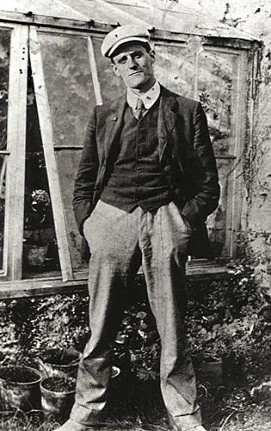
Image from Wikipedia
Image from Wikipedia
James Joyce
The Architect of Literary Modernism: James Joyce Between Dublin, Trieste, Paris, and Zurich
James Augustine Aloysius Joyce embodies the artistic development of literary modernism like few others. The Irish writer, born on February 2, 1882, in Rathgar near Dublin and died on January 13, 1941, in Zurich, revolutionized the narrative style of the 20th century with Dubliners, A Portrait of the Artist as a Young Man, Ulysses, and Finnegans Wake. His music career in the strict sense did not exist – yet music pulses through his work: ballads, operatic arias, popular tunes, and sound structures that he shaped into prose with unparalleled theatrical presence of language. Joyce's artistic evolution, his formal radicalism, and his influence on generations of writers make him a key figure in world literature.
Early Years in Dublin: Education, Identity, Literary Awakening
Growing up in a Catholic family, James Joyce attended Jesuit schools and studied at University College Dublin. During this phase, his artistic self-conception developed: a departure from dogma, a turn towards experience, and the dissection of urban everyday realities. The early stories compiled in Dubliners (1914) shape a psychorealistic panorama of the city with sober observation, precise composition, and subtle motivation. Joyce creates characters whose inner conflicts – religion, sexuality, social background – are condensed in the arrangement of short prose pieces. Here already, the guiding motif of his later aesthetics announces itself: radical subjectivity as a universal lens.
Exile and Artistic Development: Trieste, Zurich, Paris
In 1904, Joyce left Ireland. The stops in Trieste, Zurich, and Paris became laboratories for his literary production. In Trieste, he wrote the poetry collection Chamber Music (1907), the stories of Dubliners matured, and the artist's Bildungsroman project gained shape. A Portrait of the Artist as a Young Man (book edition 1916) crystallizes Joyce's poetics: language as living matter that carries the consciousness stream of the character Stephen Dedalus through composition. The artistic development explores tonalities – from ascetic sentences to rhythmically flowing periods – and sets standards for modernity.
Ulysses (1922): One Day, One City, the World
With Ulysses, Joyce broke the conventions of the novel in 1922. On the stage of a single day – June 16, 1904 – he unfolds an orchestral arrangement of voices, styles, and signs. The stream of consciousness becomes the supporting composition: inner monologues, free indirect discourse, typographical experiments, and pastiche-like chapters "intonate" the city of Dublin as a living score structure. The characters Leopold Bloom, Molly Bloom, and Stephen Dedalus move through a finely woven system of motifs; themes of memory, desire, identity, and belonging intertwine. The initially scandal-ridden novel – censored and contested – is now regarded as a monument of literary modernism and a manual of urban experience.
Finnegans Wake (1939): Language as a Sound Body
Finnegans Wake, published in 1939 after years of work, radicalizes Joyce's aesthetics. The narrative dissolves the boundaries of semantic stability: polyglot word fusions, allusions from music history, mythology, and popular culture, onomatopoeia, and rhythmic arcs form a text fabric that is more "heard" than linearly read. The novel functions as a cosmic dream chronicle, as an experimental oratorio of language. Critical reception and the history of editions attest to its status as the pinnacle of formal-aesthetic innovation – a work that continues to challenge research, translation, and interpretation to this day.
Poetry, Drama, and Minor Works: The Other Side of the Oeuvre
Besides the major novels, Joyce left behind poetry and a play that sharpen his sense of form. Chamber Music (1907) and Pomes Penyeach (1927) showcase an economic, song-like poetry with precise prosody; Exiles (1918) experiments on stage with psychological subtleties and counterpoint in dialogues. These publications expand the overall picture: Joyce's compositional talent transfers musical principles – variation, refrain, leitmotif – into literary structures and demonstrates the versatility of his poetics.
Poetics, Technique, and Style: From Stream of Consciousness to Typography
Joyce's expertise lies in the connection between formal experimentation and closeness to experience. The stream of consciousness serves as a dynamic narrative technique that sets syntax, rhythm, and layers of metaphor in motion. Intertextuality, quotation montage, parody, and pastiche-like stylistic variants interlink literary-historical registers. The composition of individual chapters – such as the "Sirens" episode in Ulysses – translates musical forms into prose: motif development, reprise, counterpoint, syncopated entries. Thus, Joyce achieves a stage of language where each sentence carries meaning, sound, gesture, and movement.
Cultural Influence and Reception: From Censorship to Canonization
The initially scandal-ridden publication history of Ulysses culminated in international recognition. Joyce became a focal point of modernism; authors from Virginia Woolf to Samuel Beckett responded to his methods. In Dublin and worldwide, readers celebrate June 16 as Bloomsday – a festival of readings, performances, and city tours that transposes the literary scene into urban space. Institutions like the James Joyce Centre in Dublin and foundations in Zurich ensure research and communication; exhibitions, reading circles, and editions continually renew critical reception.
Present: Current Projects, Festivals, and Editions
Even decades after his death, Joyce remains highly present. In Dublin, the James Joyce Centre organizes annual Bloomsday programs with readings, city walks, and staged performances. In 2025, cultural institutions in Ireland again offered curated events – from musical tributes to thematic tours. At the National Library of Ireland, the collaboration with the Joyce Centre was highlighted as part of a Bloomsday passport. At the same time, reading groups and lecture series take place, such as the "Ulysses for All" formats in Dublin. In 2026, a university book club in Dublin City will continue the dialogue with first-time readers and advanced students. These projects underscore Joyce's lasting relevance in public cultural life.
Selected Works
- Dubliners (1914): A cycle of realistic short stories about stagnation, epiphany, and urban psychograms.
- A Portrait of the Artist as a Young Man (1916): A coming-of-age novel about education, distinction, and the emancipation from religion and nation.
- Ulysses (1922): An epic of everyday life; one day in Dublin as an orchestral arrangement of voices, styles, and inner movements.
- Exiles (1918): A drama about loyalty, freedom, and the risky economy of desire.
- Chamber Music (1907) and Pomes Penyeach (1927): Poetry with song-like tendencies, metrical precision, and acoustic economy.
- Finnegans Wake (1939): An experimental late work, a polyglot dream poem in prose form.
Joyce and Music: Allusions, Musical Settings, Adaptations
Joyce's texts are imbued with music: operas, Irish ballads, salon pieces, and street songs function as the acoustic substrates of his composition. Research and collections document hundreds of musical references, particularly pronounced in Ulysses and Dubliners. Numerous composers have set his poems to music – from classical art song adaptations of Chamber Music to contemporary projects. Also, experimental endeavors that set Finnegans Wake to music entirely or interpret chapters as electroacoustic studies show the ongoing attractiveness of his linguistic music. Moreover, stage works and musicals have made free adaptations of his prose, translating Joyce's timbre into other genres.
EEAT Perspective: Experience, Expertise, Authority, Trustworthiness
Experience: Joyce's music career in a figurative sense – his theatrical presence of language – is evident in concrete career stops between Dublin, Trieste, Paris, and Zurich and in artistic moments like the "Sirens" episode. Expertise: Pairs of concepts such as composition and arrangement, genre and intertext, production and style variation mark his technical coordinate system. Authority: The canonical status of Dubliners, Ulysses, and Finnegans Wake is supported by editions, festivals, and research institutions. Trustworthiness: Biographical data, work data, and current cultural events are documented in recognized reference works and institutions.
Conclusion: Why James Joyce Remains Essential Today
James Joyce transforms ordinary life into an event of form. He composes cities, voices, and times into literature that challenges and rewards. Those who engage with his works experience the artistic evolution of modern narrative art up close. Attend readings, participate in Bloomsday, join reading groups – and discover how language can sound when it embraces the whole world.
Official Channels of James Joyce:
- Instagram: No official profile found
- Facebook: No official profile found
- YouTube: No official profile found
- Spotify: No official profile found
- TikTok: No official profile found
Sources:
- Wikipedia (de) – James Joyce
- Encyclopaedia Britannica – James Joyce: Biography, Books, Facts
- James Joyce Centre Dublin – Ulysses for All 2025
- National Library of Ireland – Bloomsday Festival 2025
- Tourism Ireland – Join the Joycean celebrations at Dublin’s Bloomsday Festival
- Wikipedia (en) – Finnegans Wake
- James-Joyce-Music.com – Music in the Works of James Joyce
- Wikipedia (en) – Waywords and Meansigns
- Wikipedia (en) – Chamber Music (Berio)
- Wikipedia (en) – Thema (Omaggio a Joyce)
- Wikipedia (en) – James Joyce’s The Dead (Musical)