
Markus (Evangelist)
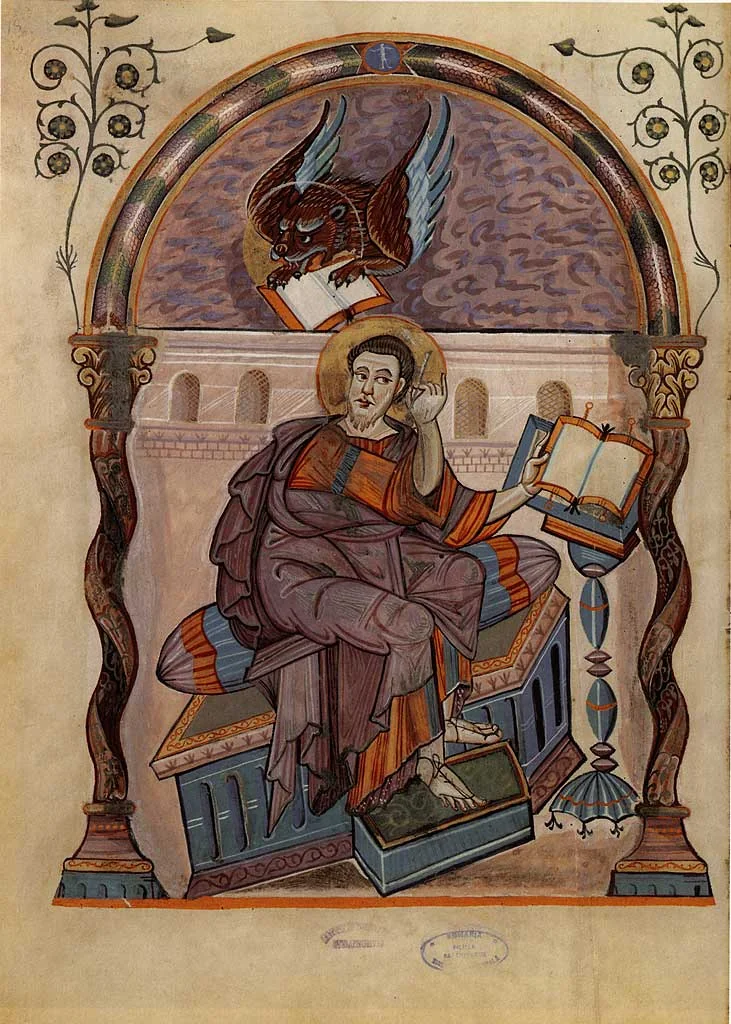
Image from Wikipedia
Image from Wikipedia
Markus (Evangelist) – Author of the Oldest Gospel and Cultural Echo Through the Centuries
The evangelist who coined the "tempo of good news" – from Jerusalem to Venice, from liturgy to sound art
In ancient church tradition, Markus is regarded as the author of the probably oldest New Testament Gospel – a text that significantly influenced the music career of Christian liturgy and the artistic development of Europe. Although the evangelist does not name himself in the work, the early Church attributed authorship to "Markus," a Roman name, linking it to the preaching of Peter. This Gospel of Mark shaped spiritual culture with its stringent dramatic arrangement, its focus on passion and resurrection, and its dense narrative rhythm: from medieval readings to Baroque passion compositions to contemporary reconstructions and performance traditions. A notable attribute of the evangelist is the winged lion – a symbol that continues to live on in the coat of arms of Venice, making the cultural reach of this biblical author visible.
Biographical Attributions: Between Church Tradition and Historical Analysis
The transmitted biography of Markus draws from New Testament evidence and patristic voices. In ancient tradition, he appears as "John Mark," who was associated with Peter and Paul. Ancient ecclesiastical exegesis maintained that Markus wrote the Gospel based on Peter's preaching; modern research, however, emphasizes the anonymity of the text and discusses authorship as a theological attribution. It is certain that Markus or Marcus is not a Jewish but a Roman name, and the mention of names in scholarly literature is a convention, not an uncritical adoption of a legend. Similarly uncertain remain later legends about his activities in Alexandria and Venice; however, they show the eminent authority that his Gospel gained in various churches.
The Gospel of Mark: Drama, Composition, and Theological Emphasis
As a literary composition, the Gospel of Mark unfolds a gripping, almost scenic narrative flow: concise pericopes, frequent changes in pace, the recurring formula "immediately," and the so-called "messianic secret" motif contour the stage presence of Jesus. From a music journalism perspective, this dramaturgy resembles a carefully set sequence of recitative, arioso, and choral scenes: short, impactful episodes condense into the final passion narrative, which occupies about one third of the text. Theologically, Markus places the passion at the center and shapes a "dynamic of proclamation," in which miracles and conflicts appear as harmonious and dissonant sound colors. This compositional style influenced liturgical recitation forms, modal psalm-tone traditions, and in the long history of influence, the grand passions of the Baroque period.
Early Dating and Canonical Importance
In historical-critical research, Markus is often regarded as the earliest of the four Gospels and as an important source for Matthew and Luke. This classification explains why the narrative architecture and text economy of Markus have such strong resonance: it forms a "prototype" of the Gospel form, whose stringency later inspired music-dramatic passions. At the same time, the strong focus on passion marks a soft tonal shift: from quick recounting of miracles to the dense illumination of the final week – a design principle that composers later musically shaped as a tension arc between contemplation and culmination.
Symbolism: The Mark Lion as an Icon of European Cultural History
The winged lion as an attribute of the evangelist is one of the best-known emblems of Christian art. Its anchoring in prophetic visions and apocalyptic literature was early typologically interpreted regarding the four evangelists and assigned to Markus. In Venice, the Mark Lion became the city’s and state’s emblem; the inscription "Pax tibi Marce, evangelista meus" connects political symbolic power with spiritual authority. In the mosaics of St. Mark's Basilica, on flags, and in countless artworks, the lion signifies a cultural identity that points to the authority of the evangelist – an example of how texts, symbols, and music intertwine in Europe.
From Text to Voice: Liturgy, Recitation, and Musical Tradition
The liturgical practice has transformed the Gospel of Mark into a sounding tradition since late antiquity: as a reading tone in worship, as part of Holy Week liturgy, and—with the refinement of polyphonic music—as a source for passion settings. Here, the written composition meets a sounding interpretation: recitatives (evangelist's report), Turbae choirs (crowds), and contemplative arias become the musical counterpart of Mark's narrative art. The strong passion-centric focus of Markus has encouraged composers to combine dramatic intensifications and meditative islands. In music history, these processes shape oratorio, passion, and vocal polyphony; the Gospel of Mark often remains the "silent motor" behind prominent developments in genres.
Baroque Resonance Spaces: The Mark Passion by Bach and His Contemporaries
The most famous Baroque reference is Johann Sebastian Bach's St. Mark Passion (BWV 247). The work is considered lost, but it has been reconstructed based on preserved texts and musical parodies, remaining the subject of lively editing, performance, and recording practice. This reconstruction history exemplifies how strongly the Gospel of Mark served as a dramaturgical basis for large musical forms. A St. Mark Passion, also attributed to "Keiser," is encountered in source materials and repertoire histories that illuminate the complex authorship attribution of the early 18th century. In any case, the Baroque treatment of Mark demonstrates: His passion narrative stimulates musical architecture, choral speaking, and the art of "affect-conscious" arrangement.
Cultural Topographies: From Alexandria to Venice
Legends tell that Markus founded the church in Alexandria; this is not historically verified, but the Egyptian and Venetian traditions link hagiographical narratives, relic translations, and political symbolism. The history of the relics brought to Venice—and their later partial return to the Coptic Church—is not just a hagiographical detail, but describes a network of piety, power, and identity. Venice stylized the Mark Lion as an emblem of a republic that connected trade, art, and liturgy; artworks and mosaic cycles in St. Mark's Basilica narrate this identity formation in iconographic "sentences" that resemble a visual score referencing the Gospel.
Style Analysis: Narrative Technique, "Arrangement," and Text-Music of Mark
Markus composes his Gospel with concise, impactful scene sequences. Figures appear, speak briefly, and act decisively – the structure of a concentrated "scene book" that favors liturgical recitation. Theologically, the silence command (messianic secret) establishes a kind of pause that withholds meanings and creates tension; semantically, the Gospel works with recurring motifs functioning like leading sounds (healing, confrontation, discipleship, suffering). For music history, this means: composable contrasts and a strongly shaped passion narrative; an "arrangement" that seamlessly integrates choral scenes (Turbae), recitative (evangelist), and aria-like reflections. Thus, Markus becomes the preferred source text for passions, in which narrative and interpretation are closely intertwined.
Critical Reception and Scholarly Perspectives
Biblical scholarship interprets Markus today not only as a window to the historical Jesus but as a mirror of early Christian communities with their conflicts, hopes, and patterns of interpretation. The authorship debate – anonymous work versus personalized attribution to "Markus" – illustrates how ecclesiastical memory and scholarly reconstruction work together. For cultural criticism, this tension field is productive: it explains why the text functions equally as a theological source, as an early biographical form, and as a performative template for liturgy and music. That the Gospel is structurally so "performable" strengthens its role as a catalyst for musical practice even into our present day.
Resonance in the Present: Reconstructions, Performance Traditions, Discourses
Because the musical tradition surrounding the Mark Passion remained fragmentary, a vibrant culture of reconstruction developed that connects source criticism, editing practice, and historical performance practice. New recordings, editorial projects, and church music cycles engage with the Mark text – a "living discography" in motion, whose discursive quality recalls critical music press. For liturgical practice, the evangelist remains a focal point of the church year; for musicology, a locale where genre history, source situation, and interpretive craft intertwine. Thus, the relevance of the Gospel of Mark continues in the present not as a museal memory but as a performative tradition.
Conclusion: Why Markus Fascinates Today
The evangelist Markus captivates because his text is simultaneously lean, vigorous, and theologically rich – a rare mix of narrative dynamism and spiritual depth. It resonates in liturgy, iconography, and music history like a resonance chamber that connects epochs: from patristics to Venetian symbolic politics to the Baroque passion and contemporary reconstructions. Those who want to experience Markus "live" can find him in the sounding liturgy of Holy Week, in performances of the Mark Passion, and in the quiet reading of his Gospel: a cultural concert where text, symbol, and sound merge into a great narrative.
Official Channels of Markus (Evangelist):
- Instagram: No official profile found
- Facebook: No official profile found
- YouTube: No official profile found
- Spotify: No official profile found
- TikTok: No official profile found
Sources:
- Wikipedia – Markus (Evangelist)
- Wikipedia – Gospel of Mark
- Encyclopaedia Britannica – Gospel According to Mark
- Domradio – Markus, Evangelist
- Verein Andere Zeiten – Evangelist Markus
- Diocese of St. Pölten – Markus (April 25)
- Wikipedia – Mark Lion
- Bibelwerk – Gospel of Mark: Introduction and Studies
- Wikipedia – St Mark Passion, BWV 247 (Johann Sebastian Bach)
- Wikipedia: Image and Text Source