
Sergei Sergejewitsch Prokofjew
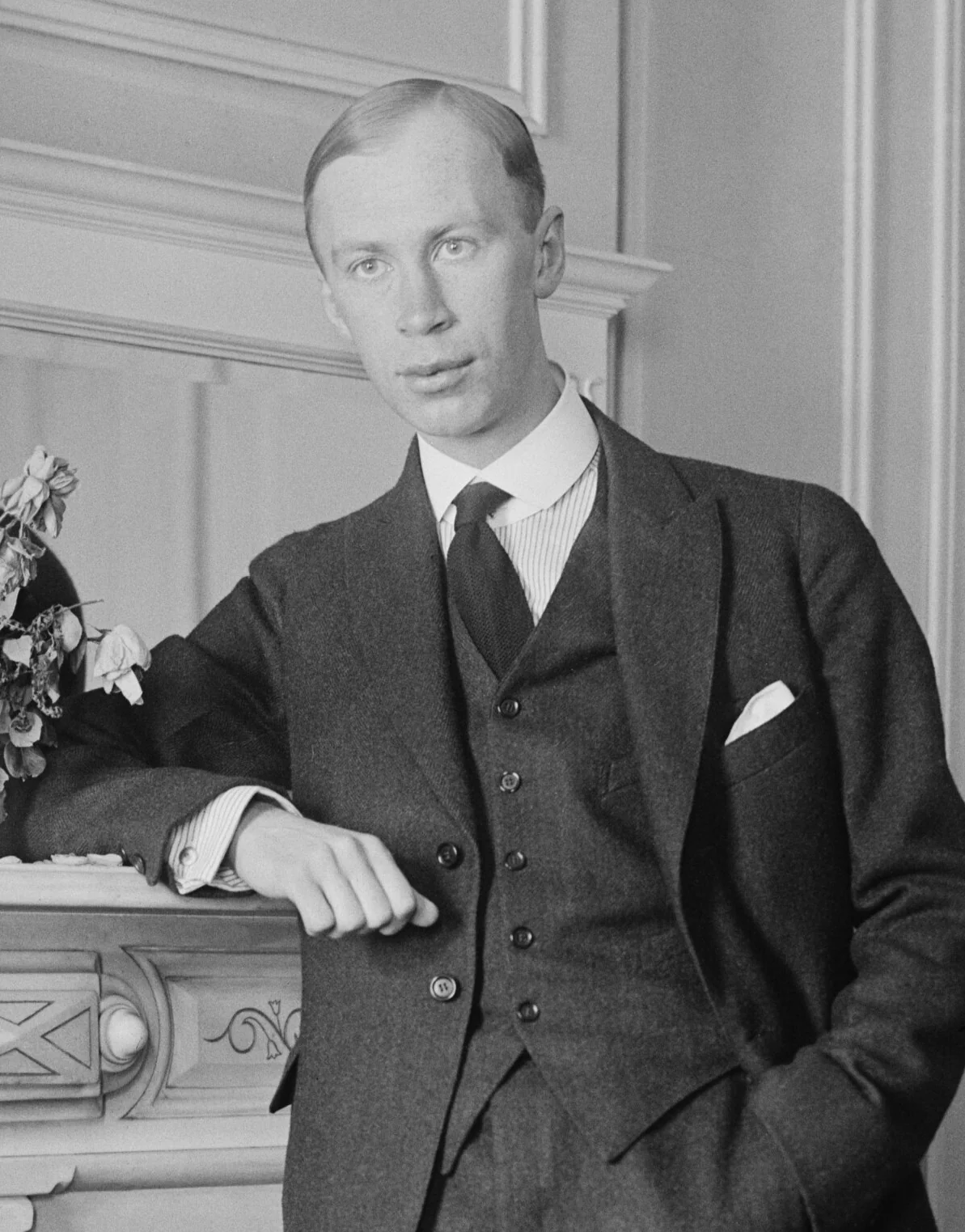
Image from Wikipedia
Image from Wikipedia
Sergei Sergeyevich Prokofiev – Architect of Modern Soundscapes
From Prodigy to Innovator: How Prokofiev Shaped the Music of the 20th Century with Ballet, Opera, Symphony, and Film Music
Sergei Sergeyevich Prokofiev was born on April 23, 1891 (Gregorian calendar) in today’s Sontsivka in the Donetsk region of Ukraine and died on March 5, 1953, in Moscow. As a pianist, composer, and conductor, he combined bold modernity with melodic catchiness. His musical fairy tale “Peter and the Wolf” is one of the most frequently performed works in classical music, but his oeuvre extends far beyond this: Seven symphonies, five piano concertos, two violin concertos, significant ballets and operas, as well as legendary film scores created a distinctive sound language with global appeal.
Childhood, Education, and Early Music Career
Growing up in a cultured household, Prokofiev discovered his artistic development early on. As a child, he composed small operas and piano pieces and exhibited a natural stage presence at the piano. Studying at the Saint Petersburg Conservatory honed his craft in composition, piano, and conducting. During this period, he sharpened the characteristics that would later become his trademark: motoric drive, clear form architecture, surprising harmony, and an ironic, often sarcastic tone. As a virtuoso, he won competitions, experimented with new playing techniques, and established himself as an uncompromisingly modern composer-pianist.
Breakthrough with Bold Modernity: From the Concert Stage to the Big Stage
Prokofiev deliberately broke with the listening habits of his time. Early works such as the first piano concertos shocked and thrilled audiences alike—with fierce dissonances, rapid tempos, and a percussive piano style becoming his signature. With the “Scythian Suite” – originally intended as a ballet for Sergei Diaghilev’s Ballets Russes – he gained international attention. The suite created a sound body with eruptive energy through vivid orchestration and archaic force. Concurrently, he developed a neoclassical line that illuminated elegance, transparency, and a dance character in classical forms, underlining his compositional versatility.
Years in the West: Opera, Ballet, and the Art of Theater
After the 1917 Revolution, Prokofiev lived in the USA and Western Europe, especially in Paris. During this time, his reputation as a theater composer grew. He wrote for the Ballets Russes and conquered the opera stage with “The Love for Three Oranges,” whose biting humor, striking thematic development, and noteworthy march confirmed the audience appeal of his music. Prokofiev used theater as a laboratory for musical dramaturgy: He combined characteristic leitmotifs, pointed rhythm, and colorful orchestration into a clear, narrative compositional technique that significantly influenced later stage and film music.
Return to the Soviet Union: New Simplicity, Great Successes
In 1936, Prokofiev permanently returned to the Soviet Union. He formulated a “new simplicity,” in which melodic directness and clear forms merged with modern harmony. This period includes “Peter and the Wolf,” a pedagogically sophisticated orchestral piece that associates instruments with characters for children, and the ballets “Romeo and Juliet” and “Cinderella,” in which lyrical melodies, fine character portrayals, and dance impulses became captivating stage events. With the orchestral suite “Lieutenant Kijé,” he also created a masterpiece of cinematic narrative economy for the concert hall – an example of how Prokofiev shaped sound images with incisive gestures and rhythmic emphasis into unforgettable program music.
Film and Sound Dramaturgy: Collaboration with Eisenstein
Milestones in his production include the film scores for Sergei Eisenstein’s “Alexander Nevsky” and “Ivan the Terrible.” Both projects were characterized by an innovative working method: some music was composed to already filmed scenes, while in other cases, the montage was oriented around the musical pulse. Prokofiev’s music here models collective narratives with striking themes, colorful instrumentation, powerful choral sections, and a dramaturgical architecture that melds sound and image into an artistic unity. A significant concert version also emerged from “Alexander Nevsky,” bringing orchestral power and choral sound grandeur into the concert hall.
Symphonies, Concertos, and Sonatas: A Discography of Interpretations
Prokofiev’s symphonic output documents his compositional development between neoclassical clarity and dramatic concentration. The seven symphonies span youthful freshness to a darker, introspective late phase. The five piano concertos explore extreme virtuosity and an orchestral interplay at eye level, while the two violin concertos balance lyrical cantability with rhythmic sharpness. His nine completed piano sonatas – including the “War Sonatas” No. 6–8 – are considered key works in terms of piano technique and expressive history. The rich discography on renowned labels attests to his unbroken relevance: recordings of his ballets, concertos, and symphonies are continuously released in new interpretations that affirm his scores as reference repertoire of the 20th century.
Style, Language, Technique: Between Neoclassicism, Irony, and Motoric Drive
Prokofiev’s music embodies an individual mix of singable melody, motoric rhythm, harmonic friction, and clear, often classicist-inspired form. His compositions connect linear transparency with multifaceted polyphony, incisive themes, and motivic transformation. Irony, parody, and dance spirit act as dramaturgical means, while percussive piano techniques, brilliant woodwind solos, and cutting brass choirs sharpen the orchestral profile. This signature influenced musical modernity without losing sight of the listener – a balancing act between avant-garde and accessibility.
Artistic Development Under Pressure: Cultural Politics and Awards
The cultural policy guidelines of the late 1940s also affected Prokofiev. Under the charge of “formalism,” works faced criticism and performances were restricted. Nonetheless, substantial music continued to emerge – from intimate chamber art to grand stage projects. His career saw state awards as well as experiences of censorship; the composer asserted his voice with works that permanently shaped the repertoire. His death on March 5, 1953, marked the end of an era, the tensions, breaks, and hopes of which are mirrored in his music. Posthumously, he solidified his status as one of the key composers of the 20th century.
Cultural Influence and Popular Culture: “Dance of the Knights” and More
Individual themes of Prokofiev – particularly from “Romeo and Juliet” – have attained iconic status beyond the concert hall. “Dance of the Knights” exemplifies his artistry in encapsulating striking intervals, pulsating ostinati, and powerful orchestration. Film scores, ballet suites, and suites like “Lieutenant Kijé” demonstrate how he combined sound dramaturgy with narrative precision. “Peter and the Wolf” continues to provide generations of listeners with an intuitive understanding of orchestral colors – a singular contribution to music education and the anchoring of classical music in the collective memory.
Overview of Works and Reception: From Opera to Oratorio
Prokofiev’s oeuvre includes eight ballets, seven operas – among them “War and Peace” as a monumental stage epic – numerous symphonic poems, cantatas, and choral music. The critical reception acknowledges his ability to economically shape large forms, combine dramatic intensification with lyrical inner tension, and maintain a distinctive sound signature. Publishers, music houses, and archives promote his work with new editions, critical commentary, and source research. The recording catalogs of international labels document a continuous history of interpretation in which historical playing styles and contemporary readings encounter each other productively.
Why Prokofiev Remains Central Today
Prokofiev’s music strikes both immediate and multifaceted notes: it offers melodic clarity, rhythmic energy, scenic imagination, and unmistakable humor. It challenges interpreters pianistically, chamber musically, and symphonically, and inspires choreography, film, and theater. In music history, he stands at the intersection of late Romanticism, modernism, and neoclassicism – a composer who mastered the grammar of classical form and accentuated it with new colors, motifs, and gestures. His compositions remain a touchstone for orchestral culture, sound balance, articulation, and narrative musicality.
Conclusion: Experience Prokofiev Live – Sound That Tells a Story
Those who listen to Prokofiev experience music as a dramatic narrative and as precisely constructed architecture. Whether it’s the cutting brilliance of the piano concertos, the colorful power of the ballets, or the suggestive imagery of the film music: these works breathe stage, movement, scene. They reveal a music career drawn from artistic development and experience and continue to shape concert programs today. Seize every opportunity to hear Prokofiev’s music live – in the ballet hall, the opera house, or the concert hall. His sound language shines brightest on stage.
Official Channels of Sergei Sergeyevich Prokofiev:
- Instagram: No official profile found
- Facebook: No official profile found
- YouTube: No official profile found
- Spotify: No official profile found
- TikTok: No official profile found
Sources:
- Wikipedia (DE) – Sergei Sergeyevich Prokofiev
- Encyclopaedia Britannica – Sergey Prokofiev
- Deutsche Grammophon – Prokofiev: Biography
- Warner Classics – Sergei Prokofiev
- Education Directorate of Tyrol – Peter and the Wolf (Background)
- Wikipedia (EN) – Alexander Nevsky (Film) and Collaboration with Eisenstein
- Wikipedia (EN) – Ivan the Terrible (Film Music)
- Wikipedia (EN) – Alexander Nevsky (Concert Version)
- LeMO – Biography Sergei Prokofiev (House of History)
- Columbia University Libraries – Serge Prokofiev Foundation Archive
- Wikipedia: Image and text source