
Bad Kissingen
Promenadestraße 2, 97688 Bad Kissingen, Deutschland
Jewish Community House Bad Kissingen | History & Exhibition
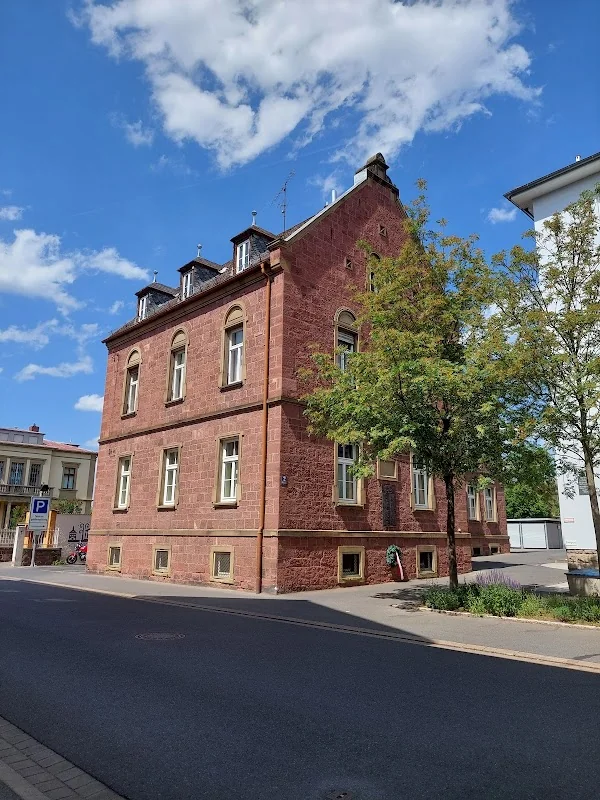
The Jewish Community House Bad Kissingen at Promenadestraße 2 is today much more than a historical building. It is a place where the Jewish history of the spa town is not told abstractly, but remains visible in a real house with a real biography. Those who come here encounter an ensemble that once bundled the religious, educational, and everyday life of the Jewish community and today offers a vivid glimpse over centuries of Jewish presence with the permanent exhibition "Jewish Life in Bad Kissingen." The house is closely connected to the neighboring synagogue, with memorial sites in the urban landscape and with the family stories of people who lived, worked, believed, learned, and were later persecuted here. It is precisely this connection of architecture, memory, and lived history that makes the building particularly appealing. Visitors do not experience an anonymous showcase, but an authentic place where the history of the Jewish community of Bad Kissingen unfolds in a very concrete way.([badkissingen.de](https://www.badkissingen.de/kultur/veranstaltungskalender?ev%5Bid%5D=109267))
History of the Jewish Community House in Bad Kissingen
The establishment of the Jewish Community House belongs to the major expansion phase of the Jewish community at the end of the 19th century. Initially, no new building was planned, but a conversion of an already acquired building. Only after the community revised its plans did it decide on a new building for the school and community house together with the synagogue. The house was intended to have three apartments, a community and meeting room, a classroom, and a mikveh. The architect Carl Krampf designed the building, the execution was in the hands of builder Joseph Wedler, and by May 1898 the new building was completed. The same colored sandstone was used as in the synagogue and in other representative houses of the time, which harmoniously integrated the building into the street scene. In the contemporary language of forms of the Neo-Renaissance, the house was meant to be not only practical but also to express dignity and social self-awareness. Thus, the community house was from the very beginning a symbol of Jewish presence, education, and organization in the spa town of Bad Kissingen.([badkissingen.de](https://www.badkissingen.de/media/www.badkissingen.de/org/med_34151/125213_5_5_das_juedische_gemeindehaus_chronik_jued_lebens_in_kg_beck_2-22.pdf.pdf))
In November 1898, the first residents moved in with cantor Ludwig Steinberger and the shochet Isaac Seelig. Later, Gustav Neustädter took over tasks and the apartment of Seelig, while the Christian synagogue attendant and caretaker Hugo Albert moved in with his family into the attic apartment. Thus, the community house became a true multi-generational house with very different functions and residents. The memories of Jack Steinberger and Rudolf Steinberger show how closely everyday life, religion, and family life were intertwined here. The Neustädter family lived on the ground floor, the Steinberger family on one of the upper floors, and the Albert family in the attic. There were living spaces, kitchens, a bathroom, heating stoves, and even a lending library for the community. The house was therefore by no means just an administrative building, but a vibrant social hub. The courtyard on the north side was even temporarily covered with a glass roof after there were complaints from the neighborhood about its use. All of this makes it clear: The Jewish Community House was a place of everyday coexistence, where Jewish religious practice, family life, and urban everyday life naturally intertwined.([badkissingen.de](https://www.badkissingen.de/media/www.badkissingen.de/org/med_34151/125213_5_5_das_juedische_gemeindehaus_chronik_jued_lebens_in_kg_beck_2-22.pdf.pdf))
Architecture, Ensemble, and Everyday Life at the Historic Site
Anyone looking at the architecture of the house quickly recognizes why the Jewish Community House was perceived together with the synagogue as a unified complex. The two buildings were coordinated with each other and conceived "as if from a single mold." The community house fulfilled several tasks at once: it was a residential house, a schoolhouse, and a house of prayer. This multifunctionality not only shaped the interior spaces but also the social role of the building in the neighborhood. It bundled religious work, teaching, administration, and private living in one place. This created a form of Jewish infrastructure, typical for emerging communities of the 19th century, but implemented in particularly high-quality form in the spa town of Bad Kissingen. The house was representative but not ostentatious; it blended into the urban landscape while still clearly conveying the claim of a self-confident, well-organized community. It is precisely this balance between functionality and representation that makes it architecturally so interesting.([badkissingen.de](https://www.badkissingen.de/media/www.badkissingen.de/org/med_34151/125213_5_5_das_juedische_gemeindehaus_chronik_jued_lebens_in_kg_beck_2-22.pdf.pdf))
In everyday life, this architecture was immediately reflected. A community and meeting room could be used for meetings, lessons, and religious services, a classroom served for learning, and the mikveh belonged to the religious infrastructure of the house. The building was thus a microcosm of Jewish life in Bad Kissingen. The residents knew each other, shared paths, heating sources, stairs, and courtyard areas, and yet they also had their respective functions in the community. The Christian caretaker Hugo Albert took care of the grounds and the synagogue, while Gustav Neustädter was known as a shochet, teacher, and religious functionary. The Steinberger family later preserved this time in personal memories, which show how naturally Jewish and non-Jewish worlds coexisted here. The community house therefore also stands for a historical Bad Kissingen, where the Jewish community did not live on the margins, but was visibly integrated into urban and spa life.([badkissingen.de](https://www.badkissingen.de/media/www.badkissingen.de/org/med_34151/125213_5_5_das_juedische_gemeindehaus_chronik_jued_lebens_in_kg_beck_2-22.pdf.pdf))
Permanent Exhibition Jewish Life in Bad Kissingen
Today, the house is primarily an important place to visit because of the permanent exhibition "Jewish Life in Bad Kissingen." The exhibition was designed by teachers and students of the Jack-Steinberger-Gymnasium and provides an overview of the history of the Jews of Kissingen from the 13th century to the present. It thus spans an exceptionally wide arc: from medieval Jewish life through the development of the community in the 19th and early 20th centuries to persecution, destruction, new beginnings, and remembrance after 1945. Particularly valuable is the approach of not only explaining major events but also the most important institutions of the community. Synagogues, clubs, and cemeteries are presented so that visitors can better understand the Jewish everyday world. At the same time, it becomes clear how anti-Semitism grew during the Imperial era and the Weimar Republic and ultimately led to exclusion, expulsion, and annihilation. The exhibition is therefore not only historically informative but also pedagogically well-structured and suitable for different visitor groups.([badkissingen.de](https://www.badkissingen.de/kultur/veranstaltungskalender?ev%5Bid%5D=109267))
Practically important for planning is the opening time: The permanent exhibition is usually open on Tuesdays from 3:00 PM to 5:00 PM. Admission is free, which makes the visit particularly accessible. Those who wish to come outside these hours can arrange a special tour or appointment through the Bad Kissingen City Archive. This is especially interesting for groups, school classes, or interested travelers who bring more time for the building and its history. The city also explicitly points out that the exhibition is not barrier-free. This is important for visit planning because the house is therefore only partially suitable for people with mobility impairments. In terms of content, the exhibition relies on a mix of documents, Judaica, and spatial reference. This makes it attractive for all who want to not only read history but also experience it spatially. Especially in connection with the original building, the exhibition visit gains a special depth.([badkissingen.de](https://www.badkissingen.de/kultur/veranstaltungskalender?ev%5Bid%5D=109267))
Mikveh, Sukkah, and Prayer Hall in the Jewish Community House
Among the most impressive elements of the house are the religious spaces and installations that are still visible today. In the basement is the former mikveh, the ritual bath that was of central importance for the religious practice of the community. In addition, there is a reconstructed sukkah, which recalls the Jewish festival of Sukkot and represents a particularly vivid detail in the historical house structure. Such spaces are not merely museum additions but explain how closely everyday life and religious prescriptions were intertwined in the community house. Those who see the basement areas immediately understand that the building was originally designed as a complete community support system: living above, community and teaching spaces in the middle, ritual infrastructure below. It is precisely this spatial compactness that makes the house so impressive and valuable for visitors who want to experience Jewish history at a specific location.([badkissingen.de](https://www.badkissingen.de/kultur/veranstaltungskalender?ev%5Bid%5D=109267))
The prayer hall also has a tumultuous history. After the destruction during the Nazi era, the building was restored to its original function after the war. Cantor Josef Weissler advocated for the clearing and restoration of the house on behalf of the American Jewish Joint Distribution Committee. In 1949, he moved in again with his family, and the provisional prayer hall was once again used for services. After the house was released from property control in 1952, renovations were undertaken, and on September 4, 1956, the prayer hall could be consecrated again in simple form. In the 1990s, a fundamental redesign took place, which was completed in 1996 with a festive re-consecration. In honor of Josef Weissler, the prayer hall was named "Josef-Weissler-Synagogue." Regular services take place there during the summer months, making the house not only a place of remembrance but also a continuing vibrant religious space.([badkissingen.de](https://www.badkissingen.de/media/www.badkissingen.de/org/med_34151/125213_5_5_das_juedische_gemeindehaus_chronik_jued_lebens_in_kg_beck_2-22.pdf.pdf))
Directions and Parking at Promenadestraße 2
The Jewish Community House is located at Promenadestraße 2 in the middle of Bad Kissingen, making it a place that is generally easily accessible for visitors. For the journey, it is worthwhile to plan the municipal parking situation as well, as Bad Kissingen operates with a clearly structured parking concept. The city describes its downtown area as a zone with various free, low-cost, and central parking spaces. For visitors planning a cultural tour, the inner-city parking spaces and the parking garage or short-term parking offers are particularly relevant. A particularly important point is the Tattersall parking lot, which was formerly known as the Salinen parking lot. There, drivers can park for a flat rate of 1 euro for two hours; each additional hour costs 0.50 euros. Those who only want to run a quick errand can also use the roll button of the parking meters to park for up to 20 minutes for free. This is very practical for a visit to the community house, as cultural stops in Bad Kissingen can be easily combined with a walk through the city center.([badkissingen.de](https://www.badkissingen.de/kultur/veranstaltungskalender?ev%5Bid%5D=109267))
The city also provides its own information for guests with limited mobility. On the parking page, Bad Kissingen refers to designated parking spaces for people with mobility impairments as well as other central parking garages. At the same time, it should be noted that the permanent exhibition itself is not barrier-free. Therefore, those planning a visit should not only look for a free spot nearby but also consider the accessibility of the house. Those arriving by train can also reach the city center well but should plan some time for the last section in the town. It is particularly pleasant that the historic location lies in an urban but still quiet environment and can be connected with other stations of Jewish history and city history. Thus, the way to the Jewish Community House becomes not just transportation but already part of the overall experience in Bad Kissingen.([badkissingen.de](https://www.badkissingen.de/wirtschaft/verkehr-und-mobilitaet/parken/36452.Parken-in-Bad-Kissingen.html))
Culture of Remembrance, Commemoration, and Current Significance
The history of the house cannot be understood without the phase of persecution. After 1939, the ruins of the burned synagogue were sold along with the community house and the property to the city. The Jewish community lost its independence, religious services were only possible under difficult conditions, and the house was repurposed during the Nazi era. Parts of the building were used for educational purposes, others were claimed by Nazi organizations. For the Neustädter family, this meant a deep cut. Gustav Neustädter was the last chairman of the Jewish community from 1939 to 1942, and his son Ernst David grew up in the community house. His biography makes it clear that the building is not only a monument but also a place of personal and family memory. The persecution ended for the family in deportation to Izbica. Such individual fates give the house a haunting historical depth, which is consciously taken into account in the current exhibition.([badkissingen.de](https://www.badkissingen.de/bildung-und-soziales/juedisches-leben/badkissinger-stolpersteine/37056.GUSTAV-NEUSTAeDTER-1892----letzter-Vorsteher-der-juedischen-Gemeinde-Promenadestrasse-2.html))
After the war, the house was revived and at the same time became a place of remembrance culture. The city erected a memorial plaque for the Jewish victims of Nazi persecution, and the building remained a central reference point for later engagement with the Jewish history of Bad Kissingen. In the 1980s and 1990s, new forms of commemoration and mediation emerged, including the permanent exhibition itself. Later, regular summer services, Jewish cultural days, and other forms of public remembrance were added. Thus, the community house today fulfills several roles simultaneously: it is a museum, a place of remembrance, a religious space, and a place of learning. Those who come here not only experience city history but also the continuing impact of Jewish life after 1945. This makes the visit particularly valuable for all who want to understand how Bad Kissingen not only preserves its Jewish history but also makes it visible and accessible.([hdbg.eu](https://hdbg.eu/juedisches_leben/gemeinde/bad-kissingen/65))
For visitors who want to consciously perceive the place, the Jewish Community House is thus an extremely compact access to the Jewish history of the city. The house tells of rise and everyday life, of architecture and religion, of destruction and new beginnings, of personal loss and public remembrance. The permanent exhibition makes these themes accessible, the preserved spaces give them substance, and the location at Promenadestraße 2 connects the building with the current urban landscape. Those who want to discover Bad Kissingen beyond the classic spa and park motifs will find here one of the most important historical sites in the city. For school classes, culture-interested guests, and travelers with a sense for authentic places, the community house is therefore a visit that resonates long after.([badkissingen.de](https://www.badkissingen.de/bildung-und-soziales/juedisches-leben/chronik-juedischen-lebens-bad-kissingen))
Sources:
Mehr anzeigenWeniger anzeigen
Jewish Community House Bad Kissingen | History & Exhibition
The Jewish Community House Bad Kissingen at Promenadestraße 2 is today much more than a historical building. It is a place where the Jewish history of the spa town is not told abstractly, but remains visible in a real house with a real biography. Those who come here encounter an ensemble that once bundled the religious, educational, and everyday life of the Jewish community and today offers a vivid glimpse over centuries of Jewish presence with the permanent exhibition "Jewish Life in Bad Kissingen." The house is closely connected to the neighboring synagogue, with memorial sites in the urban landscape and with the family stories of people who lived, worked, believed, learned, and were later persecuted here. It is precisely this connection of architecture, memory, and lived history that makes the building particularly appealing. Visitors do not experience an anonymous showcase, but an authentic place where the history of the Jewish community of Bad Kissingen unfolds in a very concrete way.([badkissingen.de](https://www.badkissingen.de/kultur/veranstaltungskalender?ev%5Bid%5D=109267))
History of the Jewish Community House in Bad Kissingen
The establishment of the Jewish Community House belongs to the major expansion phase of the Jewish community at the end of the 19th century. Initially, no new building was planned, but a conversion of an already acquired building. Only after the community revised its plans did it decide on a new building for the school and community house together with the synagogue. The house was intended to have three apartments, a community and meeting room, a classroom, and a mikveh. The architect Carl Krampf designed the building, the execution was in the hands of builder Joseph Wedler, and by May 1898 the new building was completed. The same colored sandstone was used as in the synagogue and in other representative houses of the time, which harmoniously integrated the building into the street scene. In the contemporary language of forms of the Neo-Renaissance, the house was meant to be not only practical but also to express dignity and social self-awareness. Thus, the community house was from the very beginning a symbol of Jewish presence, education, and organization in the spa town of Bad Kissingen.([badkissingen.de](https://www.badkissingen.de/media/www.badkissingen.de/org/med_34151/125213_5_5_das_juedische_gemeindehaus_chronik_jued_lebens_in_kg_beck_2-22.pdf.pdf))
In November 1898, the first residents moved in with cantor Ludwig Steinberger and the shochet Isaac Seelig. Later, Gustav Neustädter took over tasks and the apartment of Seelig, while the Christian synagogue attendant and caretaker Hugo Albert moved in with his family into the attic apartment. Thus, the community house became a true multi-generational house with very different functions and residents. The memories of Jack Steinberger and Rudolf Steinberger show how closely everyday life, religion, and family life were intertwined here. The Neustädter family lived on the ground floor, the Steinberger family on one of the upper floors, and the Albert family in the attic. There were living spaces, kitchens, a bathroom, heating stoves, and even a lending library for the community. The house was therefore by no means just an administrative building, but a vibrant social hub. The courtyard on the north side was even temporarily covered with a glass roof after there were complaints from the neighborhood about its use. All of this makes it clear: The Jewish Community House was a place of everyday coexistence, where Jewish religious practice, family life, and urban everyday life naturally intertwined.([badkissingen.de](https://www.badkissingen.de/media/www.badkissingen.de/org/med_34151/125213_5_5_das_juedische_gemeindehaus_chronik_jued_lebens_in_kg_beck_2-22.pdf.pdf))
Architecture, Ensemble, and Everyday Life at the Historic Site
Anyone looking at the architecture of the house quickly recognizes why the Jewish Community House was perceived together with the synagogue as a unified complex. The two buildings were coordinated with each other and conceived "as if from a single mold." The community house fulfilled several tasks at once: it was a residential house, a schoolhouse, and a house of prayer. This multifunctionality not only shaped the interior spaces but also the social role of the building in the neighborhood. It bundled religious work, teaching, administration, and private living in one place. This created a form of Jewish infrastructure, typical for emerging communities of the 19th century, but implemented in particularly high-quality form in the spa town of Bad Kissingen. The house was representative but not ostentatious; it blended into the urban landscape while still clearly conveying the claim of a self-confident, well-organized community. It is precisely this balance between functionality and representation that makes it architecturally so interesting.([badkissingen.de](https://www.badkissingen.de/media/www.badkissingen.de/org/med_34151/125213_5_5_das_juedische_gemeindehaus_chronik_jued_lebens_in_kg_beck_2-22.pdf.pdf))
In everyday life, this architecture was immediately reflected. A community and meeting room could be used for meetings, lessons, and religious services, a classroom served for learning, and the mikveh belonged to the religious infrastructure of the house. The building was thus a microcosm of Jewish life in Bad Kissingen. The residents knew each other, shared paths, heating sources, stairs, and courtyard areas, and yet they also had their respective functions in the community. The Christian caretaker Hugo Albert took care of the grounds and the synagogue, while Gustav Neustädter was known as a shochet, teacher, and religious functionary. The Steinberger family later preserved this time in personal memories, which show how naturally Jewish and non-Jewish worlds coexisted here. The community house therefore also stands for a historical Bad Kissingen, where the Jewish community did not live on the margins, but was visibly integrated into urban and spa life.([badkissingen.de](https://www.badkissingen.de/media/www.badkissingen.de/org/med_34151/125213_5_5_das_juedische_gemeindehaus_chronik_jued_lebens_in_kg_beck_2-22.pdf.pdf))
Permanent Exhibition Jewish Life in Bad Kissingen
Today, the house is primarily an important place to visit because of the permanent exhibition "Jewish Life in Bad Kissingen." The exhibition was designed by teachers and students of the Jack-Steinberger-Gymnasium and provides an overview of the history of the Jews of Kissingen from the 13th century to the present. It thus spans an exceptionally wide arc: from medieval Jewish life through the development of the community in the 19th and early 20th centuries to persecution, destruction, new beginnings, and remembrance after 1945. Particularly valuable is the approach of not only explaining major events but also the most important institutions of the community. Synagogues, clubs, and cemeteries are presented so that visitors can better understand the Jewish everyday world. At the same time, it becomes clear how anti-Semitism grew during the Imperial era and the Weimar Republic and ultimately led to exclusion, expulsion, and annihilation. The exhibition is therefore not only historically informative but also pedagogically well-structured and suitable for different visitor groups.([badkissingen.de](https://www.badkissingen.de/kultur/veranstaltungskalender?ev%5Bid%5D=109267))
Practically important for planning is the opening time: The permanent exhibition is usually open on Tuesdays from 3:00 PM to 5:00 PM. Admission is free, which makes the visit particularly accessible. Those who wish to come outside these hours can arrange a special tour or appointment through the Bad Kissingen City Archive. This is especially interesting for groups, school classes, or interested travelers who bring more time for the building and its history. The city also explicitly points out that the exhibition is not barrier-free. This is important for visit planning because the house is therefore only partially suitable for people with mobility impairments. In terms of content, the exhibition relies on a mix of documents, Judaica, and spatial reference. This makes it attractive for all who want to not only read history but also experience it spatially. Especially in connection with the original building, the exhibition visit gains a special depth.([badkissingen.de](https://www.badkissingen.de/kultur/veranstaltungskalender?ev%5Bid%5D=109267))
Mikveh, Sukkah, and Prayer Hall in the Jewish Community House
Among the most impressive elements of the house are the religious spaces and installations that are still visible today. In the basement is the former mikveh, the ritual bath that was of central importance for the religious practice of the community. In addition, there is a reconstructed sukkah, which recalls the Jewish festival of Sukkot and represents a particularly vivid detail in the historical house structure. Such spaces are not merely museum additions but explain how closely everyday life and religious prescriptions were intertwined in the community house. Those who see the basement areas immediately understand that the building was originally designed as a complete community support system: living above, community and teaching spaces in the middle, ritual infrastructure below. It is precisely this spatial compactness that makes the house so impressive and valuable for visitors who want to experience Jewish history at a specific location.([badkissingen.de](https://www.badkissingen.de/kultur/veranstaltungskalender?ev%5Bid%5D=109267))
The prayer hall also has a tumultuous history. After the destruction during the Nazi era, the building was restored to its original function after the war. Cantor Josef Weissler advocated for the clearing and restoration of the house on behalf of the American Jewish Joint Distribution Committee. In 1949, he moved in again with his family, and the provisional prayer hall was once again used for services. After the house was released from property control in 1952, renovations were undertaken, and on September 4, 1956, the prayer hall could be consecrated again in simple form. In the 1990s, a fundamental redesign took place, which was completed in 1996 with a festive re-consecration. In honor of Josef Weissler, the prayer hall was named "Josef-Weissler-Synagogue." Regular services take place there during the summer months, making the house not only a place of remembrance but also a continuing vibrant religious space.([badkissingen.de](https://www.badkissingen.de/media/www.badkissingen.de/org/med_34151/125213_5_5_das_juedische_gemeindehaus_chronik_jued_lebens_in_kg_beck_2-22.pdf.pdf))
Directions and Parking at Promenadestraße 2
The Jewish Community House is located at Promenadestraße 2 in the middle of Bad Kissingen, making it a place that is generally easily accessible for visitors. For the journey, it is worthwhile to plan the municipal parking situation as well, as Bad Kissingen operates with a clearly structured parking concept. The city describes its downtown area as a zone with various free, low-cost, and central parking spaces. For visitors planning a cultural tour, the inner-city parking spaces and the parking garage or short-term parking offers are particularly relevant. A particularly important point is the Tattersall parking lot, which was formerly known as the Salinen parking lot. There, drivers can park for a flat rate of 1 euro for two hours; each additional hour costs 0.50 euros. Those who only want to run a quick errand can also use the roll button of the parking meters to park for up to 20 minutes for free. This is very practical for a visit to the community house, as cultural stops in Bad Kissingen can be easily combined with a walk through the city center.([badkissingen.de](https://www.badkissingen.de/kultur/veranstaltungskalender?ev%5Bid%5D=109267))
The city also provides its own information for guests with limited mobility. On the parking page, Bad Kissingen refers to designated parking spaces for people with mobility impairments as well as other central parking garages. At the same time, it should be noted that the permanent exhibition itself is not barrier-free. Therefore, those planning a visit should not only look for a free spot nearby but also consider the accessibility of the house. Those arriving by train can also reach the city center well but should plan some time for the last section in the town. It is particularly pleasant that the historic location lies in an urban but still quiet environment and can be connected with other stations of Jewish history and city history. Thus, the way to the Jewish Community House becomes not just transportation but already part of the overall experience in Bad Kissingen.([badkissingen.de](https://www.badkissingen.de/wirtschaft/verkehr-und-mobilitaet/parken/36452.Parken-in-Bad-Kissingen.html))
Culture of Remembrance, Commemoration, and Current Significance
The history of the house cannot be understood without the phase of persecution. After 1939, the ruins of the burned synagogue were sold along with the community house and the property to the city. The Jewish community lost its independence, religious services were only possible under difficult conditions, and the house was repurposed during the Nazi era. Parts of the building were used for educational purposes, others were claimed by Nazi organizations. For the Neustädter family, this meant a deep cut. Gustav Neustädter was the last chairman of the Jewish community from 1939 to 1942, and his son Ernst David grew up in the community house. His biography makes it clear that the building is not only a monument but also a place of personal and family memory. The persecution ended for the family in deportation to Izbica. Such individual fates give the house a haunting historical depth, which is consciously taken into account in the current exhibition.([badkissingen.de](https://www.badkissingen.de/bildung-und-soziales/juedisches-leben/badkissinger-stolpersteine/37056.GUSTAV-NEUSTAeDTER-1892----letzter-Vorsteher-der-juedischen-Gemeinde-Promenadestrasse-2.html))
After the war, the house was revived and at the same time became a place of remembrance culture. The city erected a memorial plaque for the Jewish victims of Nazi persecution, and the building remained a central reference point for later engagement with the Jewish history of Bad Kissingen. In the 1980s and 1990s, new forms of commemoration and mediation emerged, including the permanent exhibition itself. Later, regular summer services, Jewish cultural days, and other forms of public remembrance were added. Thus, the community house today fulfills several roles simultaneously: it is a museum, a place of remembrance, a religious space, and a place of learning. Those who come here not only experience city history but also the continuing impact of Jewish life after 1945. This makes the visit particularly valuable for all who want to understand how Bad Kissingen not only preserves its Jewish history but also makes it visible and accessible.([hdbg.eu](https://hdbg.eu/juedisches_leben/gemeinde/bad-kissingen/65))
For visitors who want to consciously perceive the place, the Jewish Community House is thus an extremely compact access to the Jewish history of the city. The house tells of rise and everyday life, of architecture and religion, of destruction and new beginnings, of personal loss and public remembrance. The permanent exhibition makes these themes accessible, the preserved spaces give them substance, and the location at Promenadestraße 2 connects the building with the current urban landscape. Those who want to discover Bad Kissingen beyond the classic spa and park motifs will find here one of the most important historical sites in the city. For school classes, culture-interested guests, and travelers with a sense for authentic places, the community house is therefore a visit that resonates long after.([badkissingen.de](https://www.badkissingen.de/bildung-und-soziales/juedisches-leben/chronik-juedischen-lebens-bad-kissingen))
Sources:
Jewish Community House Bad Kissingen | History & Exhibition
The Jewish Community House Bad Kissingen at Promenadestraße 2 is today much more than a historical building. It is a place where the Jewish history of the spa town is not told abstractly, but remains visible in a real house with a real biography. Those who come here encounter an ensemble that once bundled the religious, educational, and everyday life of the Jewish community and today offers a vivid glimpse over centuries of Jewish presence with the permanent exhibition "Jewish Life in Bad Kissingen." The house is closely connected to the neighboring synagogue, with memorial sites in the urban landscape and with the family stories of people who lived, worked, believed, learned, and were later persecuted here. It is precisely this connection of architecture, memory, and lived history that makes the building particularly appealing. Visitors do not experience an anonymous showcase, but an authentic place where the history of the Jewish community of Bad Kissingen unfolds in a very concrete way.([badkissingen.de](https://www.badkissingen.de/kultur/veranstaltungskalender?ev%5Bid%5D=109267))
History of the Jewish Community House in Bad Kissingen
The establishment of the Jewish Community House belongs to the major expansion phase of the Jewish community at the end of the 19th century. Initially, no new building was planned, but a conversion of an already acquired building. Only after the community revised its plans did it decide on a new building for the school and community house together with the synagogue. The house was intended to have three apartments, a community and meeting room, a classroom, and a mikveh. The architect Carl Krampf designed the building, the execution was in the hands of builder Joseph Wedler, and by May 1898 the new building was completed. The same colored sandstone was used as in the synagogue and in other representative houses of the time, which harmoniously integrated the building into the street scene. In the contemporary language of forms of the Neo-Renaissance, the house was meant to be not only practical but also to express dignity and social self-awareness. Thus, the community house was from the very beginning a symbol of Jewish presence, education, and organization in the spa town of Bad Kissingen.([badkissingen.de](https://www.badkissingen.de/media/www.badkissingen.de/org/med_34151/125213_5_5_das_juedische_gemeindehaus_chronik_jued_lebens_in_kg_beck_2-22.pdf.pdf))
In November 1898, the first residents moved in with cantor Ludwig Steinberger and the shochet Isaac Seelig. Later, Gustav Neustädter took over tasks and the apartment of Seelig, while the Christian synagogue attendant and caretaker Hugo Albert moved in with his family into the attic apartment. Thus, the community house became a true multi-generational house with very different functions and residents. The memories of Jack Steinberger and Rudolf Steinberger show how closely everyday life, religion, and family life were intertwined here. The Neustädter family lived on the ground floor, the Steinberger family on one of the upper floors, and the Albert family in the attic. There were living spaces, kitchens, a bathroom, heating stoves, and even a lending library for the community. The house was therefore by no means just an administrative building, but a vibrant social hub. The courtyard on the north side was even temporarily covered with a glass roof after there were complaints from the neighborhood about its use. All of this makes it clear: The Jewish Community House was a place of everyday coexistence, where Jewish religious practice, family life, and urban everyday life naturally intertwined.([badkissingen.de](https://www.badkissingen.de/media/www.badkissingen.de/org/med_34151/125213_5_5_das_juedische_gemeindehaus_chronik_jued_lebens_in_kg_beck_2-22.pdf.pdf))
Architecture, Ensemble, and Everyday Life at the Historic Site
Anyone looking at the architecture of the house quickly recognizes why the Jewish Community House was perceived together with the synagogue as a unified complex. The two buildings were coordinated with each other and conceived "as if from a single mold." The community house fulfilled several tasks at once: it was a residential house, a schoolhouse, and a house of prayer. This multifunctionality not only shaped the interior spaces but also the social role of the building in the neighborhood. It bundled religious work, teaching, administration, and private living in one place. This created a form of Jewish infrastructure, typical for emerging communities of the 19th century, but implemented in particularly high-quality form in the spa town of Bad Kissingen. The house was representative but not ostentatious; it blended into the urban landscape while still clearly conveying the claim of a self-confident, well-organized community. It is precisely this balance between functionality and representation that makes it architecturally so interesting.([badkissingen.de](https://www.badkissingen.de/media/www.badkissingen.de/org/med_34151/125213_5_5_das_juedische_gemeindehaus_chronik_jued_lebens_in_kg_beck_2-22.pdf.pdf))
In everyday life, this architecture was immediately reflected. A community and meeting room could be used for meetings, lessons, and religious services, a classroom served for learning, and the mikveh belonged to the religious infrastructure of the house. The building was thus a microcosm of Jewish life in Bad Kissingen. The residents knew each other, shared paths, heating sources, stairs, and courtyard areas, and yet they also had their respective functions in the community. The Christian caretaker Hugo Albert took care of the grounds and the synagogue, while Gustav Neustädter was known as a shochet, teacher, and religious functionary. The Steinberger family later preserved this time in personal memories, which show how naturally Jewish and non-Jewish worlds coexisted here. The community house therefore also stands for a historical Bad Kissingen, where the Jewish community did not live on the margins, but was visibly integrated into urban and spa life.([badkissingen.de](https://www.badkissingen.de/media/www.badkissingen.de/org/med_34151/125213_5_5_das_juedische_gemeindehaus_chronik_jued_lebens_in_kg_beck_2-22.pdf.pdf))
Permanent Exhibition Jewish Life in Bad Kissingen
Today, the house is primarily an important place to visit because of the permanent exhibition "Jewish Life in Bad Kissingen." The exhibition was designed by teachers and students of the Jack-Steinberger-Gymnasium and provides an overview of the history of the Jews of Kissingen from the 13th century to the present. It thus spans an exceptionally wide arc: from medieval Jewish life through the development of the community in the 19th and early 20th centuries to persecution, destruction, new beginnings, and remembrance after 1945. Particularly valuable is the approach of not only explaining major events but also the most important institutions of the community. Synagogues, clubs, and cemeteries are presented so that visitors can better understand the Jewish everyday world. At the same time, it becomes clear how anti-Semitism grew during the Imperial era and the Weimar Republic and ultimately led to exclusion, expulsion, and annihilation. The exhibition is therefore not only historically informative but also pedagogically well-structured and suitable for different visitor groups.([badkissingen.de](https://www.badkissingen.de/kultur/veranstaltungskalender?ev%5Bid%5D=109267))
Practically important for planning is the opening time: The permanent exhibition is usually open on Tuesdays from 3:00 PM to 5:00 PM. Admission is free, which makes the visit particularly accessible. Those who wish to come outside these hours can arrange a special tour or appointment through the Bad Kissingen City Archive. This is especially interesting for groups, school classes, or interested travelers who bring more time for the building and its history. The city also explicitly points out that the exhibition is not barrier-free. This is important for visit planning because the house is therefore only partially suitable for people with mobility impairments. In terms of content, the exhibition relies on a mix of documents, Judaica, and spatial reference. This makes it attractive for all who want to not only read history but also experience it spatially. Especially in connection with the original building, the exhibition visit gains a special depth.([badkissingen.de](https://www.badkissingen.de/kultur/veranstaltungskalender?ev%5Bid%5D=109267))
Mikveh, Sukkah, and Prayer Hall in the Jewish Community House
Among the most impressive elements of the house are the religious spaces and installations that are still visible today. In the basement is the former mikveh, the ritual bath that was of central importance for the religious practice of the community. In addition, there is a reconstructed sukkah, which recalls the Jewish festival of Sukkot and represents a particularly vivid detail in the historical house structure. Such spaces are not merely museum additions but explain how closely everyday life and religious prescriptions were intertwined in the community house. Those who see the basement areas immediately understand that the building was originally designed as a complete community support system: living above, community and teaching spaces in the middle, ritual infrastructure below. It is precisely this spatial compactness that makes the house so impressive and valuable for visitors who want to experience Jewish history at a specific location.([badkissingen.de](https://www.badkissingen.de/kultur/veranstaltungskalender?ev%5Bid%5D=109267))
The prayer hall also has a tumultuous history. After the destruction during the Nazi era, the building was restored to its original function after the war. Cantor Josef Weissler advocated for the clearing and restoration of the house on behalf of the American Jewish Joint Distribution Committee. In 1949, he moved in again with his family, and the provisional prayer hall was once again used for services. After the house was released from property control in 1952, renovations were undertaken, and on September 4, 1956, the prayer hall could be consecrated again in simple form. In the 1990s, a fundamental redesign took place, which was completed in 1996 with a festive re-consecration. In honor of Josef Weissler, the prayer hall was named "Josef-Weissler-Synagogue." Regular services take place there during the summer months, making the house not only a place of remembrance but also a continuing vibrant religious space.([badkissingen.de](https://www.badkissingen.de/media/www.badkissingen.de/org/med_34151/125213_5_5_das_juedische_gemeindehaus_chronik_jued_lebens_in_kg_beck_2-22.pdf.pdf))
Directions and Parking at Promenadestraße 2
The Jewish Community House is located at Promenadestraße 2 in the middle of Bad Kissingen, making it a place that is generally easily accessible for visitors. For the journey, it is worthwhile to plan the municipal parking situation as well, as Bad Kissingen operates with a clearly structured parking concept. The city describes its downtown area as a zone with various free, low-cost, and central parking spaces. For visitors planning a cultural tour, the inner-city parking spaces and the parking garage or short-term parking offers are particularly relevant. A particularly important point is the Tattersall parking lot, which was formerly known as the Salinen parking lot. There, drivers can park for a flat rate of 1 euro for two hours; each additional hour costs 0.50 euros. Those who only want to run a quick errand can also use the roll button of the parking meters to park for up to 20 minutes for free. This is very practical for a visit to the community house, as cultural stops in Bad Kissingen can be easily combined with a walk through the city center.([badkissingen.de](https://www.badkissingen.de/kultur/veranstaltungskalender?ev%5Bid%5D=109267))
The city also provides its own information for guests with limited mobility. On the parking page, Bad Kissingen refers to designated parking spaces for people with mobility impairments as well as other central parking garages. At the same time, it should be noted that the permanent exhibition itself is not barrier-free. Therefore, those planning a visit should not only look for a free spot nearby but also consider the accessibility of the house. Those arriving by train can also reach the city center well but should plan some time for the last section in the town. It is particularly pleasant that the historic location lies in an urban but still quiet environment and can be connected with other stations of Jewish history and city history. Thus, the way to the Jewish Community House becomes not just transportation but already part of the overall experience in Bad Kissingen.([badkissingen.de](https://www.badkissingen.de/wirtschaft/verkehr-und-mobilitaet/parken/36452.Parken-in-Bad-Kissingen.html))
Culture of Remembrance, Commemoration, and Current Significance
The history of the house cannot be understood without the phase of persecution. After 1939, the ruins of the burned synagogue were sold along with the community house and the property to the city. The Jewish community lost its independence, religious services were only possible under difficult conditions, and the house was repurposed during the Nazi era. Parts of the building were used for educational purposes, others were claimed by Nazi organizations. For the Neustädter family, this meant a deep cut. Gustav Neustädter was the last chairman of the Jewish community from 1939 to 1942, and his son Ernst David grew up in the community house. His biography makes it clear that the building is not only a monument but also a place of personal and family memory. The persecution ended for the family in deportation to Izbica. Such individual fates give the house a haunting historical depth, which is consciously taken into account in the current exhibition.([badkissingen.de](https://www.badkissingen.de/bildung-und-soziales/juedisches-leben/badkissinger-stolpersteine/37056.GUSTAV-NEUSTAeDTER-1892----letzter-Vorsteher-der-juedischen-Gemeinde-Promenadestrasse-2.html))
After the war, the house was revived and at the same time became a place of remembrance culture. The city erected a memorial plaque for the Jewish victims of Nazi persecution, and the building remained a central reference point for later engagement with the Jewish history of Bad Kissingen. In the 1980s and 1990s, new forms of commemoration and mediation emerged, including the permanent exhibition itself. Later, regular summer services, Jewish cultural days, and other forms of public remembrance were added. Thus, the community house today fulfills several roles simultaneously: it is a museum, a place of remembrance, a religious space, and a place of learning. Those who come here not only experience city history but also the continuing impact of Jewish life after 1945. This makes the visit particularly valuable for all who want to understand how Bad Kissingen not only preserves its Jewish history but also makes it visible and accessible.([hdbg.eu](https://hdbg.eu/juedisches_leben/gemeinde/bad-kissingen/65))
For visitors who want to consciously perceive the place, the Jewish Community House is thus an extremely compact access to the Jewish history of the city. The house tells of rise and everyday life, of architecture and religion, of destruction and new beginnings, of personal loss and public remembrance. The permanent exhibition makes these themes accessible, the preserved spaces give them substance, and the location at Promenadestraße 2 connects the building with the current urban landscape. Those who want to discover Bad Kissingen beyond the classic spa and park motifs will find here one of the most important historical sites in the city. For school classes, culture-interested guests, and travelers with a sense for authentic places, the community house is therefore a visit that resonates long after.([badkissingen.de](https://www.badkissingen.de/bildung-und-soziales/juedisches-leben/chronik-juedischen-lebens-bad-kissingen))
Sources:
Frequently Asked Questions
Reviews
No reviews found