
Bad Kissingen
direkt im, Am Kurgarten, 97688 Bad Kissingen, Deutschland
Schmuckhof Bad Kissingen | Parking & Photos
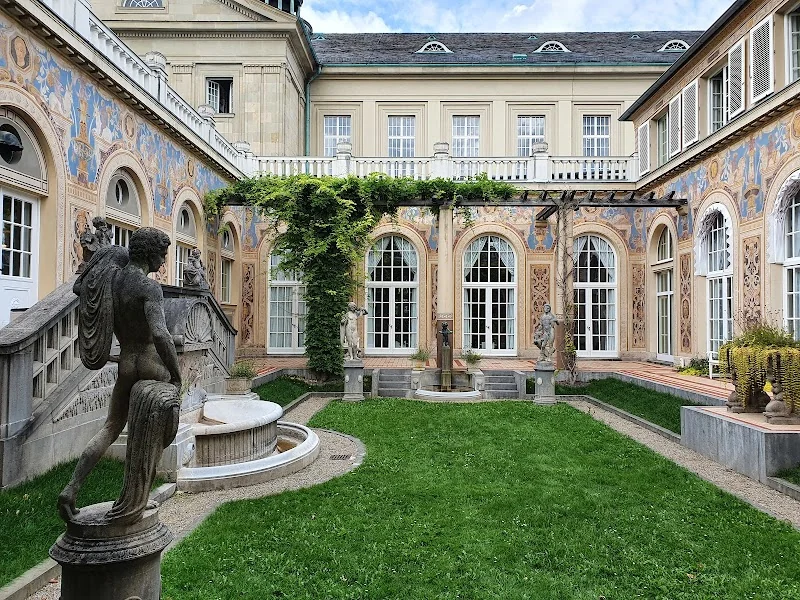
The Schmuckhof in Bad Kissingen is not an ordinary courtyard, but a small, artistically staged garden space in the middle of the historic spa district. Those who arrive here experience a place where architecture, history, and tranquility come together in a special way. The Schmuckhof is located in the spa park between the Regentenbau and the Arkadenbau and forms the architectural centerpiece of the entire ensemble. Its style appears neo-baroque, while the courtyard clearly carries the charm of a Renaissance garden. Figures from Greek and Roman mythology, the richly ornamented facades, and the sheltered location make this place one of the most atmospheric spots in Bad Kissingen. Especially for visitors looking for Schmuckhof Bad Kissingen, photos, or practical information such as opening hours and parking, this place offers a rare mix of culture and relaxation. Thus, the Schmuckhof is not just a transitional space between buildings, but an experience in itself that condenses the elegance of the spa facilities in a confined space. Anyone wanting to understand the historic spa town should not see this courtyard as a secondary location, but as the visual and spatial centerpiece of the ensemble. ([badkissingen-erleben.de](https://badkissingen-erleben.de/sehenswuerdigkeiten/schmuckhof/))
Schmuckhof Bad Kissingen: Location, Impression, and Architectural Framework
The first impression of the Schmuckhof is that of a quiet, carefully composed garden space that opens up like a hidden jewel between the historic buildings. The official visitor information describes it as a small garden in the neo-baroque style, a romantic insider tip for those seeking relaxation and lovers of well-maintained gardens. This combination of representation and intimacy is what makes its charm. The courtyard is not large, but its impact is significant: The sight lines to the White Hall, the adjacent reading rooms, and the salon at the Schmuckhof give the place depth and spatial tension. Those strolling through the spa facilities do not experience a closed space here, but an elegant connection between architecture and garden art. In the facades and frescoes, historical motifs intertwine with decorative opulence, making the courtyard appear both courtly and surprisingly lively. Particularly noteworthy is that portraits of famous spa guests from Kissingen are hidden in the frescoes. This turns the place into a kind of historical stage where the past remains visible to this day. Thus, the Schmuckhof is not only beautiful but also a narrative space where the history of the spa town lives on in images, figures, and perspectives. ([badkissingen-erleben.de](https://badkissingen-erleben.de/sehenswuerdigkeiten/schmuckhof/))
Architecturally, the Schmuckhof belongs to the Regentenbau complex, which is considered the most magnificent building in Bad Kissingen and is described as the city's central landmark. The Regentenbau was commissioned by Prince Regent Luitpold and inaugurated in 1913; it was meant to complement the Kursaal, which had become too small due to the increasing number of spa guests. The courtyard, now called Schmuckhof, was integrated in such a way that it can be experienced from various rooms. This is important because the courtyard was not intended as an isolated object, but as part of an ensemble of festivity hall, reading room, salon, and connecting corridors. The official city text emphasizes that the Regentenbau originally provided spaces for dance, concerts, and games, but also for reading, writing, and gastronomy. Therefore, the Schmuckhof stands in a tradition where spa life meant not only healing but also social and cultural life. The fact that one can still trace the same sequences of rooms today gives the place a special authenticity. Those visiting the Schmuckhof thus enter a historical spatial experience that is precisely designed for movement, changes of perspective, and lingering. ([badkissingen.de](https://www.badkissingen.de/media/www.badkissingen.de/org/med_18400/121203_regentenbau_sgi_2021_12seiten_k3.pdf))
Schmuckhof Photos: Why This Courtyard is So Photogenic
For many visitors, the search for the Schmuckhof begins with the desire for striking images. This is understandable, as the courtyard is one of the most photogenic places in Bad Kissingen. Its effect arises from the combination of light, color, and ornament. The official description speaks of frescoes in the style of the Italian Renaissance, bronze putti, and limestone gods. Additionally, the mythological figures in the courtyard give the place an almost theatrical depth. This creates motifs that not only appear documentary but also immediately convey mood. Especially in the early morning hours or in the evening, when the light becomes softer, the walls, arches, and figures unfold a calm, almost painterly presence. For this reason, the Schmuckhof is often perceived as a romantic insider tip. Those wanting to take Schmuckhof photos will find here not just any backdrop, but a dense interplay of architectural framework and garden character. The site never appears empty in pictures, but always like a place with history. This is also why the courtyard is well-suited for portraits, detail shots, travel images, and atmospheric architectural photography. The visual language of the place is clear: elegance instead of sensationalism, history instead of mere backdrop, tranquility instead of overload. ([badkissingen-erleben.de](https://badkissingen-erleben.de/sehenswuerdigkeiten/schmuckhof/))
Especially interesting for photo fans is the connection between indoor and outdoor perspectives. From the reading rooms of the Regentenbau, one has a view into the romantic Schmuckhof, and the salon at the Schmuckhof is also spatially related to this courtyard. This creates new viewpoints during the tour. This is not only pleasant for visitors but also advantageous for photographers, as motifs can be narrated in sequences: first the access through the spa garden, then the facades, then the detailed views of the figures and frescoes, and finally the view from the historic interiors onto the courtyard. In the official city historical information, the courtyard is described as a small garden idyll that also serves as a venue on mild summer nights. This dual function makes it particularly appealing for images: calm and architecturally precise during the day, atmospheric and lively in the evening. Therefore, those searching for photos of the Schmuckhof should not only consider individual views but understand the entire space as a narrative. The courtyard thrives on perspectives, and each perspective shows a different side of the spa town of Bad Kissingen. ([badkissingen.de](https://www.badkissingen.de/media/www.badkissingen.de/org/med_18400/121203_regentenbau_sgi_2021_12seiten_k3.pdf))
Directions and Parking at Schmuckhof in Bad Kissingen
Those wishing to visit the Schmuckhof need some orientation, especially in the city center, as the spa district has grown historically and is intentionally designed to be traffic-calmed. The city of Bad Kissingen explains that one can find the nearest parking option or the direct route to the city center from almost any direction of arrival. This is helpful for visitors to the Schmuckhof because its location in the spa area is central but not directly focused on cars. The public parking options provided by the city are particularly relevant: around 700 free parking spaces are available on weekdays about 10 to 15 minutes on foot from the city center, including in the Au, at the former US barracks, at Wendelinus, at Heiligenfeld, and at the ice sports hall. Additionally, there are about 500 inexpensive parking spaces in the immediate vicinity of the city center, priced at 1 euro per day. These spaces are located, among others, at Eissee, in the Au, in Kurhausstraße, at the train station, at the freight station, in Schützenstraße, and in Bergmannstraße. Therefore, those looking to park at Schmuckhof or generally seeking convenient access should use the official parking overview of the city and choose between proximity on foot and a cheaper parking space depending on the day's destination. ([badkissingen.de](https://www.badkissingen.de/information/parken/36452.Parken-in-Bad-Kissingen.html))
For visiting the Schmuckhof, the location in the spa park is ideal if one is already walking through the city center or over the historic spa facilities. The address in the visitor area is Am Kurgarten in 97688 Bad Kissingen, and it is clear that the Schmuckhof is located in an area where walking, culture, and staying often go hand in hand. Those coming from the parking lot best reach the courtyard as part of a tour through the spa district. This is advantageous because the Schmuckhof is rarely experienced as a standalone destination but mostly in the context of the Regentenbau, the Arkaden, and the Wandel- and Brunnenhalle. For this reason, it is worth planning a bit more time for the visit. Even if one was initially only looking for parking or directions, the path through the facility quickly develops into a small city experience. The city has designed its parking concept so that the city center remains traffic-calmed while various parking options are still available. For the Schmuckhof, this means: easily accessible but not dominated by car traffic. This perfectly matches the character of the place, which emphasizes tranquility, beauty, and historical atmosphere. ([badkissingen-erleben.de](https://badkissingen-erleben.de/sehenswuerdigkeiten/schmuckhof/))
Opening Hours, Admission, and Practical Visitor Information
The Schmuckhof is easily accessible and clearly structured for visitors. According to the official visitor page, it is open daily from Monday to Sunday between 10 AM and 6 PM. Admission is 7 euros, reduced 5 euros. This information makes the visit easy to plan, as one can incorporate the courtyard into the daily schedule without complicated time slots. This is particularly pleasant for travelers exploring Bad Kissingen in an afternoon or as part of a walk. The Schmuckhof is suitable for both short stops and longer stays. It is important that the courtyard is understood not only as a historical space but also as a place to stay. The official page mentions free Wi-Fi, customer toilets, and a nearby restaurant as practical notes. This infrastructure contributes to the fact that the Schmuckhof does not appear as a museum object but as a vibrant part of the spa quarter. Therefore, those searching for opening hours for Schmuckhof or admission for Schmuckhof will find reliable basic information here that makes the visit uncomplicated. ([badkissingen-erleben.de](https://badkissingen-erleben.de/sehenswuerdigkeiten/schmuckhof/))
These practical details are important because the Schmuckhof is not a separate major attraction with long waiting times, but a finely tuned cultural space. Those visiting it usually want to absorb the atmosphere, stroll, photograph, and experience the connection to the historic halls. For this, the clear opening hours are ideal. The admission is moderate, making the courtyard attractive for spontaneous visits as well. It is particularly sensible to combine the visit with a tour of the Regentenbau, as many perceptions only become clear from the sequence of rooms. From the upper and lower reading rooms, one looks into the courtyard, and the salon at the Schmuckhof complements the ensemble as a lecture and seminar room or, during balls, as a venue for festive buffets. Thus, the Schmuckhof is not an isolated garden but a hub within a cultural complex. Those visiting it experience a piece of Bad Kissingen in condensed form: history, architecture, tranquility, and a professionally managed visitor area. For SEO searches for opening hours, admission, photos, or practical tips, this combination of utility and beauty is decisive. ([badkissingen.de](https://www.badkissingen.de/media/www.badkissingen.de/org/med_18400/121203_regentenbau_sgi_2021_12seiten_k3.pdf))
Events at Schmuckhof: Lounge, Culture, and Tours
The Schmuckhof is not only a beautiful place to linger but also a space for events. The city of Bad Kissingen describes it as a place where an After-Concert Lounge takes place every Friday as part of the festival. To soft music and a good drink, the experiences can resonate while enjoying the various facets of the architecture. This is an important point for anyone searching for lounge at Schmuckhof or Schmuckhof events: the courtyard is not merely decorative but part of the cultural life of the city. Should the weather not cooperate, the adjacent salon serves as an equally elegant alternative venue. Thus, the Schmuckhof presents itself as a flexible event location that not only provides beautiful images but also allows for genuine use. On mild summer nights, according to the city historical information, it also serves as an event venue. This creates a special mix of outdoor atmosphere and historical backdrop for guests, which is part of the charm of the place. ([badkissingen.de](https://www.badkissingen.de/kultur/veranstaltungskalender?ev%5Bid%5D=115673))
Guided tours also actively incorporate the Schmuckhof into the visitor experience. During the official tour of the Regentenbau, Arkadenbau, and Wandelhalle, the path leads through the historic rooms, past the White Hall and the salon at the Schmuckhof, and then after a short stay in the Schmuckhof continues to the tourist information. This clearly shows the role of the courtyard in the overall picture: it is a link between the representative halls and the open spa garden. Those taking a guided tour do not experience the courtyard merely as a pretty stop but as a spatial axis in the historic ensemble. This is particularly exciting for visitors interested in architecture, city history, and event venues. The Schmuckhof thus offers two levels of experience: on the one hand, the quiet, almost private impression of a garden in the courtyard, and on the other, the public use during concerts, lounges, and tours. This dual role makes it so valuable for Bad Kissingen. Those searching for Schmuckhof photos, lounge at Schmuckhof, or Schmuckhof events will find a place that is indeed more than just a background. It is a stage, a transitional space, and an experience space at the same time. ([badkissingen.de](https://www.badkissingen.de/kultur/veranstaltungskalender?ev%5Bid%5D=133702&utm_source=openai))
Regentenbau, Arkadenbau, and the History of Schmuckhof
To truly understand the Schmuckhof, one must consider the larger historical context. The Regentenbau was planned starting in 1910, opened in 1913, and is considered the most magnificent building in Bad Kissingen. It was meant to complement the older Kursaal, which had become too small due to the increased number of spa guests. The city historical information makes it clear that the new building was to accommodate spaces for dance, concerts, games, reading, writing, and gastronomy. The Schmuckhof was thus integrated from the very beginning into a comprehensive spa architecture. This picture is complemented by the Arkadenbau, which was built starting in 1834 and was at the beginning of the expansion of the spa district under King Ludwig I. The Arkadenbau was designed by Friedrich von Gärtner and constructed in the neo-Romanesque round arch style. It and the Kursaal provided spa guests protection from wind and weather during the drinking cure. This development shows how Bad Kissingen evolved from a spa town in the 19th century to a representative spa ensemble with international appeal. Thus, the Schmuckhof is not only a beautiful courtyard but also a late, very consciously composed link between older and newer architecture. ([badkissingen.de](https://www.badkissingen.de/media/www.badkissingen.de/org/med_18400/121203_regentenbau_sgi_2021_12seiten_k3.pdf))
The view of the historic rooms also shows why the Schmuckhof works so well today. The White Hall opens up with its generous window front to the courtyard, and the salon at the Schmuckhof was developed from the former playroom. According to the city historical information, this salon is now used as a lecture and seminar room and also for festive buffets during balls in the Max-Littmann-Saal. Furthermore, the courtyard gains its visual density through frescoes in the style of the Italian Renaissance, bronze putti, limestone gods, and mythological figures. This is not random decoration but a historically intended program that makes the place readable as a garden of representation. In this sense, the Schmuckhof is a very good example of how Bad Kissingen makes its World Heritage quality tangible in everyday life: through spaces that not only show history but also make it walkable. Those visiting the courtyard stand in an ensemble that has grown over decades, even centuries. Therefore, the journey there is worthwhile for all those who initially searched for Bad Kissingen Schmuckhof, photos, or directions. In the end, one discovers a place that is architecturally precise and atmospherically generous at the same time. ([badkissingen.de](https://www.badkissingen.de/media/www.badkissingen.de/org/med_18400/121203_regentenbau_sgi_2021_12seiten_k3.pdf))
Sources:
Show moreShow less
Schmuckhof Bad Kissingen | Parking & Photos
The Schmuckhof in Bad Kissingen is not an ordinary courtyard, but a small, artistically staged garden space in the middle of the historic spa district. Those who arrive here experience a place where architecture, history, and tranquility come together in a special way. The Schmuckhof is located in the spa park between the Regentenbau and the Arkadenbau and forms the architectural centerpiece of the entire ensemble. Its style appears neo-baroque, while the courtyard clearly carries the charm of a Renaissance garden. Figures from Greek and Roman mythology, the richly ornamented facades, and the sheltered location make this place one of the most atmospheric spots in Bad Kissingen. Especially for visitors looking for Schmuckhof Bad Kissingen, photos, or practical information such as opening hours and parking, this place offers a rare mix of culture and relaxation. Thus, the Schmuckhof is not just a transitional space between buildings, but an experience in itself that condenses the elegance of the spa facilities in a confined space. Anyone wanting to understand the historic spa town should not see this courtyard as a secondary location, but as the visual and spatial centerpiece of the ensemble. ([badkissingen-erleben.de](https://badkissingen-erleben.de/sehenswuerdigkeiten/schmuckhof/))
Schmuckhof Bad Kissingen: Location, Impression, and Architectural Framework
The first impression of the Schmuckhof is that of a quiet, carefully composed garden space that opens up like a hidden jewel between the historic buildings. The official visitor information describes it as a small garden in the neo-baroque style, a romantic insider tip for those seeking relaxation and lovers of well-maintained gardens. This combination of representation and intimacy is what makes its charm. The courtyard is not large, but its impact is significant: The sight lines to the White Hall, the adjacent reading rooms, and the salon at the Schmuckhof give the place depth and spatial tension. Those strolling through the spa facilities do not experience a closed space here, but an elegant connection between architecture and garden art. In the facades and frescoes, historical motifs intertwine with decorative opulence, making the courtyard appear both courtly and surprisingly lively. Particularly noteworthy is that portraits of famous spa guests from Kissingen are hidden in the frescoes. This turns the place into a kind of historical stage where the past remains visible to this day. Thus, the Schmuckhof is not only beautiful but also a narrative space where the history of the spa town lives on in images, figures, and perspectives. ([badkissingen-erleben.de](https://badkissingen-erleben.de/sehenswuerdigkeiten/schmuckhof/))
Architecturally, the Schmuckhof belongs to the Regentenbau complex, which is considered the most magnificent building in Bad Kissingen and is described as the city's central landmark. The Regentenbau was commissioned by Prince Regent Luitpold and inaugurated in 1913; it was meant to complement the Kursaal, which had become too small due to the increasing number of spa guests. The courtyard, now called Schmuckhof, was integrated in such a way that it can be experienced from various rooms. This is important because the courtyard was not intended as an isolated object, but as part of an ensemble of festivity hall, reading room, salon, and connecting corridors. The official city text emphasizes that the Regentenbau originally provided spaces for dance, concerts, and games, but also for reading, writing, and gastronomy. Therefore, the Schmuckhof stands in a tradition where spa life meant not only healing but also social and cultural life. The fact that one can still trace the same sequences of rooms today gives the place a special authenticity. Those visiting the Schmuckhof thus enter a historical spatial experience that is precisely designed for movement, changes of perspective, and lingering. ([badkissingen.de](https://www.badkissingen.de/media/www.badkissingen.de/org/med_18400/121203_regentenbau_sgi_2021_12seiten_k3.pdf))
Schmuckhof Photos: Why This Courtyard is So Photogenic
For many visitors, the search for the Schmuckhof begins with the desire for striking images. This is understandable, as the courtyard is one of the most photogenic places in Bad Kissingen. Its effect arises from the combination of light, color, and ornament. The official description speaks of frescoes in the style of the Italian Renaissance, bronze putti, and limestone gods. Additionally, the mythological figures in the courtyard give the place an almost theatrical depth. This creates motifs that not only appear documentary but also immediately convey mood. Especially in the early morning hours or in the evening, when the light becomes softer, the walls, arches, and figures unfold a calm, almost painterly presence. For this reason, the Schmuckhof is often perceived as a romantic insider tip. Those wanting to take Schmuckhof photos will find here not just any backdrop, but a dense interplay of architectural framework and garden character. The site never appears empty in pictures, but always like a place with history. This is also why the courtyard is well-suited for portraits, detail shots, travel images, and atmospheric architectural photography. The visual language of the place is clear: elegance instead of sensationalism, history instead of mere backdrop, tranquility instead of overload. ([badkissingen-erleben.de](https://badkissingen-erleben.de/sehenswuerdigkeiten/schmuckhof/))
Especially interesting for photo fans is the connection between indoor and outdoor perspectives. From the reading rooms of the Regentenbau, one has a view into the romantic Schmuckhof, and the salon at the Schmuckhof is also spatially related to this courtyard. This creates new viewpoints during the tour. This is not only pleasant for visitors but also advantageous for photographers, as motifs can be narrated in sequences: first the access through the spa garden, then the facades, then the detailed views of the figures and frescoes, and finally the view from the historic interiors onto the courtyard. In the official city historical information, the courtyard is described as a small garden idyll that also serves as a venue on mild summer nights. This dual function makes it particularly appealing for images: calm and architecturally precise during the day, atmospheric and lively in the evening. Therefore, those searching for photos of the Schmuckhof should not only consider individual views but understand the entire space as a narrative. The courtyard thrives on perspectives, and each perspective shows a different side of the spa town of Bad Kissingen. ([badkissingen.de](https://www.badkissingen.de/media/www.badkissingen.de/org/med_18400/121203_regentenbau_sgi_2021_12seiten_k3.pdf))
Directions and Parking at Schmuckhof in Bad Kissingen
Those wishing to visit the Schmuckhof need some orientation, especially in the city center, as the spa district has grown historically and is intentionally designed to be traffic-calmed. The city of Bad Kissingen explains that one can find the nearest parking option or the direct route to the city center from almost any direction of arrival. This is helpful for visitors to the Schmuckhof because its location in the spa area is central but not directly focused on cars. The public parking options provided by the city are particularly relevant: around 700 free parking spaces are available on weekdays about 10 to 15 minutes on foot from the city center, including in the Au, at the former US barracks, at Wendelinus, at Heiligenfeld, and at the ice sports hall. Additionally, there are about 500 inexpensive parking spaces in the immediate vicinity of the city center, priced at 1 euro per day. These spaces are located, among others, at Eissee, in the Au, in Kurhausstraße, at the train station, at the freight station, in Schützenstraße, and in Bergmannstraße. Therefore, those looking to park at Schmuckhof or generally seeking convenient access should use the official parking overview of the city and choose between proximity on foot and a cheaper parking space depending on the day's destination. ([badkissingen.de](https://www.badkissingen.de/information/parken/36452.Parken-in-Bad-Kissingen.html))
For visiting the Schmuckhof, the location in the spa park is ideal if one is already walking through the city center or over the historic spa facilities. The address in the visitor area is Am Kurgarten in 97688 Bad Kissingen, and it is clear that the Schmuckhof is located in an area where walking, culture, and staying often go hand in hand. Those coming from the parking lot best reach the courtyard as part of a tour through the spa district. This is advantageous because the Schmuckhof is rarely experienced as a standalone destination but mostly in the context of the Regentenbau, the Arkaden, and the Wandel- and Brunnenhalle. For this reason, it is worth planning a bit more time for the visit. Even if one was initially only looking for parking or directions, the path through the facility quickly develops into a small city experience. The city has designed its parking concept so that the city center remains traffic-calmed while various parking options are still available. For the Schmuckhof, this means: easily accessible but not dominated by car traffic. This perfectly matches the character of the place, which emphasizes tranquility, beauty, and historical atmosphere. ([badkissingen-erleben.de](https://badkissingen-erleben.de/sehenswuerdigkeiten/schmuckhof/))
Opening Hours, Admission, and Practical Visitor Information
The Schmuckhof is easily accessible and clearly structured for visitors. According to the official visitor page, it is open daily from Monday to Sunday between 10 AM and 6 PM. Admission is 7 euros, reduced 5 euros. This information makes the visit easy to plan, as one can incorporate the courtyard into the daily schedule without complicated time slots. This is particularly pleasant for travelers exploring Bad Kissingen in an afternoon or as part of a walk. The Schmuckhof is suitable for both short stops and longer stays. It is important that the courtyard is understood not only as a historical space but also as a place to stay. The official page mentions free Wi-Fi, customer toilets, and a nearby restaurant as practical notes. This infrastructure contributes to the fact that the Schmuckhof does not appear as a museum object but as a vibrant part of the spa quarter. Therefore, those searching for opening hours for Schmuckhof or admission for Schmuckhof will find reliable basic information here that makes the visit uncomplicated. ([badkissingen-erleben.de](https://badkissingen-erleben.de/sehenswuerdigkeiten/schmuckhof/))
These practical details are important because the Schmuckhof is not a separate major attraction with long waiting times, but a finely tuned cultural space. Those visiting it usually want to absorb the atmosphere, stroll, photograph, and experience the connection to the historic halls. For this, the clear opening hours are ideal. The admission is moderate, making the courtyard attractive for spontaneous visits as well. It is particularly sensible to combine the visit with a tour of the Regentenbau, as many perceptions only become clear from the sequence of rooms. From the upper and lower reading rooms, one looks into the courtyard, and the salon at the Schmuckhof complements the ensemble as a lecture and seminar room or, during balls, as a venue for festive buffets. Thus, the Schmuckhof is not an isolated garden but a hub within a cultural complex. Those visiting it experience a piece of Bad Kissingen in condensed form: history, architecture, tranquility, and a professionally managed visitor area. For SEO searches for opening hours, admission, photos, or practical tips, this combination of utility and beauty is decisive. ([badkissingen.de](https://www.badkissingen.de/media/www.badkissingen.de/org/med_18400/121203_regentenbau_sgi_2021_12seiten_k3.pdf))
Events at Schmuckhof: Lounge, Culture, and Tours
The Schmuckhof is not only a beautiful place to linger but also a space for events. The city of Bad Kissingen describes it as a place where an After-Concert Lounge takes place every Friday as part of the festival. To soft music and a good drink, the experiences can resonate while enjoying the various facets of the architecture. This is an important point for anyone searching for lounge at Schmuckhof or Schmuckhof events: the courtyard is not merely decorative but part of the cultural life of the city. Should the weather not cooperate, the adjacent salon serves as an equally elegant alternative venue. Thus, the Schmuckhof presents itself as a flexible event location that not only provides beautiful images but also allows for genuine use. On mild summer nights, according to the city historical information, it also serves as an event venue. This creates a special mix of outdoor atmosphere and historical backdrop for guests, which is part of the charm of the place. ([badkissingen.de](https://www.badkissingen.de/kultur/veranstaltungskalender?ev%5Bid%5D=115673))
Guided tours also actively incorporate the Schmuckhof into the visitor experience. During the official tour of the Regentenbau, Arkadenbau, and Wandelhalle, the path leads through the historic rooms, past the White Hall and the salon at the Schmuckhof, and then after a short stay in the Schmuckhof continues to the tourist information. This clearly shows the role of the courtyard in the overall picture: it is a link between the representative halls and the open spa garden. Those taking a guided tour do not experience the courtyard merely as a pretty stop but as a spatial axis in the historic ensemble. This is particularly exciting for visitors interested in architecture, city history, and event venues. The Schmuckhof thus offers two levels of experience: on the one hand, the quiet, almost private impression of a garden in the courtyard, and on the other, the public use during concerts, lounges, and tours. This dual role makes it so valuable for Bad Kissingen. Those searching for Schmuckhof photos, lounge at Schmuckhof, or Schmuckhof events will find a place that is indeed more than just a background. It is a stage, a transitional space, and an experience space at the same time. ([badkissingen.de](https://www.badkissingen.de/kultur/veranstaltungskalender?ev%5Bid%5D=133702&utm_source=openai))
Regentenbau, Arkadenbau, and the History of Schmuckhof
To truly understand the Schmuckhof, one must consider the larger historical context. The Regentenbau was planned starting in 1910, opened in 1913, and is considered the most magnificent building in Bad Kissingen. It was meant to complement the older Kursaal, which had become too small due to the increased number of spa guests. The city historical information makes it clear that the new building was to accommodate spaces for dance, concerts, games, reading, writing, and gastronomy. The Schmuckhof was thus integrated from the very beginning into a comprehensive spa architecture. This picture is complemented by the Arkadenbau, which was built starting in 1834 and was at the beginning of the expansion of the spa district under King Ludwig I. The Arkadenbau was designed by Friedrich von Gärtner and constructed in the neo-Romanesque round arch style. It and the Kursaal provided spa guests protection from wind and weather during the drinking cure. This development shows how Bad Kissingen evolved from a spa town in the 19th century to a representative spa ensemble with international appeal. Thus, the Schmuckhof is not only a beautiful courtyard but also a late, very consciously composed link between older and newer architecture. ([badkissingen.de](https://www.badkissingen.de/media/www.badkissingen.de/org/med_18400/121203_regentenbau_sgi_2021_12seiten_k3.pdf))
The view of the historic rooms also shows why the Schmuckhof works so well today. The White Hall opens up with its generous window front to the courtyard, and the salon at the Schmuckhof was developed from the former playroom. According to the city historical information, this salon is now used as a lecture and seminar room and also for festive buffets during balls in the Max-Littmann-Saal. Furthermore, the courtyard gains its visual density through frescoes in the style of the Italian Renaissance, bronze putti, limestone gods, and mythological figures. This is not random decoration but a historically intended program that makes the place readable as a garden of representation. In this sense, the Schmuckhof is a very good example of how Bad Kissingen makes its World Heritage quality tangible in everyday life: through spaces that not only show history but also make it walkable. Those visiting the courtyard stand in an ensemble that has grown over decades, even centuries. Therefore, the journey there is worthwhile for all those who initially searched for Bad Kissingen Schmuckhof, photos, or directions. In the end, one discovers a place that is architecturally precise and atmospherically generous at the same time. ([badkissingen.de](https://www.badkissingen.de/media/www.badkissingen.de/org/med_18400/121203_regentenbau_sgi_2021_12seiten_k3.pdf))
Sources:
Schmuckhof Bad Kissingen | Parking & Photos
The Schmuckhof in Bad Kissingen is not an ordinary courtyard, but a small, artistically staged garden space in the middle of the historic spa district. Those who arrive here experience a place where architecture, history, and tranquility come together in a special way. The Schmuckhof is located in the spa park between the Regentenbau and the Arkadenbau and forms the architectural centerpiece of the entire ensemble. Its style appears neo-baroque, while the courtyard clearly carries the charm of a Renaissance garden. Figures from Greek and Roman mythology, the richly ornamented facades, and the sheltered location make this place one of the most atmospheric spots in Bad Kissingen. Especially for visitors looking for Schmuckhof Bad Kissingen, photos, or practical information such as opening hours and parking, this place offers a rare mix of culture and relaxation. Thus, the Schmuckhof is not just a transitional space between buildings, but an experience in itself that condenses the elegance of the spa facilities in a confined space. Anyone wanting to understand the historic spa town should not see this courtyard as a secondary location, but as the visual and spatial centerpiece of the ensemble. ([badkissingen-erleben.de](https://badkissingen-erleben.de/sehenswuerdigkeiten/schmuckhof/))
Schmuckhof Bad Kissingen: Location, Impression, and Architectural Framework
The first impression of the Schmuckhof is that of a quiet, carefully composed garden space that opens up like a hidden jewel between the historic buildings. The official visitor information describes it as a small garden in the neo-baroque style, a romantic insider tip for those seeking relaxation and lovers of well-maintained gardens. This combination of representation and intimacy is what makes its charm. The courtyard is not large, but its impact is significant: The sight lines to the White Hall, the adjacent reading rooms, and the salon at the Schmuckhof give the place depth and spatial tension. Those strolling through the spa facilities do not experience a closed space here, but an elegant connection between architecture and garden art. In the facades and frescoes, historical motifs intertwine with decorative opulence, making the courtyard appear both courtly and surprisingly lively. Particularly noteworthy is that portraits of famous spa guests from Kissingen are hidden in the frescoes. This turns the place into a kind of historical stage where the past remains visible to this day. Thus, the Schmuckhof is not only beautiful but also a narrative space where the history of the spa town lives on in images, figures, and perspectives. ([badkissingen-erleben.de](https://badkissingen-erleben.de/sehenswuerdigkeiten/schmuckhof/))
Architecturally, the Schmuckhof belongs to the Regentenbau complex, which is considered the most magnificent building in Bad Kissingen and is described as the city's central landmark. The Regentenbau was commissioned by Prince Regent Luitpold and inaugurated in 1913; it was meant to complement the Kursaal, which had become too small due to the increasing number of spa guests. The courtyard, now called Schmuckhof, was integrated in such a way that it can be experienced from various rooms. This is important because the courtyard was not intended as an isolated object, but as part of an ensemble of festivity hall, reading room, salon, and connecting corridors. The official city text emphasizes that the Regentenbau originally provided spaces for dance, concerts, and games, but also for reading, writing, and gastronomy. Therefore, the Schmuckhof stands in a tradition where spa life meant not only healing but also social and cultural life. The fact that one can still trace the same sequences of rooms today gives the place a special authenticity. Those visiting the Schmuckhof thus enter a historical spatial experience that is precisely designed for movement, changes of perspective, and lingering. ([badkissingen.de](https://www.badkissingen.de/media/www.badkissingen.de/org/med_18400/121203_regentenbau_sgi_2021_12seiten_k3.pdf))
Schmuckhof Photos: Why This Courtyard is So Photogenic
For many visitors, the search for the Schmuckhof begins with the desire for striking images. This is understandable, as the courtyard is one of the most photogenic places in Bad Kissingen. Its effect arises from the combination of light, color, and ornament. The official description speaks of frescoes in the style of the Italian Renaissance, bronze putti, and limestone gods. Additionally, the mythological figures in the courtyard give the place an almost theatrical depth. This creates motifs that not only appear documentary but also immediately convey mood. Especially in the early morning hours or in the evening, when the light becomes softer, the walls, arches, and figures unfold a calm, almost painterly presence. For this reason, the Schmuckhof is often perceived as a romantic insider tip. Those wanting to take Schmuckhof photos will find here not just any backdrop, but a dense interplay of architectural framework and garden character. The site never appears empty in pictures, but always like a place with history. This is also why the courtyard is well-suited for portraits, detail shots, travel images, and atmospheric architectural photography. The visual language of the place is clear: elegance instead of sensationalism, history instead of mere backdrop, tranquility instead of overload. ([badkissingen-erleben.de](https://badkissingen-erleben.de/sehenswuerdigkeiten/schmuckhof/))
Especially interesting for photo fans is the connection between indoor and outdoor perspectives. From the reading rooms of the Regentenbau, one has a view into the romantic Schmuckhof, and the salon at the Schmuckhof is also spatially related to this courtyard. This creates new viewpoints during the tour. This is not only pleasant for visitors but also advantageous for photographers, as motifs can be narrated in sequences: first the access through the spa garden, then the facades, then the detailed views of the figures and frescoes, and finally the view from the historic interiors onto the courtyard. In the official city historical information, the courtyard is described as a small garden idyll that also serves as a venue on mild summer nights. This dual function makes it particularly appealing for images: calm and architecturally precise during the day, atmospheric and lively in the evening. Therefore, those searching for photos of the Schmuckhof should not only consider individual views but understand the entire space as a narrative. The courtyard thrives on perspectives, and each perspective shows a different side of the spa town of Bad Kissingen. ([badkissingen.de](https://www.badkissingen.de/media/www.badkissingen.de/org/med_18400/121203_regentenbau_sgi_2021_12seiten_k3.pdf))
Directions and Parking at Schmuckhof in Bad Kissingen
Those wishing to visit the Schmuckhof need some orientation, especially in the city center, as the spa district has grown historically and is intentionally designed to be traffic-calmed. The city of Bad Kissingen explains that one can find the nearest parking option or the direct route to the city center from almost any direction of arrival. This is helpful for visitors to the Schmuckhof because its location in the spa area is central but not directly focused on cars. The public parking options provided by the city are particularly relevant: around 700 free parking spaces are available on weekdays about 10 to 15 minutes on foot from the city center, including in the Au, at the former US barracks, at Wendelinus, at Heiligenfeld, and at the ice sports hall. Additionally, there are about 500 inexpensive parking spaces in the immediate vicinity of the city center, priced at 1 euro per day. These spaces are located, among others, at Eissee, in the Au, in Kurhausstraße, at the train station, at the freight station, in Schützenstraße, and in Bergmannstraße. Therefore, those looking to park at Schmuckhof or generally seeking convenient access should use the official parking overview of the city and choose between proximity on foot and a cheaper parking space depending on the day's destination. ([badkissingen.de](https://www.badkissingen.de/information/parken/36452.Parken-in-Bad-Kissingen.html))
For visiting the Schmuckhof, the location in the spa park is ideal if one is already walking through the city center or over the historic spa facilities. The address in the visitor area is Am Kurgarten in 97688 Bad Kissingen, and it is clear that the Schmuckhof is located in an area where walking, culture, and staying often go hand in hand. Those coming from the parking lot best reach the courtyard as part of a tour through the spa district. This is advantageous because the Schmuckhof is rarely experienced as a standalone destination but mostly in the context of the Regentenbau, the Arkaden, and the Wandel- and Brunnenhalle. For this reason, it is worth planning a bit more time for the visit. Even if one was initially only looking for parking or directions, the path through the facility quickly develops into a small city experience. The city has designed its parking concept so that the city center remains traffic-calmed while various parking options are still available. For the Schmuckhof, this means: easily accessible but not dominated by car traffic. This perfectly matches the character of the place, which emphasizes tranquility, beauty, and historical atmosphere. ([badkissingen-erleben.de](https://badkissingen-erleben.de/sehenswuerdigkeiten/schmuckhof/))
Opening Hours, Admission, and Practical Visitor Information
The Schmuckhof is easily accessible and clearly structured for visitors. According to the official visitor page, it is open daily from Monday to Sunday between 10 AM and 6 PM. Admission is 7 euros, reduced 5 euros. This information makes the visit easy to plan, as one can incorporate the courtyard into the daily schedule without complicated time slots. This is particularly pleasant for travelers exploring Bad Kissingen in an afternoon or as part of a walk. The Schmuckhof is suitable for both short stops and longer stays. It is important that the courtyard is understood not only as a historical space but also as a place to stay. The official page mentions free Wi-Fi, customer toilets, and a nearby restaurant as practical notes. This infrastructure contributes to the fact that the Schmuckhof does not appear as a museum object but as a vibrant part of the spa quarter. Therefore, those searching for opening hours for Schmuckhof or admission for Schmuckhof will find reliable basic information here that makes the visit uncomplicated. ([badkissingen-erleben.de](https://badkissingen-erleben.de/sehenswuerdigkeiten/schmuckhof/))
These practical details are important because the Schmuckhof is not a separate major attraction with long waiting times, but a finely tuned cultural space. Those visiting it usually want to absorb the atmosphere, stroll, photograph, and experience the connection to the historic halls. For this, the clear opening hours are ideal. The admission is moderate, making the courtyard attractive for spontaneous visits as well. It is particularly sensible to combine the visit with a tour of the Regentenbau, as many perceptions only become clear from the sequence of rooms. From the upper and lower reading rooms, one looks into the courtyard, and the salon at the Schmuckhof complements the ensemble as a lecture and seminar room or, during balls, as a venue for festive buffets. Thus, the Schmuckhof is not an isolated garden but a hub within a cultural complex. Those visiting it experience a piece of Bad Kissingen in condensed form: history, architecture, tranquility, and a professionally managed visitor area. For SEO searches for opening hours, admission, photos, or practical tips, this combination of utility and beauty is decisive. ([badkissingen.de](https://www.badkissingen.de/media/www.badkissingen.de/org/med_18400/121203_regentenbau_sgi_2021_12seiten_k3.pdf))
Events at Schmuckhof: Lounge, Culture, and Tours
The Schmuckhof is not only a beautiful place to linger but also a space for events. The city of Bad Kissingen describes it as a place where an After-Concert Lounge takes place every Friday as part of the festival. To soft music and a good drink, the experiences can resonate while enjoying the various facets of the architecture. This is an important point for anyone searching for lounge at Schmuckhof or Schmuckhof events: the courtyard is not merely decorative but part of the cultural life of the city. Should the weather not cooperate, the adjacent salon serves as an equally elegant alternative venue. Thus, the Schmuckhof presents itself as a flexible event location that not only provides beautiful images but also allows for genuine use. On mild summer nights, according to the city historical information, it also serves as an event venue. This creates a special mix of outdoor atmosphere and historical backdrop for guests, which is part of the charm of the place. ([badkissingen.de](https://www.badkissingen.de/kultur/veranstaltungskalender?ev%5Bid%5D=115673))
Guided tours also actively incorporate the Schmuckhof into the visitor experience. During the official tour of the Regentenbau, Arkadenbau, and Wandelhalle, the path leads through the historic rooms, past the White Hall and the salon at the Schmuckhof, and then after a short stay in the Schmuckhof continues to the tourist information. This clearly shows the role of the courtyard in the overall picture: it is a link between the representative halls and the open spa garden. Those taking a guided tour do not experience the courtyard merely as a pretty stop but as a spatial axis in the historic ensemble. This is particularly exciting for visitors interested in architecture, city history, and event venues. The Schmuckhof thus offers two levels of experience: on the one hand, the quiet, almost private impression of a garden in the courtyard, and on the other, the public use during concerts, lounges, and tours. This dual role makes it so valuable for Bad Kissingen. Those searching for Schmuckhof photos, lounge at Schmuckhof, or Schmuckhof events will find a place that is indeed more than just a background. It is a stage, a transitional space, and an experience space at the same time. ([badkissingen.de](https://www.badkissingen.de/kultur/veranstaltungskalender?ev%5Bid%5D=133702&utm_source=openai))
Regentenbau, Arkadenbau, and the History of Schmuckhof
To truly understand the Schmuckhof, one must consider the larger historical context. The Regentenbau was planned starting in 1910, opened in 1913, and is considered the most magnificent building in Bad Kissingen. It was meant to complement the older Kursaal, which had become too small due to the increased number of spa guests. The city historical information makes it clear that the new building was to accommodate spaces for dance, concerts, games, reading, writing, and gastronomy. The Schmuckhof was thus integrated from the very beginning into a comprehensive spa architecture. This picture is complemented by the Arkadenbau, which was built starting in 1834 and was at the beginning of the expansion of the spa district under King Ludwig I. The Arkadenbau was designed by Friedrich von Gärtner and constructed in the neo-Romanesque round arch style. It and the Kursaal provided spa guests protection from wind and weather during the drinking cure. This development shows how Bad Kissingen evolved from a spa town in the 19th century to a representative spa ensemble with international appeal. Thus, the Schmuckhof is not only a beautiful courtyard but also a late, very consciously composed link between older and newer architecture. ([badkissingen.de](https://www.badkissingen.de/media/www.badkissingen.de/org/med_18400/121203_regentenbau_sgi_2021_12seiten_k3.pdf))
The view of the historic rooms also shows why the Schmuckhof works so well today. The White Hall opens up with its generous window front to the courtyard, and the salon at the Schmuckhof was developed from the former playroom. According to the city historical information, this salon is now used as a lecture and seminar room and also for festive buffets during balls in the Max-Littmann-Saal. Furthermore, the courtyard gains its visual density through frescoes in the style of the Italian Renaissance, bronze putti, limestone gods, and mythological figures. This is not random decoration but a historically intended program that makes the place readable as a garden of representation. In this sense, the Schmuckhof is a very good example of how Bad Kissingen makes its World Heritage quality tangible in everyday life: through spaces that not only show history but also make it walkable. Those visiting the courtyard stand in an ensemble that has grown over decades, even centuries. Therefore, the journey there is worthwhile for all those who initially searched for Bad Kissingen Schmuckhof, photos, or directions. In the end, one discovers a place that is architecturally precise and atmospherically generous at the same time. ([badkissingen.de](https://www.badkissingen.de/media/www.badkissingen.de/org/med_18400/121203_regentenbau_sgi_2021_12seiten_k3.pdf))
Sources:
Upcoming Events
Opening Concert Budapest Festival Orchestra
Visit the opening concert with Iván Fischer and Elisabeth Leonskaja on June 12, 2026, in Bad Kissingen.

Lounge in the Schmuckhof
A Summer Evening to Resonate: The Lounge in the Schmuckhof combines concert enjoyment, architecture, and spa town flair in Bad Kissingen. 26.06.2026, 12 euros. #KissingerSommer
Frequently Asked Questions
Reviews
No reviews found