
Dierk Berthel
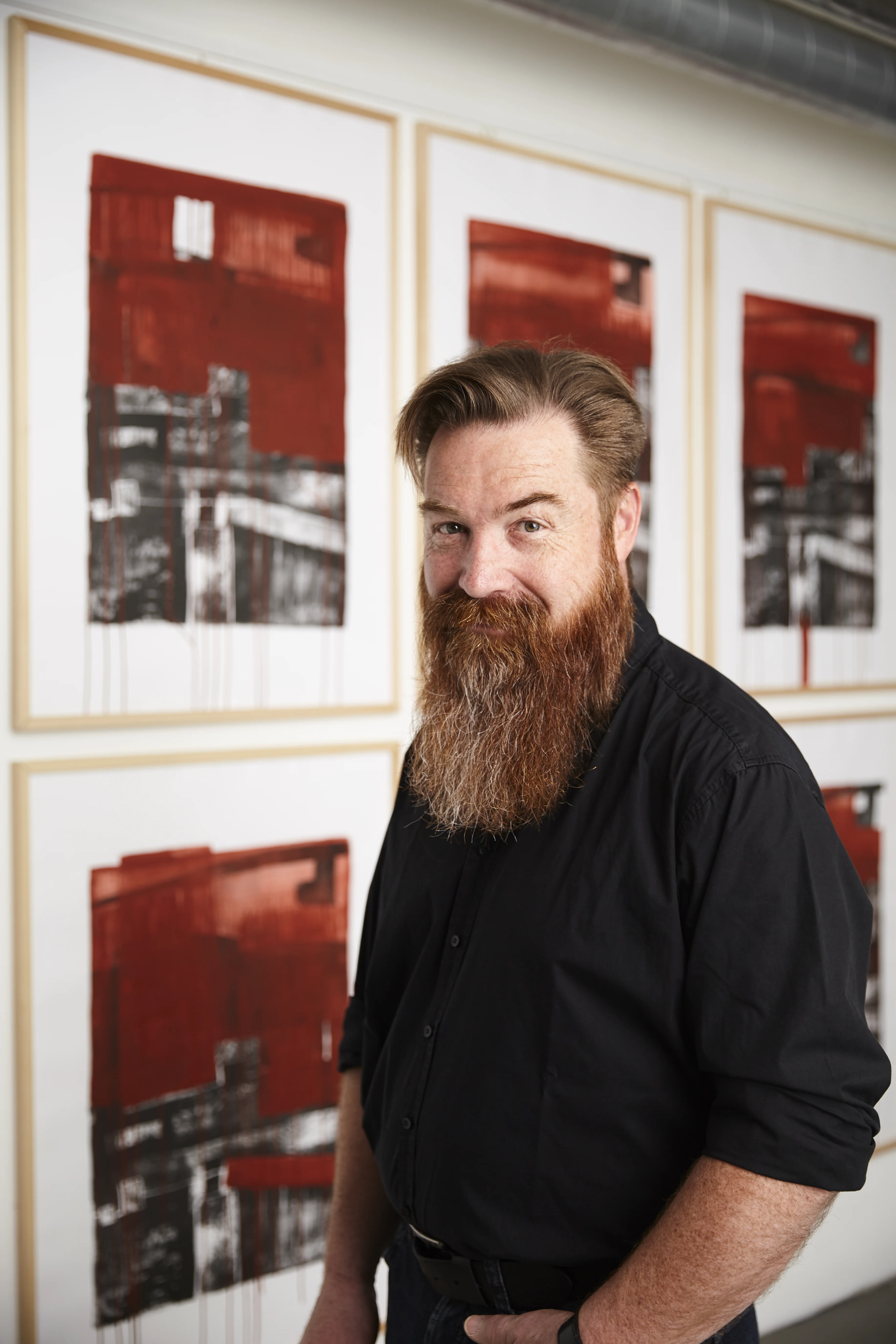
Image from Wikipedia
Image from Wikipedia
Dierk Berthel – Sculptor Between Space, Material, and Sound
An artist who opens spaces: The Franconian sculptor with a sense of form, craftsmanship, and social relevance
Dierk Berthel, born in 1963 in Schweinfurt, is one of the defining sculptors from Lower Franconia. Trained as a stonemason and stone sculptor and working independently since 1986, he creates sculptures and installations from metal, stone, and wood that consciously transform places and renegotiate the relationship between body, space, and perception. His work includes public art, architectural work, plastic interventions in sacred and urban spaces, as well as print graphics. With an unwavering connection to craftsmanship, a clear awareness of form, and an experimental openness – including sound projects – Berthel combines artistic development with social engagement.
Biography and Education: From the Workbench in Schweinfurt to Independent Sculpture
Growing up as the son of an architect, Berthel found early access to construction, statics, and space. From 1978 to 1981, he completed an apprenticeship as a stonemason and stone sculptor with Julius Katzenberger. This was followed by specialized schooling for sculptors in Aschaffenburg (1984–1986), where he deepened his craftsmanship and artistic expertise as a master student of Erwin Rager and Ernst Vollmer, finishing with a master craftsman diploma. Since 1986, he has worked as a freelance sculptor. He lives and works in Rannungen in the Bad Kissingen district; his roots in Franconia, combined with international exhibition and symposium activities, form a common thread in his artistic career – a continuous artistic development with a distinctive stage presence in public space.
Artistic Development: Material Aesthetics, Construction, and the Poetics of Space
Berthel's sculptures address the tension between constructive precision and archaic effect. Characteristic is the combination of wood and iron, of hewn stone and burnished steel. The compositional arrangement follows a clear formal dramaturgy: through incisions, slits, ring forms, and linear interpenetrations, he intertwines volume and emptiness, framework and shell, weight and balance. This approach to material and construction creates a choreography in space – sculpture as an “intervention” rather than a mere object. Early works already demonstrate this “playing with space,” which later manifests in larger spatial groupings and installative settings.
Public Art and Architectural Work: Sculpture as a Societal Place
A focus of his work lies in architectural art and public art. Berthel has realized fountain installations (including in Münnerstadt, Dittelbrunn, Schweinfurt), square designs (e.g., Milk Can Memorial in Gauaschach, Three Lambs Memorial in Wiesenfeld), as well as image stocks and sacred sculptures in Franconian communities, as well as church space designs (including Dittelbrunn, Brünn, Schweinfurt). His sculptures can also be found along sculpture trails, in town halls, and city parks. These projects connect site-specific composition and lasting materiality with public participation: the urban space becomes a stage, and sculpture becomes an impetus for encounter and dialogue.
Works, Series, and Iconic Motifs: Slit Figure, Double Ring, and Figure I
Motifs such as “slit figures,” double ring forms, and body-cut spaces shape his work. In the “slit figures,” vertical penetrations and horizontal volumes intertwine; in the double ring sculptures, elliptical tensions and serially varied arrangements explore the dynamics of circle and axis. Works like “Figure I” (burnished steel, colored wood) combine tectonic clarity with powerful color application that does not decorate the surface but enhances the plastic articulation. These serial approaches demonstrate how Berthel has analytically refined and compositionally deepened his formal vocabulary over the years.
Exhibitions, Symposia, and Teaching: Networks, Exchange, and Artistic Authority
Since the 2000s, Berthel has intensified his exhibition activities, including in Franconia, Bavaria, Austria, and China. He has participated in international sculptor symposia and showcased works in museums, galleries, and art houses; the series ranges from exchange projects ("Amplitude of Difference") to thematic group exhibitions of contemporary sculpture. In addition to his exhibition practice, he is committed to teaching – for instance, in 2019 at the International Summer Academy in Dresden and since 2020 at the State Vocational School for Wood Sculptors in Bischofsheim. This teaching activity strengthens his authority as an artist, passing on knowledge about material, tools, construction, and surface treatment to the next generation.
Reception and Art Press: Craft Precision, Semi-archaic Power
The art press emphasizes the connection between craftsmanship and aesthetic setting in Berthel's work. Reports highlight how iron and wood elements inscribe themselves in the material, expand volumes, and grant sculptures a “semi-archaic” presence. This interpretation points to his double competence: on one hand, the strict, precise elaboration of joints, seams, and structures; on the other hand, the sensory weight of the material and its resonance in space. Critics of the current exhibition cycle in Bamberg also underscore the consistency with which Berthel understands sculpture as a space-altering process.
Interdisciplinary Practice: From Sculpture to Sound
Experimental music is part of Berthel's broader artistic field. With the sound project “The Autoinductive and the Friends of the Space-reclaiming Melody” (founded in 2009) and the solo project “Noise Thief” (since 2014), he explores intersections of sculpture, resonant bodies, and auditory space. These boundary crossings are not a sideline but expand composition: the sculpture materializes structure and rhythm, while the sound makes the spatial arrangement audible. In performances and accompanying programs for exhibitions, plastic setting and acoustic atmosphere intertwine.
Current Projects 2026: “unfinished spaces, volume II” at the Kesselhaus Art Space, Bamberg
In March/April 2026, the Bamberg Art Association will present the solo exhibition “unfinished spaces, volume II” at the Kesselhaus Art Space. The show continues a body of work that Berthel began in 2020 and places sculpture as an open, processual intervention in space at its core. The opening and duration are scheduled – depending on the organizer's indication – from mid-March to April 26, 2026; the exhibition will be accompanied by a program featuring tours and a concluding event with a sound performance. The former Kesselhaus, now a vibrant venue for contemporary art, offers an industrial architecture that provides a precise resonance surface for Berthel's serially conceived sculptural groups and material-poetic installations.
Artistic Practice: Technique, Surface, Construction
The production primarily employs classical and contemporary methods: forging, welding, and burnishing of steel; hewing, grinding, and thermal treatment of wood; and stone processing with a focus on edge, ridge, and seam. Formal decisions – openings, penetrations, intertwinings – are constructively justified and rhythmically composed. Surfaces modulate light, keep traces of processing visible, and translate craftsmanship into semantic density. This material rhetoric makes the sculpture the conductor of space; in turn, the space responds with shadows, sightlines, and the movement of observers.
Cultural Influence and Engagement: Professional and Cultural Political Responsibility
In addition to his artistic production, Berthel has been involved in professional associations for years. In the BBK Unterfranken, he served as the 1st chairman from 2011 to 2020; he is active in the state and federal associations, acting as a delegate in the Bavarian Association of Free Professions and since 2021 on the federal board of the BBK. He has also been responsible for the project management of the nationwide “Day of Print Art” since 2022. These roles strengthen the visibility of sculptural practice, promote fair conditions, and anchor the role of art in the social fabric – a crucial part of his authority as a contemporary artist.
Selected Works and Placement
Public works (selection): Fountain installations in Münnerstadt (Juliusspital), Dittelbrunn (village center), Schweinfurt (Christuskirche); square designs including the Milk Can Memorial (Gauaschach) and Three Lambs Memorial (Wiesenfeld); sculptures in Bad Salzhausen (spa park), Abtsgmünd (sculpture trail), Stockach (city park), Poppenhausen (town hall), and Kirchheim near Würzburg (sculpture square); church space designs in Dittelbrunn (“Arche”), Brünn (altar, ambo, tabernacle), and Schweinfurt (“St. Johannis,” gallery railing). Additionally, there are serial sculptures and print graphic works that continue his plastic thinking in two dimensions. In the art-historical classification, Berthel connects constructive modernism, material-conscious sculpture of the post-war period, and contemporary, site-specific practice.
Conclusion: Why Discover Dierk Berthel Now?
Dierk Berthel encapsulates craftsmanship mastery, clear formal concepts, and an attitude that understands art as a societal space. His sculptures are precisely composed interventions that open visual and cognitive spaces – in the museum as well as in the urban environment. Anyone who wants to experience contemporary sculpture as a lively engagement with material, place, and presence should visit “unfinished spaces, volume II” in Bamberg and experience Berthel's works in direct dialogue with the architecture. Live, his sculptures unfold their full physical presence, rhythm, and calm, sustainable energy.
Official Channels of Dierk Berthel:
- Instagram: No official profile found
- Facebook: No official profile found
- YouTube: No official profile found
- Spotify: No official profile found
- TikTok: No official profile found
Sources:
- Wikipedia – Dierk Berthel
- Bamberg Tourism – Exhibition: Dierk Berthel “unfinished spaces, volume II” (Dates and opening hours)
- Kunstraum JETZT! – Sculpture as Space: Dierk Berthel – “unfinished spaces”, volume II (Exhibition data and context)
- Fränkischer Tag – Kesselhaus Bamberg: Dierk Berthel shows sculptures (Report, 11.03.2026)
- art-in.de – Dierk Berthel: “unfinished spaces, volume II” (Report and duration)
- Radio Bamberg – Event notice: “unfinished spaces, volume II”
- Wikimedia Commons – “Slit Figure, Dierk Berthel (Bad Salzhausen)” (Work documentation)
- Wikipedia: Image and text source
Upcoming Events
Exhibition: Dierk Berthel – unfinished spaces, volume II
Dierk Berthel - unfinished spaces, volume II - Guided Tour of the Exhibition
Dierk Berthel - unfinished spaces, volume II - Finissage with Sound Performance