
Igor Strawinsky
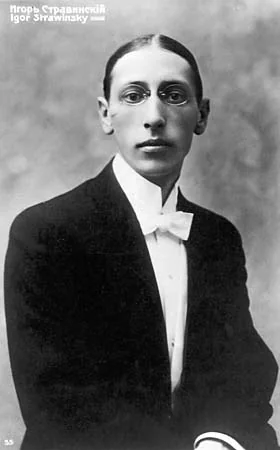
Image from Wikipedia
Image from Wikipedia
Igor Stravinsky – Architect of Modernity and Master of Sound Revolution
The Composer Who Reinvented 20th Century Music
Igor Stravinsky (also: Igor Strawinsky) shaped music history like few others. Born on June 17, 1882, in Oranienbaum, Russia, and died on April 6, 1971, in New York City, his musical career embodies the radical artistic evolution from late Romantic sound ideals through Neoclassicism to serial composition. As a composer and conductor of Russian descent, later holding French (from 1934) and American citizenship (from 1945), he combined stage presence, compositional innovation, and intellectual sharpness into a body of work that influenced generations of musicians, choreographers, conductors, and listeners. His works are staple repertoire for international orchestras, labels, and ballet companies – symbolically representing Modernity.
Early Years and Artistic Influences
Growing up in a musical household – his father was a bass at the Imperial Opera in St. Petersburg – Stravinsky received a thorough education and was significantly influenced by Nikolai Rimsky-Korsakov. Early works such as the Symphony in E-flat and the vocal piece "The Faun and the Shepherdess" mark a phase where orchestration, color, and melodic shaping still adhere to the tradition of the Russian school. At the same time, his later compositional style begins to emerge: concise motifs, clear textures, and the quest for new sound combinations.
Breakthrough with the Ballets Russes: The Firebird, Petrushka, The Rite of Spring
The international breakthrough came through collaboration with Sergei Diaghilev and the Ballets Russes. "The Firebird" (1910) catapulted the young composer into the forefront of the avant-garde overnight. "Petrushka" (1911) expanded the orchestral palette, intertwining folk idioms with vibrant harmonies and a novel polyrhythm. With "Le Sacre du printemps" (premiere on May 29, 1913, in Paris), Stravinsky achieved an aesthetic turning point: eruptive rhythms, bitonal frictions, and a radically dance-like energy shattered listening habits and set standards for 20th-century music. The artistic collaboration between composer, choreography, and set design became a blueprint for modern music theater.
Exile Years, Stylistic Turning Points, and the Path to Neoclassicism
The political upheavals of the 20th century led Stravinsky through various stations in Switzerland and France. After World War I, he turned to Neoclassicism: clarity of form, reference to Baroque and classical models, and a deliberately "de-cluttered" instrumentation characterize works such as "Pulcinella" (1920), the concerto for piano and wind instruments (1924/25), the "Symphony of Psalms" (1930), and the Violin Concerto in D (1931). This phase showcases his expertise in composition and arrangement: motivic condensation, transparent counterpoint, and subtle instrumentation – all consistently linked with a distinctive rhythmic pulse.
Emigration to the USA, Hollywood Years, and Orchestral Mastery
With the onset of World War II, Stravinsky emigrated to the United States. The years in California were marked by productive composition, teaching, and conducting activities. His "Concerto in D" for string orchestra (1946) and the "Symphony in Three Movements" (1945) exhibit a taut, cinematic dramaturgy and brilliant mastery of orchestral articulation. Concurrently, recordings under his own direction were made, which still serve as reference documents of his interpretative intentions and capture the performative aspects of his work – from tempo perception to phrasing.
Serial Late Phase and Sacred Works
In the 1950s and 1960s, Stravinsky embraced serial techniques without losing his personal sound language. Works such as "Agon" (ballet, 1957), "Canticum Sacrum" (1955), and "Requiem Canticles" (1966) combine strict construction principles with ascetic expressivity. Sacred miniatures – such as "Ave Maria" and "Pater noster" – exhibit an inner composure that contrasts with his early rhythmic wildness. His last work for voice and piano, "The Owl and the Pussy-Cat" (1966), concludes a body of work that ranges from folk song arrangements to experimental choral and stage music.
Discography and Editions: From Studio Recordings to Sounding Surveys
Stravinsky's discography is remarkable, as the composer conducted many works himself, setting significant interpretative standards. Labels and archives have secured this historical dimension in extensive editions. Major recordings of his ballets and symphonies, reference productions, and source-critical box sets allow today's listeners to trace the developmental lines of his music. In addition to the famous ballets "The Firebird," "Petrushka," and "Le Sacre du printemps," there are symphonic works, concertos, sacred works, stage and chamber music that collectively form one of the most diverse discographies of Modernity.
Critical Reception and Cultural Influence
Few composers have been discussed as passionately as Igor Stravinsky. Contemporary criticisms ranged from fascination to disquiet to genuine resistance – particularly "Le Sacre du printemps" provoked intense reactions at its premiere. However, with the passage of time, it became clear that Stravinsky fundamentally renewed rhythmic organization, harmony, formal thinking, and the relationship between music and movement. His music has influenced composers from classical modernism through post-war avant-garde to jazz, film music, and progressive rock movements. Today, Stravinsky is among the most performed composers of the 20th century worldwide; his scores serve as teaching pieces in composition, orchestration, and dramaturgy.
Style Analysis: Rhythm, Color, Form
Stravinsky's compositional language is rooted in the intertwining of multiple parameters. Rhythmically, he is characterized by layering, syncopation, additive patterns, and unexpected meter changes. Harmonically, he employs bitonality, modal shifts, and sonic "blocks"; melodically, he favors concise, often folk-inspired cells that recur in varying constellations. Orchestrally, he selects pointed, well-defined colors – woodwinds in exposed registers, brass with sharp contours, percussion as a structure-building force. In the Neoclassical phase, he shapes clear phrases, motor energies, and concertante dialogues; in the serial late phase, he condenses material and space into concentrated, ascetic sound discourse.
Stage Presence and Conducting Style
As a conductor, Stravinsky understood his works from their internal logic: tempo, articulation, and balance always served formal clarity. His approach to production – from the rehearsal process to recording – reflects the authority of a composer who did not delegate interpretative responsibility but actively shaped it. Numerous recordings document this attitude and remain essential references for interpreters working on his music today.
Career Stations and International Networks
Collaboration with the Ballets Russes opened a transnational network of orchestras, conductors, choreographers, and artistic directors for Stravinsky. Commissions and premieres in Paris and later in the USA solidified his reputation. His compositions early on entered the programs of significant orchestras and opera houses, and publishers as well as today's rights holders maintain his repertoire with editorial care. Numerous institutions, festivals, and foundations dedicate themselves to his work, uncovering sources, publishing critical editions, and keeping his music alive in concert practice.
Genre Diversity and Dramaturgical Intelligence
Stravinsky's music encompasses nearly all genres: ballet, opera and music theater, choral works, symphonic pieces, concertos, chamber music, piano and vocal literature. This breadth is accompanied by dramaturgical intelligence: each score is precisely constructed, every formal decision functionally justified. Even in experimental pieces, the plastic readability of the musical architecture is preserved – a reason why Stravinsky's works equally fascinate musicology, performers, and audiences.
Awards, Impact History, and Teaching
As one of the most significant representatives of New Music, Stravinsky received international honors, his works are standard repertoire in universities, and his writings and interviews are part of the theoretical foundation of 20th-century music. Young composers study his scores to understand rhythmic organization, textural craft, and orchestration art. Educational programs and institutions worldwide use excerpts to vividly convey the language of modernity – from elementary education to master classes.
Current Projects and Editions
Even decades after his death, Stravinsky's music remains at the center of the international concert and recording market. Major labels release comprehensive editions of his ballets, symphonies, and orchestral works, supplemented by historically informed booklets and curated playlists. Concert series and festivals dedicate cycles to the different phases of his work, and foundations manage the estate, source research, and work maintenance. This creates a vibrant dialogue between historical performance practice, modern production techniques, and current reception.
Conclusion: Why Igor Stravinsky Remains Indispensable Today
Igor Stravinsky combines artistic radicalism with formal clarity, a spirit of experimentation with precise compositional technique. His music breathes stage, movement, and dramaturgy – from the first beat of the "Sacre" to the concentrated choral texture of the late sacred works. Following his development from Russian color to serial condensation offers a lens into the story of Modernity. Experiencing Stravinsky live remains an encounter of electrifying intensity: rhythmically gripping, sonically layered, intellectually challenging, and emotionally immediate.
Official Channels of Igor Stravinsky:
- Instagram: No official profile found
- Facebook: No official profile found
- YouTube: No official profile found
- Spotify: No official profile found
- TikTok: No official profile found
Sources:
- Wikipedia – Igor Stravinsky
- Encyclopaedia Britannica – Igor Stravinsky
- Fondation Igor Stravinsky – Official Website
- Deutsche Grammophon – Stravinsky Complete Ballets & Symphonies
- Warner Classics (via jpc) – Strawinsky Edition
- Wise Music Classical – Igor Stravinsky Short Bio
- Boston Symphony Orchestra – Igor Stravinsky Profile
Upcoming Events
The Wedding & The Rite of Spring
The Weddings & The Rite of Spring – Staatstheater Augsburg
Stravinsky: Les Noces & The Rite of Spring – Ballet Evening
The Wedding & The Rite of Spring
Strawinsky: Les Noces & Le Sacre du printemps – Staatstheater Augsburg
Stravinsky: The Wedding & The Rite of Spring
Card Game / Pulcinella
The Wedding & The Rite of Spring
The Weddings & The Rite of Spring