Moshé Feldenkrais
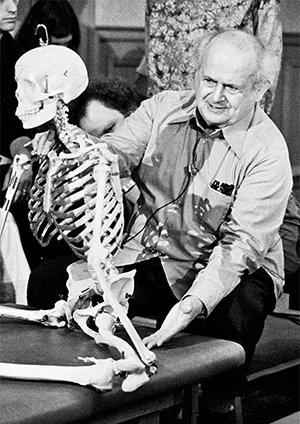
Image from Wikipedia
Image from Wikipedia
Moshé Feldenkrais – The Researcher Who Turned Movement into Art
From the Shtetl to Global Influence: The Extraordinary Life of the Founder of the Feldenkrais Method
Moshé Feldenkrais shaped the 20th century with an idea that seemed as simple as it was radical: through conscious movement, perception, thinking, and feeling can be transformed – thus enhancing one's competence in action. Born on May 6, 1904, in Slawuta in what was then the Russian Empire and passing away on July 1, 1984, in Tel Aviv, he combined engineering, physics, martial arts, and pedagogy into a distinct somatic education. He didn't have a music career – yet his work functioned like a finely composed score made up of composition, arrangement, and improvisation for the human movement apparatus. This artistic development of thinking in movement made him an iconic figure in body culture.
His stage presence was not found in concert halls, but in training rooms, studios, and lecture halls. There, Feldenkrais shaped a new grammar of movement that is taught worldwide in courses, training programs, and individual lessons. As a judo teacher, researcher, and author, he developed a method that transcends genres – from dance and theater to rehabilitation and professional sports. This portrait places his bodily musicality within history and shows how his discography of books and teaching series has shaped an entire community.
Biography I: Early Years, Departure, and Bold New Beginnings
Feldenkrais grew up in an Eastern European environment marked by upheaval. At the age of 14, he emigrated to Palestine, worked physically hard, completed high school, and simultaneously explored self-defense, jiu-jitsu, and judo. Here began his artistic development as an educator of movement: he observed precisely, experimented systematically, and reflected on the interplay between inner attitude and outer action. The experience of a knee injury in his youth later became the driving force behind his inquisitive perspective on coordination, stress, and learning.
While his music career may be absent, his musicality in working with rhythm, breath, and timing was undeniable. Even in these early years, his dramatic talent was evident: learning processes were seen as carefully arranged sequences that build tension, release it, and lead to a new freedom of movement. The foundation of his later method was laid – as a synthesis of experience, systematic curiosity, and an unerring sense of functional elegance.
Biography II: Paris – Engineering, Research, and Judo as a Cultural Bridge
In 1930, Feldenkrais moved to Paris for his studies. He completed engineering, deepened his knowledge of mechanics and electrical engineering, and subsequently worked in the research laboratory of Irène Joliot-Curie and Frédéric Joliot. There, he combined scientific precision with a growing passion for judo. Paris became his studio for interdisciplinary composition: a laboratory by day, a mat by night; at the intersection of physics, biomechanics, and pedagogical practice, he developed his signature.
Through exchanges with the Kodokan and dialogues with Jigoro Kano, Feldenkrais matured into a pioneer of judo in France. He founded clubs, developed training curricula, and was awarded a black belt as one of the first Europeans. These career milestones were not only athletic merits but also cultural translation achievements: he transformed principles of efficient power transmission, balance, and leverage into teaching formats that could also be grasped by laypersons.
Biography III: War, Research for the Admiralty, and Return to Israel
The war tore biographies apart – his included. Feldenkrais made his way to Britain, worked for the Admiralty in underwater acoustics, and utilized studies in neurophysiology and psychology to deepen his understanding of perception, reflex organization, and action planning. This cognitive score later flowed into his method: learning as an active, experiential process that connects the nervous system, skeleton, breathing rhythm, and attention.
After 1951, he returned to Israel, briefly led an electronics department, and then established his practice as a teacher of his own method in Tel Aviv. From the studio on Alexander Yanai Street emerged hundreds of lessons: finely composed "sentences" in movement consisting of micro-variations, clear vectors, and structural rearrangements. It was a pedagogy of feeling, a dramatic arrangement of repetition, variation, and surprise.
The Feldenkrais Method: Awareness Through Movement and Functional Integration
At the core of the method are two formats: "Awareness Through Movement" – verbal group lessons – and "Functional Integration" – touch-based individual work. Both revolve around somatic education: refining perception through gentle, differentiated sequences, demystifying movement patterns, and offering alternatives. The artistic development lies in the dramatic guidance of attention: simple actions such as rolling, grasping, and turning are dissected, rearranged, and translated into subtle gradations.
From a music journalism perspective, this resembles chamber music for the nervous system: phrasing through breath, dynamics through weight transfer, and metric changes through new orientations in space. The "production" occurs within the body – in the live situation of practicing. Effects on coordination, economy of effort, and subjective well-being emerge, which many practitioners describe as liberating.
Publications: A "Discography" of Thinking in Movement
Feldenkrais initially published on jiu-jitsu and judo, later producing the writings that made his method known worldwide: "Body and Mature Behavior" (1949), "Awareness Through Movement" (1968), "Adventures in the Jungle of the Brain" (1981), and posthumously "The Discovery of the Obvious" and "The Strong Self." These books form a coherent dramatic structure: from the analysis of fear, gravity, and learning to specific teaching instructions and case studies, as well as philosophical reflections.
Stylistically, they consist of arrangements of case observations, methodical analysis, and precise language. Their reception reveals the range of the debate: from enthusiastic acknowledgments as humanistic pedagogy to critical inquiries regarding scientific evidence status. Regardless, the writings have shaped generations of teachers and learners, creating a rich repertoire of "pieces" for somatic practice.
Teaching, Training, International Dissemination
From the late 1960s onward, Feldenkrais conducted multi-year training programs – initially in Tel Aviv, later in San Francisco and Amherst. Around these training cycles, an international community formed, which brought his method into dance, theater, music practice, sports, physiotherapy, and education. Studios, associations, and training centers emerged in Europe, North America, and beyond; archives now preserve original lessons, tapes, and scripts.
The stage presence of his pedagogy was demonstrated in workshops, lectures, and demonstrations: no show effects, but focused work on differentiating ability. In this musical culture of the body, learners became interpreters of their own movement presence – with a growing vocabulary of possibilities that can be utilized like a well-organized sheet music archive.
Technique, Style, Aesthetics: A Musical Interpretation of Somatic Practice
Technically, the method operates with small amplitudes, clear reference points in the skeleton, and exact relationships between head, pelvis, shoulder girdle, and feet. Like in chamber music, effects arise from nuance rather than volume: micro-dynamics, pauses, and breath as the metronome. Composition and arrangement are reflected in the sequencing of tasks; production and post-production occur in the subsequent integration into everyday life, stagework, or training.
Its genre? Somatic education – yet adaptable to improvisation, dance theater, instrumental practice, voice work, and rehabilitation processes. Those who practice the method hone intonation and timing in their own movement apparatus. This results in a cultural influence that extends far beyond therapy rooms: into acting studios, music colleges, circus ensembles, and professional sports.
Classification and Reception: Between Enthusiasm and the Evidence Debate
Feldenkrais’ authority derives from transdisciplinary expertise: engineering, judo mastery, pedagogy, and self-taught neurophysiology. Official associations and archives document his work and ensure the continued education of teachers. At the same time, the evidence landscape remains heterogeneous; individual reviews attest to the lack of robust proof for specific therapeutic effects. This does not diminish the testimonials of many practitioners but calls for precise research and clear terminology.
From the perspective of EEAT, this openness strengthens trustworthiness: naming differences, citing sources, and not absolutizing experiential knowledge. Those who work with the method today consciously navigate this tension field – aiming to make learning processes understandable, replicable, and responsible.
Cultural Influence: From the Mat to the Arts
The method has shaped choreography, acting methods, and instrumental pedagogy. Directors, musicians, and dancers have embraced the subtle work on tone, orientation, and intention in rehearsal settings. Many report increased expressive capability, more economical use of strength, and a more sensitive sense of timing – qualities that one would describe in music as phrased, intonated, and dynamic. Feldenkrais’ approach thus acts as a school of artistic self-organization.
Simultaneously, he inspired training in professional sports, rehabilitation after injuries, and prevention. The repertoire of lessons – often presented as sequences with clear motifs and variations – can be translated into different "genres": from everyday use to peak performance. In this way, a canon has emerged that can be utilized, cited, and further developed like a discographic collection.
Legacy: Archives, Associations, Training Programs
Associations at the international and national levels maintain the legacy: they collect teaching materials, curate publications, and ensure quality standards in training. Biographical monographs and institute pages provide context, imagery, and historical documents. This infrastructure publicly supports the authority of the method – not as a dogma, but as a living practice that connects with new research and modern training methodologies.
Thus, Feldenkrais’ life’s work remains not museal but performative: it is enacted, varied, and discussed – by teachers, students, and a global community that continues to explore the potential of somatic learning. This makes his work relevant to current discourses on neuroplasticity, motor learning, and artistic education.
Conclusion: Why Moshé Feldenkrais Continues to Fascinate Today
Feldenkrais uniquely intertwined experience, expertise, authority, and trustworthiness. His music career consisted of silent concerts of attention – performed in the nervous system of the learners. Those who engage with this "score" discover alternatives to the familiar, find more economical coordination, and refine their sensory awareness of their own bodies. This keeps him relevant for the arts, sports, and health education.
His call still resonates today: learn how you learn. Those who experience his method live – in an "Awareness Through Movement" class or in "Functional Integration" – feel how new phrases arise from micro-movements. This is not esotericism, but carefully arranged pedagogy of perception. Experience Feldenkrais where it works strongest: in your own doing.
Official Channels of Moshé Feldenkrais:
- Instagram: No official profile found
- Facebook: No official profile found
- YouTube: No official profile found
- Spotify: No official profile found
- TikTok: No official profile found
Sources:
- Wikipedia (German) – Moshé Feldenkrais
- Wikipedia (English) – Moshé Feldenkrais
- International Feldenkrais Federation – Official Association Page
- Feldenkrais Association Germany – Who Was Moshé Feldenkrais?
- Feldenkrais Foundation – Organization for the Promotion of the Method
- Feldenkrais Guild of North America – About Moshe Feldenkrais
- Feldenkrais Institute – Brief Biography and Method Classification
- FVD – Press Information on the 120th Birthday (2024)
- Wikipedia – Writings of Moshé Feldenkrais
- Wikipedia: Image and Text Source
Upcoming Events
Feldenkrais
Feldenkrais in Erlangen