Social Projects & Initiatives in Bad Kissingen
Social Projects & Initiatives Moving Bad Kissingen (Outlook on Upcoming Actions)
What really holds a city together – representative buildings or people who are there for each other? In Bad Kissingen (Lower Franconia, Bavaria), cohesion often arises where you might not expect it: on playgrounds and exercise areas, in open meeting places, through low-threshold support for families, or in projects made possible by funding and community financing.
This overview bundles upcoming priorities and typical ways to get involved for 2026/2027: Where are new offerings expected, which formats are planned next – and how can you participate without major hurdles or prior knowledge?
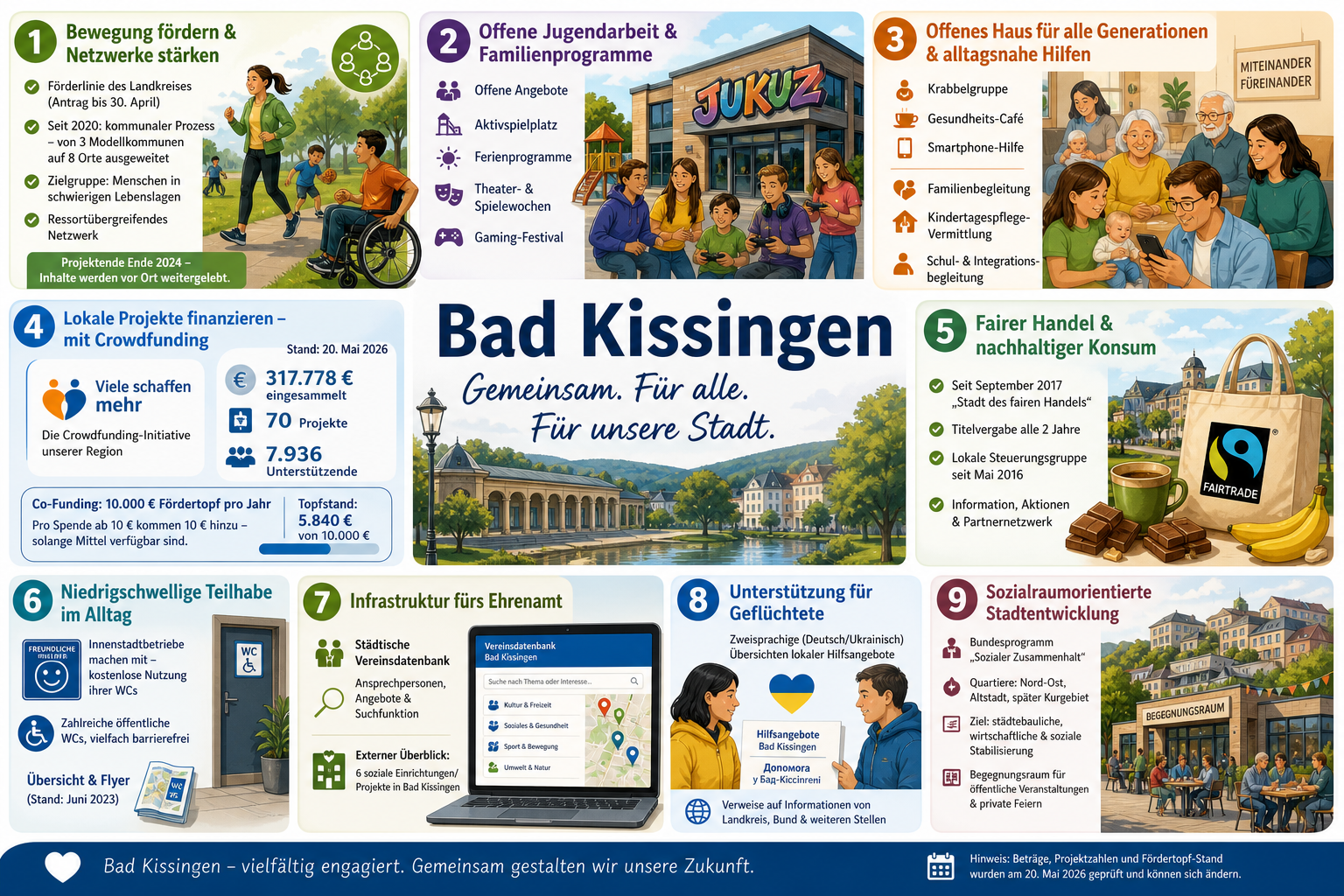
Open Youth Work: Youth and Culture Center as the Heart
In 2026/2027, open youth work in Bad Kissingen is also expected to remain a central component for providing young people with a reliable meeting place, opportunities for participation, and support in everyday life. Open formats are especially valuable because they work without membership and usually without participation fees – enabling encounters across social boundaries.
Formats That Will Be Especially in Demand in the Coming Months
- Open Meeting Times & Counseling: Spaces for being together, accompanied by educational staff.
- Creativity & Culture: Projects around music, theater, media, or small stage formats that young people actively help shape.
- Holiday and Weekly Programs: Bundled offerings (e.g., during summer and autumn holidays) that relieve families and strengthen community.
Especially for planned youth formats, early information is worthwhile: Dates, age limits, registration methods, and participation conditions are usually announced by the city, the youth/culture center, or local event calendars.
Multi-Generational House & Everyday Support: An Open House for All
For 2026/2027, it is expected that meeting places such as a multi-generational house (or comparable open meeting points) will continue to play a key role: They combine everyday help, low-threshold counseling, and community-building offerings. The added value lies not only in the “program” but in reliability: You can go there, ask questions, make contacts – without a long lead time.
Encounters That Prevent Loneliness (Outlook)
- Parent & Family Offerings: Meetings focused on exchange and mutual relief.
- Health-Related Discussion Formats: Low-threshold info and exchange appointments that strengthen prevention and well-being.
- Digital Help in Everyday Life: Support with smartphones, apps, online appointment bookings, or forms – especially important as administrative and health services become more digital.
Everyday Support That Really Helps
For families and individuals, the most relevant support in the future will continue to be those that provide immediate relief: orientation in the support system, assistance with organizational topics, referral to suitable services, or help accessing care and education. Those seeking such help are best advised to check with the official contact points of the city or independent providers for opening hours, responsibilities, and contact persons.
Crowdfunding & Funding: How Many Small Contributions Make Big Things Possible
Many social projects do not fail because of the idea, but because of the initial financing steps: materials, room rental, technology, insurance, or public relations. For 2026/2027, the combination of traditional funding (e.g., municipal, through foundations or programs) and crowdfunding will therefore remain particularly relevant.
Why Crowdfunding Remains Important in the Region
- Transparency: Supporters see the goal, purpose, and progress of a project.
- Community Effect: Donations are not just money, but a public “yes” to the idea.
- Starter Motor: Even small amounts can enable the crucial first step.
Co-Funding & Matching: What to Watch for in 2026/2027
Many platforms and partners work with time-limited matching or co-funding pots (e.g., “every donation is additionally subsidized” as long as funds are available). For initiatives in Bad Kissingen, it is therefore worthwhile to plan campaigns so that they fall within such time windows. Conversely, for supporters: Those who donate during a matching phase can often achieve a particularly great impact.
Important: The current rules of the respective platform or funding body (minimum amount, period, funding criteria, proof) are always binding. Check these before starting or donating on the official platform page.
Participation in Everyday Life: Fair Trade & “Friendly Toilets”
Social urban development in 2026/2027 is not only reflected in large programs but also in small, very practical decisions: Where is fair shopping done? How accessible is a visit to the city center? Which offerings can be used without a consumption requirement? In Bad Kissingen, such questions are likely to become even more important – especially with regard to inclusion, demographic change, and visitor flows.
Fair Trade as a Local Participation Topic (Outlook)
If Bad Kissingen wants to remain visible as a Fairtrade-oriented municipality (or with a similar focus), three levers will be crucial in the coming years: local educational work, involvement of gastronomy/retail, and recurring actions that anchor fair consumption in everyday life. For 2027, many municipalities are expected to have renewed campaign and recertification phases around Fairtrade Towns; specific dates result from official announcements.
“Friendly Toilets” & Public Restrooms: Accessibility You Can Feel Immediately
Initiatives in which businesses make their toilets (partly) available without a consumption requirement are particularly relevant for 2026/2027 – not as “comfort,” but as a participation issue. Those traveling with children, those with chronic conditions, or those with limited mobility often decide their radius based on whether infrastructure is reliably accessible.
For your next visit to the city, it is recommended to check the city's official lists of public toilets and, if applicable, participating businesses in advance, as locations, opening hours, and access rules may change.
Volunteering, Clubs, Integration: The Social Backbone of the City
A large part of social stability arises where people take responsibility: in sports and cultural clubs, in neighborhood help, in projects for children and young people, or in support networks for newcomers. For 2026/2027, it will be crucial to make engagement findable – and to keep entry barriers low.
Finding Clubs & Engagement: Why Databases and Overviews Matter
Digital club and initiative overviews are a real lever for new residents (and for anyone who wants to get involved): They save time, reduce uncertainty, and make contact persons visible. If you are looking for a volunteer position in 2026/2027, such overviews are usually the quickest entry point – especially if you can filter by topic, age group, or district.
Integration as a Joint Task (Outlook)
For newcomers, the following will remain particularly important in 2026/2027: clear initial information (in multiple languages), information on counseling, education, language and leisure offerings, as well as opportunities to become active themselves. Good integration is not a one-way street – it works best where encounters in clubs, open meetings, and projects become a matter of course.
Strengthening Neighborhoods: Socially Oriented Development (Outlook)
In cities working on the “Social Cohesion” program (or comparable urban development programs), two things are often in focus in the coming years: structural improvements and social infrastructure. For Bad Kissingen, this probably means: Places where neighbors meet (halls, meeting points, neighborhood rooms) will be further developed as “social hubs” – for public events as well as for civic initiatives.
How You Can Get Involved in 2026/2027
If you want to be part of this development, you don't need a “perfect” resume – just a suitable entry point. These ways have proven particularly practical in 2026/2027:
- Support once: Support a project via a regional crowdfunding platform – especially during matching phases.
- Participate without obligation: Visit open meetings, action days, or neighborhood events and make contacts.
- Engage regularly: Take on a small, clearly defined task package in a club or initiative (e.g., 2 hours/week).
- Start your own idea: Begin with a small pilot action, look for cooperation partners (e.g., school, club, neighborhood), then check for funding/crowdfunding.
- Help with low barriers: Offer skills that are immediately useful (e.g., language or learning support, digital help, driving services as part of club offerings).
For all options: Reliable contact persons, dates, and participation conditions can most reliably be found on the official pages of the city of Bad Kissingen, the district, and the respective providers/organizations.